Begleiten Sie uns auf eine literarische Weltreise!
Buch zum Bücherregal hinzufügen
Grey
Einen neuen Kommentar schreiben Default profile 50px
Grey
Jetzt das ganze Buch im Abo oder die ersten Seiten gratis lesen!
All characters reduced
Tactical Espionage - cover

Tactical Espionage

Michael Davies

Übersetzer A AI

Verlag: Publifye

  • 0
  • 0
  • 0

Beschreibung

Tactical Espionage explores the hidden world where nations engage in shadow wars, using intelligence and covert operations to gain strategic advantages. It delves into the evolution of espionage, from ancient methods to modern cyber warfare, revealing how these tactics have shaped global conflicts. The book dissects significant covert operations, analyzing their planning, execution, and impact on political and military outcomes.

 
Understanding espionage is crucial because it's not just a supplementary tool but a fundamental driver of geopolitical power. The book analyzes the structures and functions of prominent intelligence agencies like the CIA, MI6, and the KGB, illustrating how these organizations operate within and outside conventional warfare. It begins with foundational concepts like tradecraft and intelligence gathering (SIGINT, HUMINT) before moving into detailed case studies.

 
By drawing on declassified documents, historical archives, and memoirs, Tactical Espionage provides a balanced, evidence-based view, avoiding sensationalism while offering a comprehensive understanding of espionage as an instrument of state power. The book progresses through chapters that explore foundational concepts, detailed case studies of covert operations, and the role of intelligence agencies. Concluding chapters synthesize these insights, offering a framework for understanding the future of espionage in the digital age and discussing the ethical implications of covert actions.

 
This makes the book valuable for students, policymakers, security professionals, and anyone interested in the complex world of international relations.
Verfügbar seit: 21.03.2025.
Drucklänge: 77 Seiten.

Weitere Bücher, die Sie mögen werden

  • Design Against Racism - Creating Work That Transforms Communities - cover

    Design Against Racism - Creating...

    Omari Souza

    • 0
    • 0
    • 0
    A historical and philosophical exploration of the impact of design on underserved communities, examining the field’s shortcomings as well as its potential to create positive change. Through essays that delve into history and practice, and case studies that demonstrate practical strategies, Design Against Racism explores how designers of all disciplines can address, through their work, the legacies of racism and oppression. 
      
    Design profoundly influences culture. The heart of this book is its powerful blend of essays on design history, case studies, and discussions of practical methods to approach design work, adapted from the restorative justice movement. It explores how design as a professional practice and academic discipline directly affects historically excluded communities, offering frameworks and examples that foster collective improvement. 
      
    Topics from author Omari Souza, founder of the annual State of Black Design conference, and contributing design professionals include:  
    • Unveiling the White Gaze: The Narrative of Whiteness and Colonial Nostalgia  
    • Language as a Tool for Marginalization—and Resistance  
    • Hip-Hop Architecture: Transforming Spaces through Culture and Innovation  
    • Afrofuturism as a Design Strategy  
    • Whose Knowledge Is It? Reclaiming Histories, Narratives, and the Plurality of Knowledge  
    • Nonhierarchical Engagement with Communities—Anti-Racist Design Community Pop-Up  
      
    This is a critique of design and a practical handbook that will teach designers and educators how a restorative justice approach can transform their design practice to counteract and fight racism. 
      
    TIMELY AND ESSENTIAL TOPICS: Thought-provoking essays from leaders in design diversity offer an anti-racist approach to design practice based in an understanding of history, a focus on community building, and a commitment to inclusion. 
      
    AUTHOR & CONTRIBUTORS: Omari Souza is an Assistant Professor of Communication Design at the University of North Texas and co-host of the highly acclaimed minisode podcast The Design of Business | The Business of Design. Contributors include preeminent design professionals George Fourlas, Shamika Klassen, Kaleena Sales, Zariah Cameron, Lesley-Ann Noel, Cassini Nazir, Yolanda A. Rankin, Soniyah Robinson, and Danielle Lake. 
      
    Perfect for:  
    • Student and professional design practitioners of all disciplines, including graphic designers, product designers, architects, and more  
    • Course adoption for design programs  
    • Anyone eager to explore the themes of anti-racism and decolonizing design
    Zum Buch
  • Dream States - Smart Cities Technology and the Pursuit of Urban Utopias - cover

    Dream States - Smart Cities...

    John Lorinc

    • 0
    • 0
    • 0
    WINNER OF THE 2022 WRITERS’ TRUST BALSILLIE PRIZE FOR PUBLIC POLICY
    		 
    Is the ‘smart city’ the utopia we’ve been waiting for?
    		 
    The promise of the so-called smart city has been at the forefront of urban planning and development since the early 2010s, and the tech industry that supplies smart city software and hardware is now worth hundreds of billions a year.
    		 
    But the ideas and approaches underpinning smart city tech raise tough and important questions about the future of urban communities, surveillance, automation, and public participation. The smart city era, moreover, belongs firmly in a longer historical narrative about cities — one defined by utopian ideologies, architectural visions, and technological fantasies.
    		 
    Smart streetlights, water and air quality tracking, autonomous vehicles: with examples from all over the world, including New York, Los Angeles, Boston, Portland, and Chicago, Dream States unpacks the world of smart city tech, but also situates this important shift in city-building into a broader story about why we still dream about perfect places.
    		 
    “John Lorinc’s incisive analysis in Dream States reminds us that the search for urban utopia is not new. Throughout the book, Lorinc underscores the fact that a gamut of urban innovations – from smart city megaprojects to e-government to pandemic preparedness tools – only provide promise when scrutinized together with the political, economic, social, and physical complexities of urban life.” – Shauna Brail, University of Toronto
    		 
    “Dream States: Smart Cities, Technology, and the Pursuit of Urban Utopias takes us on a fascinating journey across world cities to show how technology has shaped them in the past and how smart city technology will reshape them in the future. This book is essential reading for policy makers, researchers, and practitioners interested in understanding the opportunities and challenges of smart city technology and what it means for city building.” – Enid Slack, University of Toronto School of Cities
    		 
    “Utopia may be the oldest grift in the city-building business, but Dream States shows that technology is a timeless tool for turning the most ordinary of urban dreams – clean air and water, safe streets, and decent homes – into reality. As digital dilettantes try to sell us on a software overhaul, John Lorinc provides us an indispensable and flawless guide to the must-haves and never-agains of the smart city.” – Anthony Townsend, Urbanist in Residence, Cornell Tech, author of Smart Cities
    Zum Buch
  • Boundless Brothers - Two Warriors From The Heartland One Mission For The Homeland - cover

    Boundless Brothers - Two...

    Ronald A. Lambrecht, Steven S....

    • 0
    • 0
    • 0
    Fans of TOPGUN, The Hunt for Red October and Forrest Gump will love this epic tale of struggle, tenacity and heroism.  
    Separated in age by eighteen years, Ron and Steve Lambrecht lived under the same farmhouse roof for only six months—yet both left the Minnesota cornfields of their birth for distinctly different roads of military service and achievement.   
    Their joint memoir, Boundless Brothers: Two Warriors from the Heartland, One Mission for the Homeland, offers a fresh spin on a classic American motif of homegrown country boys who navigate the wild blue yonder of sky and sea. From sailing the world on one-hundred-thousand-ton aircraft carriers to flying supersonic combat missions, these two brothers share raucous boyhood gambols, vivid sea stories, and pursuits of identity and inspiration spanning decades of selfless military service.
    Zum Buch
  • Avars and Magyars The: The History of the Medieval Ethnic Groups that Settled in Hungary - cover

    Avars and Magyars The: The...

    Editors Charles River

    • 0
    • 0
    • 0
    The Avars entered Eastern Europe from the Central Asian steppes in the 6th century, and like the Huns before them and the Cumans and Magyars after them, the Avars were raiders and warriors who lived on their horses. The Avars’ impact on Europe was immediately felt, and from the Byzantine Empire to the Merovingian Kingdom in Gaul, some of Europe’s strongest powers had to learn how to deal with these new people through a combination of diplomacy and warfare. Eventually, the Avars established themselves in what is today Hungary and played an important role in the development of European history during its transitional period by earning a reputation as a fearsome and sometimes avaricious group. The medieval sources described the Avars as efficient and brutal horseback warriors who could devastate entire kingdoms in a matter of days and leave just as quickly. 
    Of all the steppe peoples in the medieval period, perhaps none were more important to European history than the Magyars. Like the Huns and Avars before them and the Cumans and Mongols after them, the Magyars burst into Europe as a destructive, unstoppable horde, taking whatever they wanted and leaving a steady stream of misery in their wake. They used much of the same tactics as the other steppe peoples and lived a similar, nomadic lifestyle. The Magyars also had many early cultural affinities with other steppe peoples, following a similar religion and ideas of kingship and nobility, among other things. That said, as similar as the Magyars may have been to other steppe nomads before and after them, they were noticeably different in one way: the Magyars settled down and became a part of Europe and Western Civilization in the Middle Ages. The Magyars exploded onto the European cultural scene in the late 9th century as foreign marauders, but they made alliances with many important kingdoms in less than a century.
    Zum Buch
  • The Meme Humanoids - Modern Myths or Real Monsters - cover

    The Meme Humanoids - Modern...

    Lon Strickler

    • 0
    • 0
    • 0
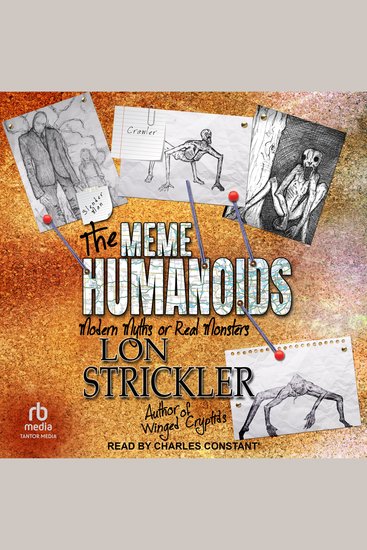
    In 2012, an incredible phenomenon began to occur. Internet users, in earnest, began reporting frightening encounters with emaciated, pale, hairless humanoids that, for the most part, crawled on all fours. Internet users attempted to equate these entities with characters of Native American mythology, oblivious to the fact that the humanoids in these encounters bore a resemblance to the fictional Rake. Many witnesses suggested that they were "Skinwalkers," medicine men or witches of traditional Navajo lore who possess the ability to transform into animals. Others proposed that these emaciated humanoids were manifestations of the "Wendigo," a malevolent cannibalistic spirit of Cree and Algonquin legend. Others still began to invent new names for these creatures, such as "Fleshgaits" and "Crawlers," the latter evoking the 2005 movie entities that likely helped to inspire the Rake originally. 


    The humanoid encounters and sightings that are detailed in this book over varied glimpses into the phenomenon. Ask yourself—are these humanoids actual corporeal beings that are manifested by the human mind and perceivable by others? Or are we witnessing the nexus of an unknown and monstrous species of humanoid?
    Zum Buch
  • The Ripple Effect - China's Complex Presence in Southeast Asia - cover

    The Ripple Effect - China's...

    Enze Han

    • 0
    • 0
    • 0
    Many studies of China's relations with and influence on Southeast Asia tend to focus on how Beijing has used its power asymmetry to achieve regional influence. Yet, scholars and pundits often fail to appreciate the complexity of the contemporary Chinese state and society, and just how fragmented, decentralized, and internationalized China is today. 


    In The Ripple Effect, Enze Han argues that a focus on the Chinese state alone is not sufficient for a comprehensive understanding of China's influence in Southeast Asia. Instead, we must look beyond the Chinese state, to non-state actors from China, such as private businesses and Chinese migrants. These actors affect people's perception of China in a variety of ways, and they often have wide-ranging as well as long-lasting effects on bilateral relations. Looking beyond the Chinese state's intentional influence reveals many situations that result in unanticipated changes in Southeast Asia. Han proposes that to understand this increasingly globalized China, we need more conceptual flexibility regarding which Chinese actors are important to China's relations, and how they wield this influence, whether intentional or not.
    Zum Buch