Rejoignez-nous pour un voyage dans le monde des livres!
Ajouter ce livre à l'électronique
Grey
Ecrivez un nouveau commentaire Default profile 50px
Grey
Abonnez-vous pour lire le livre complet ou lisez les premières pages gratuitement!
All characters reduced
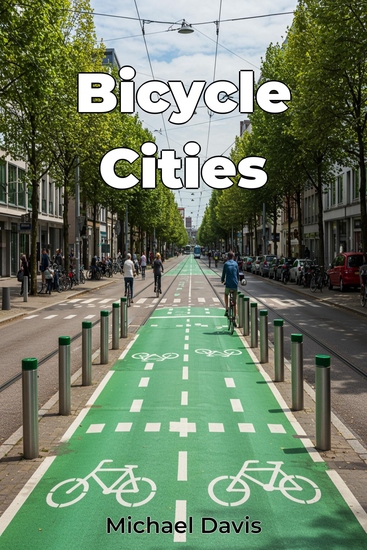
Bicycle Cities - cover

Bicycle Cities

Michael Davies

Traducteur A AI

Maison d'édition: Publifye

  • 0
  • 0
  • 0

Synopsis

Bicycle Cities explores how urban areas can thrive by prioritizing cycling through strategic urban planning. It argues that transitioning to bicycle-centric urban planning involves a comprehensive shift in urban design, policy, and culture, not just installing bike lanes. The book highlights intriguing facts, such as how bicycle infrastructure can boost local retail sales and property values while reducing carbon emissions. It also emphasizes the importance of protected bike lanes, dedicated bicycle highways, and secure bicycle parking facilities. The book takes a holistic approach, integrating practical guidance with theoretical insights, and examines successful case studies like Copenhagen and Amsterdam to demonstrate the benefits of bicycle urbanism. By providing data-driven analyses of bicycle ridership and cost-benefit evaluations, the book offers a roadmap for cities seeking to become bike-friendly. It begins by introducing bicycle urbanism and progresses through analyzing successful cities, focusing on practical infrastructure design, and exploring the economic, health, and environmental impacts of cycling. The book's unique value lies in its synthesis of practical guidance with theoretical insights, making it an invaluable resource for urban planners, policymakers, and cycling advocates seeking to create more sustainable and livable cities. Aligned with the genres of Politics, Architecture General, Architecture, the book also uses visual elements like maps and photographs to showcase innovative bicycle infrastructure design.
Disponible depuis: 21/02/2025.
Longueur d'impression: 76 pages.

D'autres livres qui pourraient vous intéresser

  • Don't Talk Negatively Behind Anybody's Back - cover

    Don't Talk Negatively Behind...

    Pastor Philip

    • 0
    • 0
    • 0
    The fact that you would take time to talk negatively about someone, means that you have a picture in your mind of the person you're talking about. The picture in your mind of the person you're talking negatively about, will be transmitted by that person's angel in protest to our Father in heaven.  The song "It'll Be Ok" sung by Chey at the end of the message gives the audience the opportunity to reflect on the message.
    Voir livre
  • The Ultimate Guide to Manage and Stress Relief - How to Identify Your Stress Warning Signs and Learn how to Better Manage Stressful Situations - cover

    The Ultimate Guide to Manage and...

    Brian Gibson

    • 0
    • 0
    • 0
    There is more than enough stress between regular work stress, maintaining relationships, navigating social engagements, and managing the kids. Fortunately, if you put your mind to it, there are ways to reduce your stress levels. Stress is valuable in helping us react quickly to threats and stay safe. Long-term stress exposure, however, may result in increased physical or mental health issues like anxiety and depression.  
    In this audiobook, you will learn how to recognize high-stress levels, how they affect the body and the mind, and how to manage, prevent, and relieve them.
    Voir livre
  • Delhi Sultanate - Muslim Dynasties That Shaped Medieval India - cover

    Delhi Sultanate - Muslim...

    Rolf Hedger

    • 0
    • 0
    • 0
    The Delhi Sultanate was a defining era in Indian history, marking the establishment of Muslim rule in northern India. Its rise was shaped by a series of invasions, strategic conquests, and the formation of a centralized administration. The foundation of the Sultanate can be traced back to the late 12th century when Muslim forces, primarily from Central Asia, began making inroads into the Indian subcontinent. These incursions set the stage for a new political order that would influence the region for centuries. 
    One of the earliest significant Muslim invasions was led by Mahmud of Ghazni in the 11th century. Although he did not establish permanent rule, his raids weakened Indian kingdoms and demonstrated the vulnerability of the region. However, it was Muhammad Ghori in the late 12th century who laid the groundwork for the Delhi Sultanate. Unlike Mahmud, Ghori aimed for long-term control rather than mere plundering. His victory over Prithviraj Chauhan at the Second Battle of Tarain in 1192 was a turning point, allowing Muslim forces to establish a foothold in northern India. 
    Following Ghori’s assassination in 1206, his general, Qutb al-Din Aibak, took control of his Indian territories and proclaimed himself the first Sultan of Delhi. Aibak, originally a slave who rose through the ranks, became the founder of the Mamluk or Slave Dynasty. He consolidated his rule by strengthening administrative structures and commissioning architectural marvels like the Qutb Minar, which symbolized the establishment of Muslim rule. However, his reign was short-lived, and his successor, Iltutmish, played a more crucial role in shaping the Delhi Sultanate into a powerful and stable empire.
    Voir livre
  • Swapped for My Lesbian - Gender Swap - cover

    Swapped for My Lesbian - Gender...

    Kinky Press

    • 0
    • 0
    • 0
    Peter and Jessie are best friends, but they don’t hit for the same team… for now. 
      
    After years of sexual frustration, Peter is finally ready to do something so he can be with his hot and horny lesbian friend. 
      
    Seeking advice at the local magic shop, he searches for a love potion that will not force his will on Jessie — and is given one very unique solution… Give Jessie everything she wants. 
      
    Will the love between friends turn into something much more erotic if only Peter grows a pair… of tits?
    Voir livre
  • City Growth and Urban Form - Models and Theories - cover

    City Growth and Urban Form -...

    Lyric Vale

    • 0
    • 0
    • 0
    Urban growth and development have been central to human progress for centuries, shaping the landscape, economies, and cultures of societies around the world. As the global population continues to urbanize, cities are experiencing rapid expansion and transformation. This urbanization process, which involves the migration of people from rural to urban areas, is driven by a combination of economic, social, and political factors. Understanding the forces behind urban growth is essential for urban planners, policymakers, and scholars who aim to navigate the challenges and opportunities that come with it. 
    The rise of cities is closely linked to the development of agriculture, trade, and industry. In early history, cities were established as centers of commerce and governance, offering opportunities for social, political, and economic advancement. With the Industrial Revolution, cities became hubs of production, attracting large numbers of people seeking employment and better living conditions. This period marked a significant shift from agrarian economies to industrial economies, fueling the growth of urban centers across Europe and North America. 
    In the modern era, urbanization has reached unprecedented levels, with more than half of the world’s population now residing in urban areas. The growth of cities is not limited to developed countries but is also occurring rapidly in the developing world, particularly in regions of Asia, Africa, and Latin America. This has led to the expansion of megacities—urban areas with populations exceeding 10 million people—while smaller cities also experience considerable growth. The factors driving this global urbanization include the pursuit of better economic opportunities, access to education and healthcare, and the promise of improved living standards.
    Voir livre
  • Civil Resistance - What Everyone Needs to Know - cover

    Civil Resistance - What Everyone...

    Erica Chenoweth

    • 0
    • 0
    • 0
    Civil resistance is a method of conflict through which unarmed civilians use a variety of coordinated methods (strikes, protests, demonstrations, boycotts, and many other tactics) to prosecute a conflict without directly harming or threatening to harm an opponent. Sometimes called nonviolent resistance, unarmed struggle, or nonviolent action, this form of political action is now a mainstay across the globe. It was been a central form of resistance in the 1989 revolutions and in the Arab Spring, and it is now being practiced widely in Trump's America. If we are going to understand the manifold protest movements emerging around the globe, we need a thorough understanding of civil resistance and its many dynamics and manifestations. 


    In Civil Resistance: What Everyone Needs to Know®, Erica Chenoweth—one of the world's leading scholars on the topic—explains what civil resistance is, how it works, why it sometimes fails, how violence and repression affect it, and the long-term impacts of such resistance. Featuring both historical cases of civil resistance and more contemporary examples such as the Arab Awakenings and various ongoing movements in the United States, this book provides a comprehensive yet pithy overview of this enormously important subject.
    Voir livre