
Rejoignez-nous pour un voyage dans le monde des livres!
Ajouter ce livre à l'électronique
Grey
Ecrivez un nouveau commentaire Default profile 50px
Grey
Abonnez-vous pour lire le livre complet ou lisez les premières pages gratuitement!
All characters reduced
Space Warfare Risks - cover

Space Warfare Risks

Michael Davies

Traducteur A AI

Maison d'édition: Publifye

  • 0
  • 0
  • 0

Synopsis

Space Warfare Risks explores the escalating potential for military clashes in space, driven by geopolitical tensions and technological advancements. The book highlights how our reliance on space-based assets like satellites for vital services, such as communication and navigation, ironically makes them prime targets. One intriguing fact is the increasing development of anti-satellite (ASAT) weapons, designed to disrupt or destroy these crucial systems. Another key insight is the dangerous lack of comprehensive international laws governing military activities in space, which creates a risk of miscalculation and escalation.

 
The book traces the evolution of space technology from ballistic missiles to its current integration into military and civilian life, examining the erosion of early treaties intended to prevent weaponization. It delves into current military space capabilities and strategies of major world powers, arguing that the absence of robust international agreements, combined with the growing importance of space assets, has created instability. The approach is holistic, integrating technological, political, and legal considerations.

 
Beginning with core concepts and key players, the book analyzes threats like ASAT weapons and cyber warfare targeting satellites. It examines case studies of past incidents and near misses to illustrate the fragility of the current situation. Finally, it discusses potential solutions, including arms control and improved space situational awareness, offering a balanced assessment of the dangers and opportunities in space warfare.
Disponible depuis: 04/03/2025.
Longueur d'impression: 79 pages.

D'autres livres qui pourraient vous intéresser

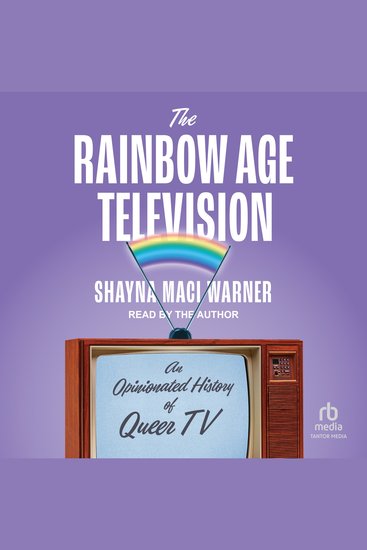
  • The Rainbow Age of Television - An Opinionated History of Queer TV - cover

    The Rainbow Age of Television -...

    Shayna Maci Warner

    • 0
    • 0
    • 0
    With the last decade's television boom across a multitude of platforms, American audiences are being treated to a cascade of shows that some have trumpeted as a second Golden Age. But something completely new is stirring, too—the Rainbow Age. For the first time in the history of American television, we have shows in which LGBTQIA+ characters have evolved from being an anomaly to being an almost given and celebrated presence on the small screen. But what more can queer TV do? Is each new queer character really breaking ground? And has the curse of the fictional dead lesbian finally been defeated? 


    The Rainbow Age of Television tackles these questions and more as author Shayna Maci Warner tracks the history and evolution of LGBTQIA+ icons across the televised ages and into the future—from the first televised queer kiss (we think) to the shows that are making household names and heroes of queer characters. Warner uses original interviews with queer TV icons along with detailed history to investigate the constraints under which queer people have been allowed to exist on American television. The Rainbow Age of Television explores why queer people are so invested in—and conflicted by—the kinds of storytelling that TV has to offer. Above all, it's a celebration of the LGBTQIA+ shows, their characters, and their creators that define this new age in television.
    Voir livre
  • Germany vs Great Britain in the Air: The History of the Enemy Air Forces in World War I and World War II - cover

    Germany vs Great Britain in the...

    Editors Charles River

    • 0
    • 0
    • 0
    One of the most important breakthroughs in military technology associated with World War I, and certainly the one that continues to capture the public imagination, was the use of airplanes, which were a virtual novelty a decade before. While the war quickly ground to a halt in its first few months, the skies above the Western Front became increasingly busy. The great powers had already been acquiring aircraft for potential uses, but given that aerial warfare had never been a major component of any conflict, it’s understandable that few on either side had any idea what the planes were capable of doing. Furthermore, at the start of the war, all sides’ aircraft were ill-equipped for combat mostly because the idea that planes might somehow fight was still a novel one. 
    The Royal Air Force (RAF), Britain's legendary air arm, was born in the skies above the First World War. The British had previously used balloons for spotting and reconnaissance for decades, and in the years leading up to the war, planes started seeing military use. They mostly provided reconnaissance, though experiments were made in using them offensively. During the Boer War of 1899-1902, the British Army used the crews of helium-filled balloons to plot and help target artillery fire. But these were small, tentative steps. The first patent to fit a machine gun to a plane, taken out in 1910, had not yet led to active fighting vehicles, and there was no doctrine, no tactics, and no combat between massed air fleets.  
    The Third Reich's Luftwaffe began World War II with significant advantages over other European air forces, playing a critical role in the German war machine's swift, powerful advance. By war's end, however, the Luftwaffe had been decimated by combat losses and crippled by poor decisions at the highest levels of military decision-making, and it proved unable to challenge Allied air superiority despite a last-minute upsurge in German aircraft production.
    Voir livre
  • Leadership from Bad to Worse - What Happens When Bad Festers - cover

    Leadership from Bad to Worse -...

    Barbara Kellerman

    • 0
    • 0
    • 0
    Leadership from Bad to Worse is about how leadership that is bad, invariably, inexorably, gets worse—unless it is somehow, by someone or something, stopped or slowed. 


    This work draws on four cases of bad leadership—two in political leadership, two in business leadership—to show how it goes from bad to worse. Kellerman finds that bad leadership and bad followership go through four phases of development: 1) Onward and Upward; 2) Followers Join In; 3) Leaders Start In; and 4) Bad to Worse. These findings correctly suggest that the book, in addition to being of theoretical interest, is of practical import. It is intended, deliberately, to serve as an early warning system. By breaking bad leadership and followership into phases—each more ominous and ultimately dangerous than the one preceding—their progression will be easier to predict and detect. And easier, therefore, to slow or, preferably, to stop before they turn toxic. 


    Bad leadership is a social disease. But unlike diseases that are physical or psychological, it remains at the margins of our collective concerns. Leadership from Bad to Worse is, then, a corrective. Knowing that bad leadership can be checked before it corrupts is knowing that bad and then worse can be, if not completely precluded, then sometimes short-circuited.
    Voir livre
  • How to Be Kind - cover

    How to Be Kind

    Olivia Werner

    • 0
    • 0
    • 0
    [How to Be Kind] delves into the intricate nature of compassion through a richly layered exploration of human connection. With the precision of a poet and the insight of a philosopher, this guide illuminates the subtle art of kindness in all its forms—from the gentle power of listening to the profound impact of small, everyday gestures. Unlike conventional self-help books, it weaves together psychological understanding with literary sensitivity, examining how tiny moments of consideration can reshape our relationships, our communities, and ultimately, ourselves. Through chapters that read like intimate conversations, the book unravels the complexities of empathy, vulnerability, and patience, offering a nuanced perspective on what it truly means to navigate the world with an open heart.
    Voir livre
  • Conversational Phrases Urdu Audiobook - Level 1 - Absolute Beginner - cover

    Conversational Phrases Urdu...

    UrduPod101.com, Innovative...

    • 0
    • 0
    • 0
    Are you trying to learn Urdu…but having trouble speaking?
     
    Do you struggle coming up with your own Urdu sentences?
     
    Are you tired of not understanding how Urdu grammar works?


    If you answered yes to any of these questions, …


    ...then the Conversational Phrases Audiobook, Level 1 - Absolute Beginner is for you!


    In this beginner-level Audiobook, you will master over 25 common sentence patterns across 25 simple lessons. By the end, you’ll be able to ask common questions and answer them in your own way, all while acquiring over 100 Urdu words. 


    Most importantly, you’ll be able to have real conversations in various social situations.


    How, you may ask? Each lesson introduces a new conversation reflecting a real-world situation, including casual chats between friends as well as dialogues in more formal settings. Learning is made easy with three simple steps:


    1. Get familiar: First, you get a sample conversation and its translation.
     
    2. Understand: Then, we explain an underlying sentence pattern, so you can grasp the grammar and actually understand how the Urdu works.
     
    3. Practice: Lastly, you create your own responses… and start speaking Urdu!


    Lessons in this audiobook include:
     
    - Going Sightseeing
     
    - Going to a Restaurant
     
    - Giving Directions
     
    - Going to the Movies
     
    - Renting an Apartment
     
    And much more!


    Conversational Phrases Audiobook, Level 1 - Absolute Beginner contains:
     
    - 25 Lessons 
     
    - 4 Hours+ of Content
     
    - 1 Core Pattern Per Lesson
     
    - 100+ Urdu Vocabulary Words
     
    - 28 Page Accompanying PDF eBook


    Download the PDF and read along
    Voir livre
  • Louvre and the Hermitage The: The History and Contents of Europe’s Biggest Art Museums - cover

    Louvre and the Hermitage The:...

    Editors Charles River

    • 0
    • 0
    • 0
    The very name of the Louvre conjures up scenes of art and elegance, and of long halls filled with beauty and people strolling through them whispering quietly among themselves about the glories they are witnessing. Even those who have never been to the Louvre know some of its most prized possessions, from ancient statues to Leonardo Da Vinci’s “Mona Lisa”. As the world’s largest museum, the Louvre is unquestionably the cultural highpoint of Paris, a city that has long been considered the cultural center of Europe. 
    However, life is rarely as simple as one imagines, and the life of the Louvre is no different. While just about everyone is familiar with its history as an art museum, the Louvre’s history goes back over 800 years, and it used to have far different purposes, both as a medieval fortress and a palatial residence for French kings. The Louvre bore witness to mass murder during the French Revolution, and there have been countless accusations of theft and other questionable actions since its opening. 
    Catherine the Great came to power in the midst of the Enlightenment, which was flourishing in France and Britain, and she would rule as an Enlightened ruler. A known correspondent of Voltaire’s, Catherine sought to modernize Russia and turn it into a force in its own right, creating a rich and cultured court at the same time. Over the course of nearly 35 years in power, Catherine ushered in the Russian Enlightenment and presided over a period of time known as the Golden Age of the Russian Empire. 
    Moreover, Catherine had an unmatched passion for the arts, and she began a private art collection that would eventually evolve into galleries upon galleries of historical treasures shipped in from all over the world. This fabled museum was none other than the Hermitage, located in the heart of Saint Petersburg, a city founded by the imperial empire's very own Peter the Great.
    Voir livre