Join us on a literary world trip!
Add this book to bookshelf
Grey
Write a new comment Default profile 50px
Grey
Subscribe to read the full book or read the first pages for free!
All characters reduced
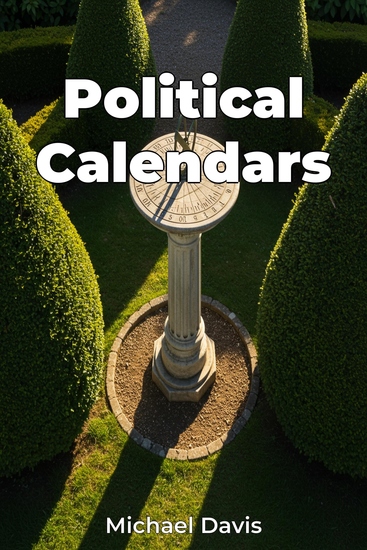
Political Calendars - cover

Political Calendars

Michael Davies

Translator A AI

Publisher: Publifye

  • 0
  • 0
  • 0

Summary

Political Calendars explores the surprising influence of calendars on politics, demonstrating how they shape governance and policy. Governments strategically use calendars to time elections, legislative sessions, and national events, influencing political outcomes in ways we often overlook. For example, the timing of elections can significantly impact voter turnout and campaign strategies. The book reveals that calendars are not neutral; they are active instruments of power. Legislative agendas are often dictated by calendrical constraints like fiscal years, impacting which laws can be passed. National holidays also serve a political purpose, reinforcing narratives and mobilizing support. This book adopts a multidisciplinary approach, drawing from political science, history, and other fields to examine the ethical implications of using calendars as tools of power. Starting with the basics of political time and different calendar systems, Political Calendars progresses through electoral cycles, legislative agendas, and national events, offering a unique perspective on the temporal dimensions of power.
Available since: 03/05/2025.
Print length: 61 pages.

Other books that might interest you

  • The Little Book of Christmas and Hogmanay - Scotland's Festive Traditions - cover

    The Little Book of Christmas and...

    Anonymous

    • 0
    • 0
    • 0
    From Celtic druids and Viking Yule to the outright banning of Christmas for 400 years, The Broons, first footing and the Loony Dook, this is a joyous miscellany that showcases the creative, elaborate and sometimes downright bizarre aspects of Scottish Christmas and New Year, from the ancient past to the more recent present. It includes different local traditions, from those practised in the Borders all the way to the islands of Orkney and Shetland, as well as the nationwide pastimes enjoyed by everyone.
    The book is packed with tradition, lore and legend, as well as poems, stories, carols, recipes, history, jokes and fun facts. Illustrated throughout with line drawings and black and white photographs.
    Best enjoyed in front of an open fire with a glass of whisky and a black bun.
    Show book
  • I Came to Cast Fire - An Introduction to René Girard - cover

    I Came to Cast Fire - An...

    Fr. Elias Carr

    • 0
    • 0
    • 0
    The Catholic anthropologist René Girard (1923–2015) has emerged as one of the most important thinkers of the past century. His sweeping mimetic theory changed the landscape of both the social sciences and Christian theology. And with the rise of social media, political polarization, and globalized conflict, Girard’s ideas have only proven increasingly prophetic with every passing year. But where to begin with this “new Darwin of the human sciences”? His massive body of work remains daunting and disorienting, and secondary literature either academic in tone or limited in scope. General readers—if Girard shows up on their radar at all—face a high barrier of entry to understanding his theory and applying it to daily life.I Came to Cast Fire offers a timely solution: a comprehensive but accessible introduction to the thought of René Girard. In short and digestible chapters, Fr. Elias Carr takes readers through the basics of mimetic theory and how it plays out through history—from the violent origins of religion and culture to the radical revelation that unfolds in Christ—weaving in compelling personal anecdotes along the way. The perfect first step for those new to Girard, I Came to Cast Fire will not only inspire readers to see the world in a new light—the fire of the Paraclete proclaiming the innocence of the victim—but more importantly, to enter into it. 
    Show book
  • Answer to the Question An: What is Enlightenment? - cover

    Answer to the Question An: What...

    Immanuel Kant

    • 0
    • 0
    • 0
    "Answering the Question: What Is Enlightenment?" is a 1784 essay by the philosopher Immanuel Kant. In the December 1784 publication of the Berlinische Monatsschrift (Berlin Monthly), edited by Friedrich Gedike and Johann Erich Biester, Kant replied to the question posed a year earlier by the Reverend Johann Friedrich Zöllner, who was also an official in the Prussian government. Zöllner's question was addressed to a broad intellectual public community, in reply to Biester's essay entitled: "Proposal, not to engage the clergy any longer when marriages are conducted" (April 1783) and a number of leading intellectuals replied with essays, of which Kant's is the most famous and has had the most impact. Kant's opening paragraph of the essay is a much-cited definition of a lack of enlightenment as people's inability to think for themselves due not to their lack of intellect, but lack of courage.
    Kant's essay also addressed the causes of a lack of enlightenment and the preconditions necessary to make it possible for people to enlighten themselves. He held it necessary that all church and state paternalism be abolished and people be given the freedom to use their own intellect. Kant praised Frederick II of Prussia for creating these preconditions. Kant focused on religious issues, saying that "our rulers" had less interest in telling citizens what to think in regard to artistic and scientific issues.
    Show book
  • World War II in 1942: The History of the Year the Allies Turned the Tide Against the Axis - cover

    World War II in 1942: The...

    Editors Charles River

    • 0
    • 0
    • 0
    The United States began 1942 determined to avenge Pearl Harbor, but the Allies, now including the Soviet Union by necessity, did not agree on the war strategy. In 1941, both the Germans and British moved armies into North Africa, where Italy had already tried and failed to reach the Suez Canal. The British sought American help in North Africa, where British General Bernard Montgomery was fighting the legendary “Desert Fox,” General Erwin Rommel. At the same time, Stalin was desperate for Allied action on the European continent that could free up the pressure on the besieged Soviets. 
    President Roosevelt had a consequential decision to make, and he eventually decided to land American forces on North Africa to assist the British against Rommel, much to Stalin’s chagrin. While the Americans and British could merely harass the Germans with air power and naval forces in the Atlantic, Stalin’s Red Army had to take Hitler’s best shots in Russia throughout 1942. But the Red Army’s tenuous hold continued to cripple the Nazi war machine while buying the other Allies precious time. 
    Despite fighting in North Africa and the Atlantic, the United States still had the resources and manpower to fight the Japanese in the Pacific. Though the Japanese had crippled the American fleet at Pearl Harbor, its distance from Japan made an invasion of Pearl Harbor impossible, and Japan had not severely damaged important infrastructure. Thus, the United States was able to quickly rebuild a fleet, still stationed at Pearl Harbor right in the heart of the Pacific. This forward location allowed the United States to immediately push deeply into the Pacific theater. In fact, the turning point in the Pacific theater took place in 1942 near Midway Island. The Japanese had moved a sizable fleet intending to occupy Midway Island and draw the American navy near.
    Show book
  • Was Muhammad Crazy? - cover

    Was Muhammad Crazy?

    Frédéric Joy

    • 0
    • 0
    • 0
    Through a careful psychological re-reading of the Qur'an and other biographical sources about Muhammad, the author identifies the pathological symptoms of the prophet of Islam. His diagnosis is unambiguous: the man suffered from a querulous paranoia with dissociative identity disorder. 
    The author shows that Mohammed identified himself with previous prophets (Jesus and Moses in particular), whom he plagiarized. Adapting their words and deeds to the culture of the Arab world, he imposed these new doctrines on his people primarily through direct aggression and political manipulation. Yet, Islam was phenomenally successful during his lifetime and over the centuries. 
    At this point, another question arises: How did Muhammad manage to convince the masses? The author then analyzes the personality of the submissive people and the success of this religion through the centuries. The author also deconstructs all the scientific and philosophical presuppositions behind the Muslim religion (cosmology, biology, psychology, etc.). Muhammad's moral and political discourse is confronted with its own contradictions.
    Show book
  • Business and Accounting for Authors - How to treat your writing as a business manage your money and use your accounting data to make better decisions - cover

    Business and Accounting for...

    Tora Moon

    • 0
    • 0
    • 0
    You have a dream … 
    … become a full-time author. 
    Your book is finished and your finger hovers over the publish button. Your dream is about to become a reality. Have you set up the foundation for success? 
    Too often authors wait to consider their writing as a business. Most beginning authors, and far too many experienced wordsmiths, don’t have any idea what it takes to manage the business side of their career. 
    There’s more to being an indie author, or authorpreneur, than just writing books and uploading them on the distribution sites. 
    This book will help! 
    You’ll learn to:Set up your businessTrack your moneyKnow what you own and what you oweBuild an accounting systemAnalyze your business for growth 
    …and much more! 
    No matter where you are in your writing career, it’s never too late to treat your writing like a business. 
    You’ll love this easy-to-understand guide, because it simplifies a process many find daunting. 
    Get started today! 
    As a fantasy author, and a former Certified Public Accountant, Tora Moon knows what an author needs to manage their money and business. She has used this expertise to help her make sense of her own writing and publishing career. Her information isn’t limited to spreadsheets and money management. She provides you with resources to help you be successful in your writing career.
    Show book