¡Acompáñanos a viajar por el mundo de los libros!
Añadir este libro a la estantería
Grey
Escribe un nuevo comentario Default profile 50px
Grey
Suscríbete para leer el libro completo o lee las primeras páginas gratis.
All characters reduced
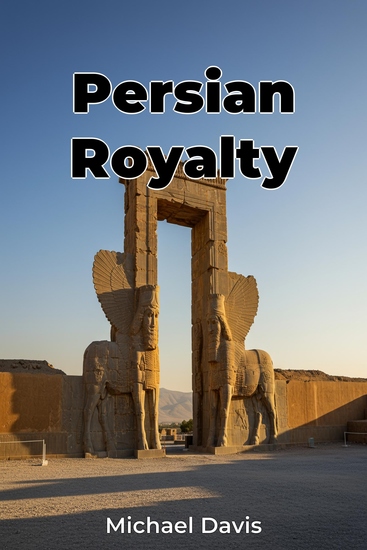
Persian Royalty - cover

Persian Royalty

Michael Davies

Traductor A Ai

Editorial: Publifye

  • 0
  • 0
  • 0

Sinopsis

Persian Royalty explores the significant role Persia's monarchs played in shaping the Middle East's political landscape and cultural identity. The book examines how rulers like Cyrus the Great, Darius, and Xerxes influenced the region through innovative administrative systems, religious policies, and the promotion of arts and sciences, challenging Eurocentric views of history. The Achaemenid Empire, for instance, implemented a postal system akin to a modern delivery service, while Zoroastrianism's influence on Persian society highlights the era's religious complexity.

 
The book progresses chronologically through major dynasties, including the Achaemenids, Parthians, and Sasanians, detailing their military campaigns, legal reforms, and architectural achievements. It draws upon royal inscriptions, archaeological findings, and ancient texts to offer a comprehensive overview.

 
By connecting Persian history to comparative religion, art history, and political science, Persian Royalty provides a nuanced understanding of the factors that shaped this influential empire, making it valuable for history enthusiasts and students alike.
Disponible desde: 20/03/2025.
Longitud de impresión: 53 páginas.

Otros libros que te pueden interesar

  • A History of Some of London’s Most Famous Landmarks - cover

    A History of Some of London’s...

    Editors Charles River

    • 0
    • 0
    • 0
    It almost goes without saying that Westminster Abbey is one of the foremost sites in Europe when it comes to being steeped in history. Dating back to the reign of William the Conqueror and the Norman conquest, Westminster Abbey has traditionally been the site of royal coronations, royal weddings, and royal burials, and anyone who enters can instantly feel that they are walking in the footsteps of some of the most influential figures in history, from Henry III to Queen Elizabeth I.  
    It’s impossible to fully appreciate the Tower of London without understanding its context. Like all fortresses, it was built to control and protect its surroundings, and the history of the Tower is bound up in the mutual histories of London and the Monarchy. The unfolding saga of war, imprisonment, glory, and treason in England can all be told through the lens of the Tower, and the lives that intersected with it. 
    When people think of the British Royal family, and more specifically where they live, the first image that often pops into mind is that of stately Buckingham Palace, with its changing of the guard and the occasional royal coach leaving or entering. Others may think of the royal country estate of Windsor Castle, a favorite of both Britain’s longest-reigning and second longest-reigning monarchs. And there was a time when both royal residences played second fiddle to a much better known home, the elegant Kensington Palace.  
    Big Ben is one of the most recognizable symbols of Britain, and indeed one of the most famous structures in the world. A quintessential part of London, every movie set in London features an establishing shot of Big Ben, and many guidebooks of London have the clock tower as its cover photo. London and Big Ben are forever linked in the consciousness of the Western world.
    Ver libro
  • Slavs and the Slave Trade The: The History of Enslaved Slavs across Eastern Europe and the Islamic World - cover

    Slavs and the Slave Trade The:...

    Editors Charles River

    • 0
    • 0
    • 0
    some historians have aligned the term Slav as deriving from descriptions of slaves: “The word “slave” and its cognates in most modern European languages is itself derived from “sclavus,” meaning “slav,” the ethnic name for the inhabitants of this region.” Some historians have outlined how they believe that Slavic slaves were used intensively in the ninth and tenth centuries and acted as a driver of Western European economic growth and allowed them to “emerge from the Dark Ages.” It is only fair to note that this assertion has been disputed. Separately, other scholars have asserted that Constantinople’s rapid rise to become one of Europe’s largest cities was fueled by a large supply of Slavic slaves. 
    	These trans-European routes diminished somewhat from the thirteenth century but demonstrated how common slave trading was in the region during these centuries. The majority of the people would have been kidnapped from Southeast Europe, as well as the Eurasian and Caucasus regions. Today, that encompasses Russia, Ukraine, Georgia, the Baltic states, Poland, Romania, Bulgaria, and the states of the former Yugoslavia. Crucially, an important component of Slavic identity was the Christian faith, in particular Orthodox Christianity.  
    	In the medieval period, a slave trading network became more entrenched, transporting people from Slavic lands in Eastern Europe to the Mediterranean and beyond. The growing schism between the Catholic and Orthodox versions of Christianity made Orthodox Christians targets of the former’s slave traders. As a result, Slavic slaves were captured and taken to parts of Christian Spain, including Aragon and Valencia, in the fourteenth and fifteenth centuries.
    Ver libro
  • A Devil Went Down to Georgia - Race Power Privilege and the Murder of Lita McClinton - cover

    A Devil Went Down to Georgia -...

    Deb Miller Landau

    • 0
    • 0
    • 0
    The 1987 murder of Lita McClinton Sullivan sent shock waves through the affluent Atlanta suburb of Buckhead, Georgia like few other crimes before it. The neighborhood, with its stately mansions and top-tier schools, was simply not the kind of place where women were gunned down in broad daylight. How many socialites had enemies so dangerous they would be murdered by a hit man pretending to deliver roses on an early winter morning? 


    Lita was an intelligent, accomplished, and stunning Black woman from a respected Atlanta family. Her interracial marriage to white millionaire Jim Sullivan was a newsworthy occurrence in 1970s Georgia. Unfortunately, it wasn't long before Jim's roving eye and controlling nature put Lita on edge, leading to a divorce years later. As the legal battle raged and Jim's financial outlook grew precarious, he had a chance encounter with an ex-con who said he could "take care" of Jim's wife problem . . . 


    Award-winning writer Deb Miller Landau details the shocking events that followed Lita's murder in 1987, including the surprising lack of evidence, racial bias in the justice system, and the international manhunt for Lita's killer. Full of twists and turns, legal battles, and the McClinton family's unrelenting dedication to justice, Landau's investigation is the first complete account of this tragic American crime.
    Ver libro
  • Summary of Kevin Simler & Robin Hanson’s The Elephant in the Brain - cover

    Summary of Kevin Simler & Robin...

    Falcon Press

    • 0
    • 0
    • 0
    Buy now to get the main key ideas from Kevin Simler & Robin Hanson’s The Elephant in the Brain 
      
    We, the human species, not only act on hidden motives, but we’re naturally designed to do so. Our brains are programmed to act in our own interest, even while we are trying hard not to be selfish. That’s why our brain often keeps our conscious mind in the dark. The more we ignore our ugly, hidden motives, the easier it is for us to keep them hidden from others, too. Self-deception is a strategic ploy that our brain adopts to disguise our bad behavior, and the key to change is understanding it.  
    In The Elephant in the Brain (2017), writer Kevin Simler and professor Robin Hanson uncover the hidden motives behind our main social behaviors and shed light on unexamined aspects of public life: respected social institutions in which nearly all participants are strategically self-interested, self-deceived, and driven by social signaling. 
     
    Ver libro
  • Being Sam Harris - Feeling the Power of Life - cover

    Being Sam Harris - Feeling the...

    Paul Chaplin

    • 0
    • 0
    • 0
    New York Times bestselling author Sam Harris is one of the most famous popular thinkers of our day. With a YouTube podcast channel Making Sense of almost half a million subscribers, and almost three million views of his debates with Jordan Peterson. The author of several books, and podcaster, Sam can be described for British audiences as Russell Brand with a neurology doctorate.
    Being Sam Harris challenges the central ideas of Sam's works. Ranging through philosophy, logic, history, religion, the science of neuro-imaging, and more.
    Sam is accused of being a one trick charlatan. A disingenuous showman who uses the technique of Singularity to generate a kaleidoscope of logically flawed and socially dangerous ideas. Despite their neo-liberal hippy patina, Sam's recipes for life demand suicide for the Self. All that remains is the autodidactic, synthesist benevolence of being Sam Harris.
    Ver libro
  • Letters to a Young Teacher - Wisdom for Those Who Guide Others - cover

    Letters to a Young Teacher -...

    Francinne Kaye Gacilo Paul O’Neill

    • 0
    • 0
    • 0
    This is not a manual. It’s a quiet act of rebellion. 
    Letters to a Young Teacher is a poetic and piercing exchange between two educators — a seasoned guide and a young teacher navigating burnout, grief, and the quiet longing to feel again. 
    What begins as an honest back-and-forth becomes a reckoning with perfectionism, a gentle rebellion against performative strength, and a soft return to joy. 
    These letters don’t preach. They breathe. They carry tools that don’t demand, stories that regulate the body, and language that grants permission — to rest, to feel again, to reclaim wonder. 
    For anyone who leads while still learning to stand. 
    Paul O’Neill is the author of Back into Delight and the Neuro-Resilience Skills series, helping leaders stay clear, calm, and connected — so their teams can move as one. 
    Francinne Kaye Gacilo is an educator and coach who brings the heart of a teacher to every role — from classroom care to digital transformation.
    Ver libro