Join us on a literary world trip!
Add this book to bookshelf
Grey
Write a new comment Default profile 50px
Grey
Subscribe to read the full book or read the first pages for free!
All characters reduced
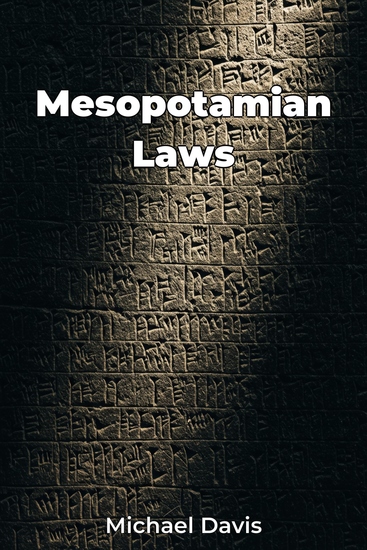
Mesopotamian Laws - cover

Mesopotamian Laws

Michael Davies

Translator A AI

Publisher: Publifye

  • 0
  • 0
  • 0

Summary

Mesopotamian Laws explores the origins of justice and legal systems in ancient Mesopotamia, focusing on how these early laws influenced modern legal principles. The book examines the social, political, and economic factors that shaped Mesopotamian law, particularly Hammurabi's Code. Intriguingly, Mesopotamian law included concepts of retribution and social order, and their cuneiform law influenced later legal traditions in the Near East and beyond. The book traces the evolution of legal thought, from early collections to systematized codes like Hammurabi's. It provides historical context, exploring the socio-political structures of Mesopotamian city-states and their impact on legal disputes. The book supports its arguments with translations of legal texts and archaeological findings, presenting complex legal concepts in an accessible style. It begins by introducing Mesopotamian law, progresses into detailed analyses of specific codes, and culminates in an examination of its lasting impact on Western legal thought, making it valuable for anyone interested in the history of law and political science.
Available since: 03/20/2025.
Print length: 54 pages.

Other books that might interest you

  • Meet the Ancient Greeks - cover

    Meet the Ancient Greeks

    James Davies

    • 0
    • 0
    • 0
    There's so much to digest when it comes to History - how do you know where to begin? These incredible short introductions are just the thing for readers who are beginning to explore ancient history. Get to know the basics on Ancient Greece from religious ceremonies to day to day life, with easy-to-digest, humorous text that is reminiscent of the bestselling Horrible Histories series. James Davies' stunning artwork and infographics provide a fresh nonfiction approach that is sure to captivate young readers.
    Show book
  • Democracy Lives in Darkness - How and Why People Keep Their Politics a Secret - cover

    Democracy Lives in Darkness -...

    Emily Van Duyn

    • 0
    • 0
    • 0
    In Democracy Lives in Darkness, Emily Van Duyn discovers and follows a secret political organization of progressive women in a conservative community in rural Texas. Its members met in secret to protect themselves from retaliation by their conservative neighbors, friends, and family. They discussed immigrant rights, women's reproductive rights, racism, and intolerance of those of different racial/ethnic and cultural backgrounds in their community. Democracy Lives in Darkness is about this group: their daily lives, their choices, and ultimately, their incubation. But it is also about what led them to meet in secret—the political prejudice and hostility that marginalizes and makes people afraid, and the growing political, social, and geographic cleavages that now make even mainstream dissent dangerous. 


    Van Duyn asks why mainstream partisans feel the need to hide their political beliefs from others, why they feel afraid of those from the opposite party, how they stay politically engaged in secret, and how this can transform them and their communities. Van Duyn challenges the assumption that the United States is a liberal democracy where ideas can be expressed freely and publicly. Rather, she suggests that democracy in the United States may exist in darkness, but, more optimistically, that it uses this darkness to move forward.
    Show book
  • White Poverty - How Exposing Myths about Race and Class Can Reconstruct American Democracy - cover

    White Poverty - How Exposing...

    Reverend Dr. William Barber II,...

    • 0
    • 0
    • 0
    A generational work with far-ranging social and political implications, White Poverty promises to be one of the most influential books in recent years. 


    One of the most pernicious and persistent myths in the United States is the association of Black skin with poverty. Though there are forty million more poor white people than Black people, most Americans, both Republicans and Democrats, continue to think of poverty—along with issues like welfare, unemployment, and food stamps—as solely a Black problem. Why is this so? What are the historical causes? And what are the political consequences that result? 


    These are among the questions that the Reverend Dr. William J. Barber II, a leading advocate for the rights of the poor and the "closest person we have to Dr. King" (Cornel West), addresses in White Poverty, a groundbreaking work that exposes a legacy of historical myths that continue to define both white and Black people, creating in the process what might seem like an insuperable divide. Analyzing what has changed since the 1930s, when the face of American poverty was white, Barber, along with Jonathan Wilson-Hartgrove, addresses white poverty as a hugely neglected subject that just might provide the key to mitigating racism and bringing together tens of millions of working class and impoverished Americans.
    Show book
  • Reconstructing the Dreamland - The Tulsa Riot of 1921: Race Reparations and Reconciliation (Updated Edition) - cover

    Reconstructing the Dreamland -...

    Alfred L. Brophy

    • 0
    • 0
    • 0
    The 1921 Tulsa Race Riot was the country's bloodiest civil disturbance of the century. Thirty city blocks were burned to the ground, perhaps 150 died, and the prosperous black community of Greenwood, Oklahoma, was turned to rubble.Alfred L. Brophy draws on his own extensive research into contemporary accounts and court documents to chronicle this devastating riot, showing how and why the rule of law quickly eroded. Brophy shines his lights on mob violence and racism run amok, both on the night of the riot and the following morning. Equally important, he shows how the city government and police not only permitted looting, shootings, and the burning of Greenwood, but actively participated in it by deputizing white citizens haphazardly, giving out guns and badges, or sending men to arm themselves. Likewise, the National Guard acted unconstitutionally, arresting every black resident they found, leaving property vulnerable to the white mob.Brophy's stark narrative concludes with a discussion of reparations for victims of the riot through lawsuits and legislative action. That case has implications for other reparations movements, including reparations for slavery. This updated edition features a new foreword by Randall Kennedy.
    Show book
  • Toxic Water Toxic System - Environmental Racism and Michigan's Water War - cover

    Toxic Water Toxic System -...

    Michael Mascarenhas

    • 0
    • 0
    • 0
    The tireless resistance of local communities fighting for ownership of America's third largest water system 


    Toxic Water, Toxic System exposes the consequences of a seemingly anonymous authoritarian state willing to maintain white supremacy at any cost—including poisoning an entire city and shutting off water to thousands of people. Weaving together narratives of frontline activists along with archival data, Michael Mascarenhas provides a powerful exploration of the political alliances and bureaucratic mechanisms that uphold inequality. 


    Drawing from three years of ethnographic fieldwork in Flint and Detroit, this book amplifies the voices of marginalized communities, particularly African American women, whose perspectives and labor have been consistently overlooked. Toxic Water, Toxic System offers a fresh perspective on the ties between urban austerity policies, environmental harm, and the advancement of white supremacist agendas in predominantly Black and brown cities.
    Show book
  • Becoming Homeschoolers - Give Your Kids a Great Education a Strong Family and a Life They'll Thank You for Later - cover

    Becoming Homeschoolers - Give...

    Monica Swanson, Sarah Molitor

    • 0
    • 0
    • 0
    Read by the author. 
    Monica Swanson helps you navigate your real-world concerns about school, culture, and what it takes to create an amazing homeschool experience that you and your kids will never regret! 
    If you've ever wondered whether you have what it takes to homeschool your children, look no further. Parenting author, podcaster, and homeschool mom Monica Swanson is here to tell you: you can do it. In fact, it can be the most fun, family-unifying, character-building, life-equipping experience you and your children will ever have. 
    Becoming Homeschoolers tackles your legitimate doubts and fears about homeschooling, as well as the questions you want answered before you commit--questions like where to start and how to choose a curriculum, build social skills, teach what you're not good at, and prepare for college. With humor and encouragement, Monica weaves her own story of homeschooling her four boys with step-by-step, practical advice on how to:Assess whether home education is right for you and your childrenEstablish a foundation of faith in your everyday homeschool routineFind socialization opportunities such as sports and extracurricular activitiesCare for yourself and your marriage even as you spend more time each day with your kidsTackle the practical side of homeschooling, including standardized tests, transcripts, college readiness, and navigating education requirements 
      
    It's time to trade fear for empowerment and insecurity for confidence as you live out your own story of becoming homeschoolers. 
    Useful resources can be found in the audiobook companion PDF download.
    Show book