Begleiten Sie uns auf eine literarische Weltreise!
Buch zum Bücherregal hinzufügen
Grey
Einen neuen Kommentar schreiben Default profile 50px
Grey
Jetzt das ganze Buch im Abo oder die ersten Seiten gratis lesen!
All characters reduced
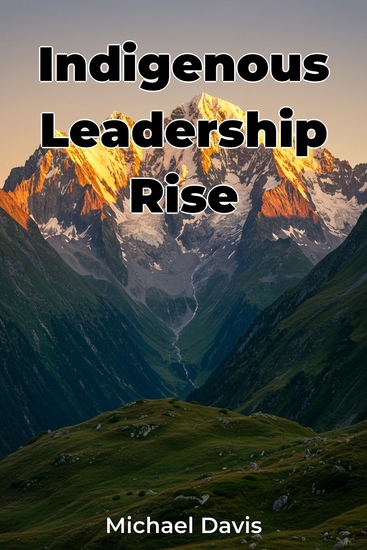
Indigenous Leadership Rise - cover

Indigenous Leadership Rise

Michael Davies

Übersetzer A AI

Verlag: Publifye

  • 0
  • 0
  • 0

Beschreibung

Indigenous Leadership Rise examines the growing influence of indigenous leaders in politics and activism, highlighting their vital role in shaping policy and driving social change. This book explores how indigenous perspectives are essential for inclusive governance, addressing issues like climate change and social justice. The increasing representation of indigenous leaders marks a turning point, challenging conventional power structures and offering solutions rooted in traditional knowledge.

 
The book provides a comprehensive analysis, beginning with the historical context of injustices and barriers faced by indigenous peoples. It then delves into case studies of successful indigenous leaders, analyzing policy outcomes and social impacts of indigenous-led initiatives. For example, indigenous-led environmental protection efforts often blend traditional ecological knowledge with modern conservation strategies, leading to more sustainable outcomes.

 
Ultimately, the book discusses the broader implications of indigenous leadership for democracy and global governance. It advocates for greater inclusivity and collaboration, offering a fresh perspective by centering indigenous voices and experiences. The book progresses through key concepts, case studies, policy analyses, and culminates in actionable steps for fostering equitable societies.
Verfügbar seit: 27.02.2025.
Drucklänge: 70 Seiten.

Weitere Bücher, die Sie mögen werden

  • The art of winning The Startup Guide - cover

    The art of winning The Startup...

    Yury Yavorsky

    • 0
    • 0
    • 0
    This book is about setting up your own business and what is the best way to start if you have made up your mind.Multiple tips from the author are illustrated by 25 years of experience and urge the reader to perform gap analysis if you are in business and contain recommendations on avoiding typical mistakes or misconceptions found in American books, and dispel the myths that armchair business wizards create.
    Zum Buch
  • The Temples of Egypt - Sacred Spaces and Religious Practices - cover

    The Temples of Egypt - Sacred...

    Omar Khalil

    • 0
    • 0
    • 0
    Temples in ancient Egypt were far more than mere places of worship. They stood at the very heart of Egyptian civilization, functioning as both spiritual centers and instruments of political and social order. Each temple was seen as a dwelling place for a god or goddess, and the rituals performed within their walls were believed to maintain the cosmic balance known as ma’at. The presence of a temple in a city or region signaled divine favor and legitimacy, reinforcing the bond between the gods and the ruling pharaoh. 
    Pharaohs were considered divine intermediaries between the gods and the people, and their authority was deeply rooted in religious belief. Temples were a direct reflection of this divine connection. Often constructed by pharaohs to honor specific deities, temples helped assert royal power and ensure harmony across the land. Through grand architecture and lavish offerings, rulers demonstrated their piety and reaffirmed their right to govern. This link between kingship and temple worship made temples central to the ideological framework of the state. 
    Beyond their religious significance, temples also played a pivotal role in the social life of ancient Egyptians. They were the sites of numerous festivals and ceremonial events that brought entire communities together. These occasions were marked by processions, music, dancing, and the display of sacred statues, all of which reinforced communal identity and devotion. The most prominent of these was the Opet Festival in Thebes, during which statues of Amun, Mut, and Khonsu were transported from Karnak to Luxor Temple in a public procession along the Nile. Such festivals reminded people of the gods’ presence and the pharaoh’s divine role in upholding order.
    Zum Buch
  • Structuring Inequality - How Schooling Housing and Tax Policies Shaped Metropolitan Development and Education - cover

    Structuring Inequality - How...

    Tracy L. Steffes

    • 0
    • 0
    • 0
    How inequality was forged, fought over, and forgotten through public policy in metropolitan Chicago. As in many American metropolitan areas, inequality in Chicagoland is visible in its neighborhoods. These inequalities are not inevitable, however. They have been constructed and deepened by public policies around housing, schooling, taxation, and local governance, including hidden state government policies.In Structuring Inequality, historian Tracy L. Steffes shows how metropolitan inequality in Chicagoland was structured, contested, and naturalized over time even as reformers tried to change it through school desegregation, affordable housing, and property tax reform. While these efforts had modest successes in the city and the suburbs, reformers faced significant resistance and counter-mobilization from affluent suburbanites, real estate developers, and other defenders of the status quo who defended inequality and reshaped the policy conversation about it. Grounded in comprehensive archival research and policy analysis, Structuring Inequality examines the history of Chicagoland’s established systems of inequality and provides perspective on the inequality we live with today.
    Zum Buch
  • Great Patriotic War The: The History of the Fighting Between the Soviets and Germans during World War II - cover

    Great Patriotic War The: The...

    Editors Charles River

    • 0
    • 0
    • 0
    In the warm predawn darkness of June 22, 1941, 3 million men waited along a front hundreds of miles long, stretching from the Baltic coast of Poland to the Balkans. Ahead of them in the darkness lay the Soviet Union, its border guarded by millions of Red Army troops echeloned deep throughout the huge spaces of Russia. This massive gathering of Wehrmacht soldiers from Adolf Hitler's Third Reich and his allied states – notably Hungary and Romania – stood poised to carry out Operation Barbarossa, Hitler's surprise attack against the country of his putative ally, Soviet dictator Joseph Stalin.  
    	Though Germany was technically Russia’s ally, Stalin had no delusions that they were friends. Instead, he used this time to build up his forces for what he saw as an inevitable invasion. First, on the heels of the German invasion of Poland in September 1939, Stalin had his troops invade and reclaim the land Russia had lost in World War I. Next he turned his attention to Finland, which was only 100 miles from the newly named Leningrad.  He initially tried to negotiate with the Finnish government for some sort of treaty of mutual support. When this failed he simply invaded. While the giant Russian army ultimately won, the fact that little Finland held them off for three months demonstrated how poorly organized the bigger force was. 
    What Stalin did not realize was that Hitler had simply overstretched himself in Yugoslavia and only planned to delay the invasion by a few weeks.  The Soviets were so caught by surprise at the start of the attack that the Germans were able to push several hundred miles into Russia across a front that stretched dozens of miles long, reaching the major cities of Leningrad and Sevastopol in just three months. 
    Zum Buch
  • Powerful Questioning - Strategies for improving learning and retention in the classroom - cover

    Powerful Questioning -...

    Michael Chiles

    • 0
    • 0
    • 0
    Foreword by John Hattie.
    Questioning is a staple feature of a teacher's toolkit across all phases of education. Classrooms are awash with explanation, modelling and feedback, but of all the pedagogical strategies at a teacher's disposal, questioning is one of the most important. It is the heartbeat of a classroom. While the art of asking a question seems relatively straightforward, to what extent do teachers consider the types of questions they're using? Are the questions they ask students actually helping to support learning? InPowerful Questioning,Michael Chiles delves into the complexity of asking questions and how best to use this pedagogical tool as a powerful springboard to support learning in the classroom.
    Teachers are described by many as 'professional question-askers' and the use of questioning in the teaching and learning process dates back to one of the most influential users and developers of questions, the Greek philosopher Socrates. Socrates believed that by asking questions we encourage reflection, and that their use is most effective when we create a continual loop of dialogue between the asker and the receiver, to allow movement from surface to deeper level thinking.Powerful Questioningtakes inspiration from this, providing original theory that relates back to the historical use of questioning in the classroom throughout.
    Offering a fresh perspective on how questioning can be engineered to support effective learning,Powerful Questioningexamines the reasons behind the questions we ask and reveals the power of asking the right questions, in the right way, at the right time. It details a set of core principles, recommendations and classroom-based practical examples that can be used to implement powerful questioning both in the classroom and wider school.
    Michael's aim is to help teachers become research-informed on the theories around the use of questioning in the classroom, whilst also providing a wide range of practical classroom-based strategies. Readers will take away specific examples from a broad range of case studies in which teachers at different phases of education (from Key Stages one to five) share how they use questioning to improve learning and retention.
    Essential reading for all teachers and school leaders.
    Zum Buch
  • Who Runs the World? - Unlocking the Talent and Inventiveness of Women Everywhere - cover

    Who Runs the World? - Unlocking...

    Lois Quam

    • 0
    • 0
    • 0
    Women and girls across the world are often made to feel as if the challenges, limitations, and barriers they face are personal, belonging to them alone. When, in fact, they affect us all. The issues are systemic, societal, and global – and we have the power to create change.In Who Runs the World?, author Lois Quam emphasizes the need to unlock the immense potential of women and girls globally. Quam argues that empowering women is the long-needed step for justice and the progress needed to address the growing challenges we face today.Throughout the book, she speaks to the barriers – personal and systemic – that block the humanity and talent of half the all the world’s people – women.Who Runs the World? sheds light on the path to change and the vital role women and girls play in addressing global challenges. Join the movement to unlock all the world’s talent and contribute to a more equitable and thriving world.
    Zum Buch