Rejoignez-nous pour un voyage dans le monde des livres!
Ajouter ce livre à l'électronique
Grey
Ecrivez un nouveau commentaire Default profile 50px
Grey
Abonnez-vous pour lire le livre complet ou lisez les premières pages gratuitement!
All characters reduced
First War Photos - cover

First War Photos

Michael Davies

Traducteur A AI

Maison d'édition: Publifye

  • 0
  • 0
  • 0

Synopsis

First War Photos explores the dawn of war photography, examining how early photographic technology captured 19th-century warfare and shaped public perception. It delves into the challenges faced by pioneers like Roger Fenton during the Crimean War and Mathew Brady during the American Civil War, revealing how their images, despite technical limitations, brought the battlefield to the home front. These first war photos, though sometimes staged, marked a significant shift in war reporting. The book investigates the evolution of photographic processes, from daguerreotypes to wet plate collodion, and their impact on documenting military history. It highlights how these images altered the relationship between the public and armed conflict. Through meticulous examination of primary sources and photographic analysis, the book progresses from an introduction covering photography's pre-war state to chapters focusing on specific conflicts and photographers, culminating in a conclusion assessing the long-term impact and ethical implications of early war photography.
Disponible depuis: 26/02/2025.
Longueur d'impression: 60 pages.

D'autres livres qui pourraient vous intéresser

  • Love Death + Explosives - Thomas Pynchon's Polipsychology - cover

    Love Death + Explosives - Thomas...

    Michael Finney

    • 0
    • 0
    • 0
    Love Death + Explosives: Thomas Pynchon’s Polipsychology is an essay that addresses the postmodern angle in the reclusive titular author’s writing, challenging readers to decontextualize the interpretive lens for the literal.
    Voir livre
  • The History of Historical Writing in America - cover

    The History of Historical...

    J. Franklin Jameson

    • 0
    • 0
    • 0
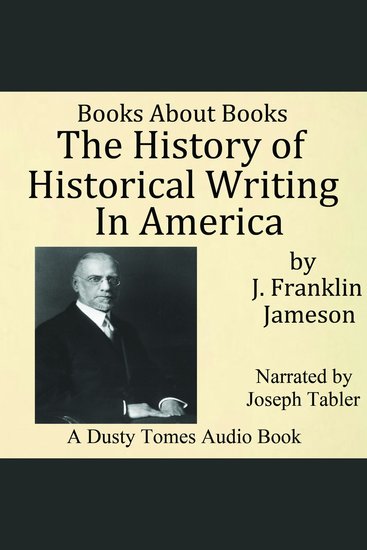
    A Dusty Tomes Audio BookIn Cooperation with Spoken Realms 
    THE HISTORY OF HISTORICAL WRITING IN AMERICA by J. Franklin Jameson, PhD, Professor of History at Brown University. Houghton, Mifflin and Company, 1891. 
    Note: This book is “read as written.” It was published in 1891. It is in the public domain. 
    Jameson helped found the American Historical Association (1884), and was the first managing editor of the American Historical Review. He also wrote The American Revolution Considered as a Social Movement (1926) and invited W. E. B. Du Bois to present a paper concerning Reconstruction at the 1909 AHA meeting. With Waldo Leland, he started lobbying Congress to create the National Archives, the building for which was first funded in 1926. (from Wikipedia) 
    CONTENTS I. THE HISTORIANS OF THE SEVENTEENTH CENTURYII. THE HISTORIANS OF THE EIGHTEENTH CENTURYIII. FROM THE REVOLUTION TO THE CIVIL WARIV. SINCE THE CIVIL WARDusty Tomes Audio Books are public domain books retrieved from the ravages of time, available as never before, as audio books, for your edification, pleasure, and consideration. Please excuse the dust. 
    This Dusty Tomes audio book was Read Online at Internet Archive.
    Voir livre
  • He Breaks The Shell & I Know My Father - Special Edition - Self Hypnosis Guided Prayer Meditation Visualization - Neville Goddard Book and Extra Chapter with Guided Prayer Visualization Meditation by Richard Hargreaves - cover

    He Breaks The Shell & I Know My...

    Neville Goddard

    • 0
    • 0
    • 0
    This audiobook unites two profound works by visionary mystic Neville Goddard: "He Breaks the Shell" (1964) and "I Know My Father" (1960), paired with an exclusive guided meditation by Richard Hargreaves to deepen your journey of self-realization. Blending timeless spiritual philosophy with actionable practices, this special edition invites you to transcend limitations, reclaim your divine identity, and awaken the creator within.  In He Breaks the Shell, Neville unveils the transformative process of resurrection as an awakening within the “sepulcher” of the human skull—a mystical rebirth into your Christ-consciousness. Through vivid scriptural analysis and firsthand mystical testimony, he reveals how God’s four mighty acts (resurrection, fatherhood, temple-splitting, and divine affirmation) dismantle the “shell” of mortal identity, birthing you as “the image of the invisible God.” This esoteric masterwork reframes biblical prophecy as an inward journey: “God became man that man may become God.”  I Know My Father distills Neville’s cornerstone teaching: “Your awareness of being is God.” Here, he dismantles illusions of separation, reframing “God” as your I AM presence—the formless awareness that molds reality. Through razor-sharp insights, Neville empowers you to shed limiting attachments, wield consciousness as the “foundation stone” of creation, and manifest desires by “wearing” new states of being. “To claim ‘I AM free’ is to let your savior in,” he teaches—a call to dissolve lack through radical self-revaluation.   
    The meditation by Hargreaves is designed to anchor Neville’s teachings into daily practice. Through breathwork, visualization, and manifestation techniques, this immersive session helps you manifest from unwavering faith.   
    "He Breaks the Shell and I Know My Father—Special Edition" is a roadmap to self-deification. Neville’s revelations dissolve the illusion of separation, empowering you to wield imagination consciously and sculpt a life of purpose.
    Voir livre
  • Operation Condor: The History of the Notorious Intelligence Operations Supported by the United States to Combat Communists across South America - cover

    Operation Condor: The History of...

    Charles River Editors

    • 0
    • 0
    • 0
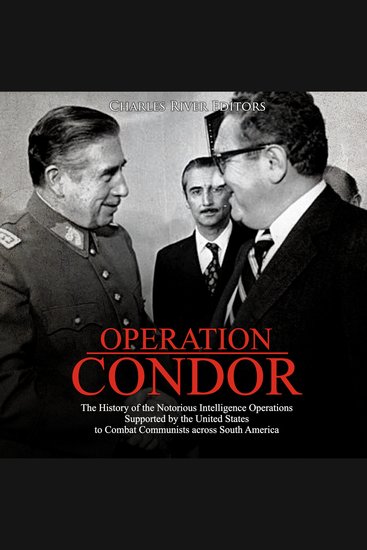
    “Let's say there were 7,000 or 8,000 people who had to die to win the war against subversion... We couldn't execute them by firing squad. Neither could we take them to court... For that reason, so as not to provoke protests inside and outside the country, the decision was reached that these people should be disappeared.” – General Jorge Rafael Videla 
    For much of the 20th century, South American governments in large part lived under a system of military junta governments. The mixture of indigenous peoples, foreign settlers and European colonial superpowers produced cultural and social imbalances into which military forces intervened as a stabilizing influence. The proactive personalities of military heads and the rigid structures of such a hierarchy guaranteed the “strong man” commanding officer an abiding presence in the form of executive dictator. Such leaders often bore the more collaborative title of “President,” but the reality was, in most cases, identical. Likewise, the gap between rich and poor was often vast, and a disappearance of the middle class fed a frequent urge for revolution, reenergizing the military’s intent to stop it. With no stabilizing center, the ideologies most prevalent in such conflicts alternated between a federal model of industrial and social nationalization and an equally conservative structure under privatized ownership and autocratic rule drawn from the head of a junta government. 
    Whichever belief system was in play for the major industrial nations of the continent, a constant bombardment of foreign influence pushed the people of states such as Chile, Brazil, Argentina, and others, toward overthrow, in one direction or the other. From the left came Stalinist influences from the Soviet Union and Castro’s Cuba, while the German World War II model and an anti-communist mindset from the United States worked behind the scenes to upset any movement toward extreme liberalism. 
    The reign of Juan Peron in Argentina became the most iconic such arrangement to the Western observer, but General Augusto Pinochet’s 17-year rule over Chile after an American-supported coup in the 1970s proved the most enduring and the most resistant to eradication by subsequent leaders of an opposite bent. Pinochet himself openly bragged, “My library is filled with UN condemnations.” By combating Marxists and Communists during the Cold War, Pinochet ensured he would at the very least remain undisturbed by America, even as he carried out policies that would be labeled tyrannical by any objective measurement. As writer Jacob C. Hornberger put it while analyzing appraisals of Pinochet based on political background, “[T]error in the name of fighting terror is a grave criminal offense against humanity no matter what economic philosophy the state terrorist happens to hold.” 
    The tacit acceptance of these right-wing dictators across South America was part of an overarching effort known as Operation Condor, consisting mostly of CIA operations that are as infamous and controversial as ever, with a lasting legacy that affects current events such as reactions to the ongoing unrest in Venezuela. 
    Operation Condor: The History of the Notorious Intelligence Operations Supported by the United States to Combat Communists across South America looks at the various intelligence operations and the winding chain of events that brought about conflicts in the region. Along with pictures and a bibliography, you will learn about Operation Condor like never before.
    Voir livre

  • The Dean of Shandong - Confessions of a Minor Bureaucrat at a Chinese University - cover

    The Dean of Shandong -...

    Daniel A. Bell

    • 0
    • 0
    • 0
    This audiobook narrated by Wyntner Woody provides an inside view of Chinese academia and what it reveals about China's political system
    
    On January 1, 2017, Daniel Bell was appointed dean of the School of Political Science and Public Administration at Shandong University—the first foreign dean of a political science faculty in mainland China's history. In The Dean of Shandong, Bell chronicles his experiences as what he calls "a minor bureaucrat," offering an inside account of the workings of Chinese academia and what they reveal about China's political system. It wasn't all smooth sailing—Bell wryly recounts sporadic bungles and misunderstandings—but Bell's post as dean provides a unique vantage point on China today.
    
    Bell, neither a Chinese citizen nor a member of the Chinese Communist Party, was appointed as dean because of his scholarly work on Confucianism—but soon found himself coping with a variety of issues having little to do with scholarship or Confucius. These include the importance of hair color and the prevalence of hair-dyeing among university administrators, both male and female; Shandong's drinking culture, with endless toasts at every shared meal; and some unintended consequences of an intensely competitive academic meritocracy. As dean, he also confronts weightier matters: the role at the university of the Party secretary, the national anticorruption campaign and its effect on academia (Bell asks provocatively, "What's wrong with corruption?"), and formal and informal modes of censorship. Considering both the revival of Confucianism in China over the last three decades and what he calls "the Communist comeback" since 2008, Bell predicts that China's political future is likely to be determined by both Confucianism and Communism.
    Voir livre
  • French Revolution The - Thomas Carlyle - cover

    French Revolution The - Thomas...

    Thomas Carlyle

    • 0
    • 0
    • 0
    "The French Revolution" by Thomas Carlyle is a classic historical work that chronicles the events leading up to and during the French Revolution. Written in 1837, Carlyle's account is known for its vivid and passionate style, and for its ability to bring to life the key figures and events of the revolution. 
    The book begins with an analysis of the state of France in the late 18th century, and the social and economic conditions that contributed to the revolution. It then goes on to provide a detailed account of the revolution itself, including the storming of the Bastille, the Reign of Terror, and the rise of Napoleon Bonaparte. 
    Throughout the book, Carlyle emphasizes the role of individual actors and their personal struggles and motivations, rather than simply analyzing the structural forces at play. He also reflects on the broader philosophical and moral questions raised by the revolution, such as the nature of power, the relationship between the individual and the state, and the struggle for liberty. 
    Overall, "The French Revolution" is a powerful and engaging work of history that offers a unique perspective on one of the most significant events of modern times.
    Voir livre