¡Acompáñanos a viajar por el mundo de los libros!
Añadir este libro a la estantería
Grey
Escribe un nuevo comentario Default profile 50px
Grey
Suscríbete para leer el libro completo o lee las primeras páginas gratis.
All characters reduced
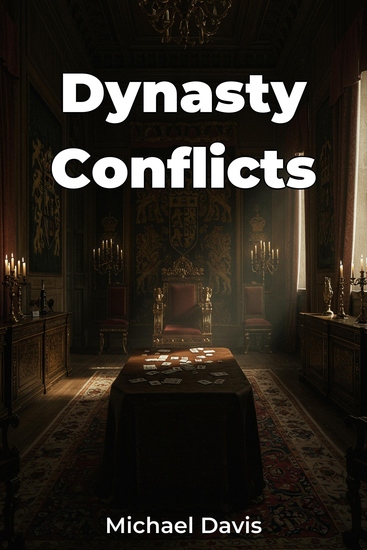
Dynasty Conflicts - cover

Dynasty Conflicts

Michael Davies

Traductor A AI

Editorial: Publifye

  • 0
  • 0
  • 0

Sinopsis

"Dynasty Conflicts" explores how internal power struggles within royal families have shaped history, leading to conflicts and the fall of dynasties. The book delves into succession crises and the political intrigue that fueled civil wars and assassinations. These internal conflicts are not merely isolated incidents; they represent pivotal moments that altered political landscapes, reshaped empires, and determined the fate of nations.

 
Succession, often governed by complex and contested rules, became a breeding ground for rivalries and conspiracies. The book examines specific dynasties, such as the Romanovs and the Ming Dynasty, providing historical context and exploring the cultural norms, religious beliefs, and economic pressures that influenced royal decision-making.

 
It argues that internal power struggles represent a critical, often overlooked, driving force in historical change, demonstrating that these conflicts were significant determinants of long-term political stability and societal development. The book progresses chronologically and thematically, offering a broader analysis of the patterns and commonalities that characterize royal power struggles across different cultures and time periods.
Disponible desde: 21/03/2025.
Longitud de impresión: 61 páginas.

Otros libros que te pueden interesar

  • Introduction to Internal Family Systems - A Step-by-Step Guide to Mastering IFS Therapy - cover

    Introduction to Internal Family...

    Harper Susan Evergreen

    • 0
    • 0
    • 0
    Introduction to Internal Family Systems: A Step-by-Step Guide to Mastering IFS TherapyJourney into the captivating realm of the Internal Family Systems model with our audio guide, 'Introduction to Internal Family Systems.' This comprehensive exploration delves deep into a therapeutic method that promises personal growth, healing, and unparalleled self-awareness.Embark on a historic voyage, tracing the roots of IFS from its inception to its contemporary recognition in the world of therapy. Let our narrator guide you through the core concepts, painting vivid pictures of the Self, parts, burdens, and their delicate dance of interaction.Harness the power of practical IFS techniques, from immersive visualization exercises to illuminating dialogue methods, all crafted to enrich your understanding and pave your path to healing. Witness first-hand the far-reaching applications of IFS—stretching beyond therapy rooms, influencing arenas like business leadership, team dynamics, education, and personal growth.Be moved by real-world stories, as compelling case studies showcase the transformative might of IFS, juxtaposed with other therapeutic models, giving you a holistic grasp of its transformative potential.Whether you're a therapist, a student of psychology, or someone simply on a quest for self-discovery, let this audio guide be your compass. Tune in and unlock profound insights, embrace the vastness of the human psyche, and stride confidently towards a future of internal harmony and healing.Get your copy now, plug in those headphones, and embark on an auditory expedition that promises to reshape the way you perceive yourself and the world.
    Ver libro
  • Aghora I: At the Left Hand of God - cover

    Aghora I: At the Left Hand of God

    Dr. Robert Svoboda

    • 0
    • 0
    • 0
    The first book in the Aghora trilogy containing the teachings of Dr. Svoboda’s mentor, the Aghori Vimalananda. Written almost entirely in Vimalananda’s own words, it presents events from his life, tenets of his philosophy, and highlights from his spiritual practices. Designed partly to shock and partly to comfort, but wholly as an offering to his Beloved, Aghora is a picture of a man who was a riddle wrapped up in an enigma.
    Ver libro
  • Anarchy and Authority - Irish Encounters with Romanov Russia - cover

    Anarchy and Authority - Irish...

    Angela Byrne

    • 0
    • 0
    • 0
    From the ascent of Peter the Great to the Russian Revolution. From the Battle of the Boyne to the Easter Rising. Between these epochal events were two astounding centuries of war, diplomacy, intrigue, innovation and international radical political movements, the reverberations of which are still felt in both Ireland and the former territories of the Russian empire today.
    In Anarchy and Authority, readers follow contemporaneous accounts of Irish men and women who ventured into the Russian empire during the long centuries of Romanov rule. Human connections, political intrigues, cultural cross-pollination mesh with sweeping historical narratives in the story of the island and the empire.
    Meticulously researched and energetically told, these are the stories of Irish residents, travellers and migrants to Russia from that time, ranging from diplomats and governesses, to early tourists, travel writers, soldiers, servants and even a revolutionary music-teacher. From the Irishmen and women who benefitted from the imperial wars waged by the Russian state, to those Irish observers who bore witness to the horrors of serfdom and the oppression of dissenting voices.
    Anarchy and Authority brings to vivid life these Irish perspectives. Their fascinating insights and unique depths of field give increasing relevance to the turbulent geo-politics of modern times.
    Ver libro
  • James Cook - His First Voyage His Accomplishments and His Death - cover

    James Cook - His First Voyage...

    Kelly Mass

    • 0
    • 0
    • 0
    Captain James Cook FRS was a British explorer, navigator, cartographer, and captain in the Royal Navy who is most well-known for his 3 explorations to the Pacific Ocean, especially to Australia, between 1768 and 1779. Prior to finishing 3 trips to the Pacific, he drew precise maps of Newfoundland and made the first documented European encounter with the eastern coast of Australia and the Hawaiian Islands, and the first noted circumnavigation of New Zealand. 
    As a youngster, Cook signed up with the British merchant fleet before signing up with the Royal Navy in the year 1755. Throughout the siege of Quebec, he saw fight in the 7 Years' War and later on surveyed and recorded much of the Saint Lawrence River's entryway, bringing him to the notification of the Admiralty and the Royal Society. That honor took place at a rather critical point in his profession and in the direction of British abroad expedition, resulting in his appointment as leader of HMS Endeavor for the first of 3 Pacific explorations in the year 1766.  
    Cook traveled countless kilometers over mainly untouched parts of the world on these journeys. He checked out spots in the Pacific Ocean from New Zealand to Hawaii in greater detail and on a scale never ever before seen by Western explorers. For the first time, he surveyed and recognized things, and recording isles and shorelines on European maps. He displayed seamanship, remarkable surveying and cartography abilities, physical bravery, and the capability to lead men to different area all over the world.
    Ver libro
  • Great Northern War The: The History of the Conflict that Made Russia the Dominant Empire in the Baltic - cover

    Great Northern War The: The...

    Editors Charles River

    • 0
    • 0
    • 0
    The Great Northern War, fought from 1700-1721, gets its name from the fact the war focused on the Baltic, but the battlefields extended into Germany and deep into Poland and Ukraine. Sweden was a military power with a small empire in the Baltic, while Russia was still a landlocked place, backward when compared to the rest of Europe, not very powerful, and highly xenophobic. The Poland-Lithuanian Commonwealth was still powerful, and the Cossacks were still free. Moreover, despite the fact the Ottoman Empire was weakened, it held sway in the Balkans and deep into Eastern Europe, and the Krim Tatars were still raiding into Ukraine, Russia, and Poland for slaves. The Great Northern War would involve the Ottomans and the Tatars as well. 
    	Given the length of the conflict, perhaps it’s not surprising that other Western European kingdoms ended up in the mix. Brandenburg-Prussia was involved in the later phases of the war - Frederick William was an elector of Brandenburg and had just been granted the right (by the Holy Roman Emperor) to call himself king in Prussia. He held both titles, but there was still a formal separation between Brandenburg and Prussia. Frederick William was strongly interested in acquiring some or all of Pomerania, a region on the Baltic coast, particularly in acquiring a port, which would eliminate paying Swedish tolls in Swedish-controlled ports. 
    	Ultimately, the most important aspect of the war is that it laid the foundations for the Russian Empire. By 1718, the Russians had conquered most of Finland, the port of Riga, and the Swedish city of Vyborg. These gains in the Baltic Sea strengthened the burgeoning Russian Empire and provided ports and access to the rich resources of Finland, including valuable meat and lumber. Peter also proved to be a rather benevolent conqueror, allowing these regions to maintain both their faith and culture.
    Ver libro
  • The Dust Bowl - America's Great Depression - cover

    The Dust Bowl - America's Great...

    Nova Ashford

    • 0
    • 0
    • 0
    The Dust Bowl was one of the most devastating environmental disasters in American history, affecting the Great Plains during the 1930s. A combination of severe drought, poor agricultural practices, and economic hardship led to massive dust storms, which wiped out crops, destroyed farmland, and caused widespread suffering. The impact of the Dust Bowl was felt not only in the affected regions but throughout the nation, as it brought attention to the fragile relationship between human activity and the environment. 
    The Great Plains, which stretches across parts of Oklahoma, Texas, Kansas, Nebraska, and Colorado, was once a region of rich soil and expansive farmland. As settlers moved westward in the late 19th and early 20th centuries, the area became a major agricultural hub, known for wheat production. However, the rapid expansion of farming techniques, including over-plowing and monoculture farming, had unintended consequences. The deep-rooted grasses that once protected the soil from erosion were removed, leaving the land vulnerable to the forces of nature. 
    In the early 1930s, the region experienced a prolonged drought, which exacerbated the situation. Without the natural protection of grasslands, the dry, cracked soil was easily swept up by strong winds, creating massive dust storms that could last for days. These "black blizzards" blotted out the sun and coated everything in a thick layer of dust, suffocating both people and animals. The economic hardships of the Great Depression, which had already affected the nation, further intensified the crisis, leaving farmers struggling to survive.
    Ver libro