Begleiten Sie uns auf eine literarische Weltreise!
Buch zum Bücherregal hinzufügen
Grey
Einen neuen Kommentar schreiben Default profile 50px
Grey
Jetzt das ganze Buch im Abo oder die ersten Seiten gratis lesen!
All characters reduced
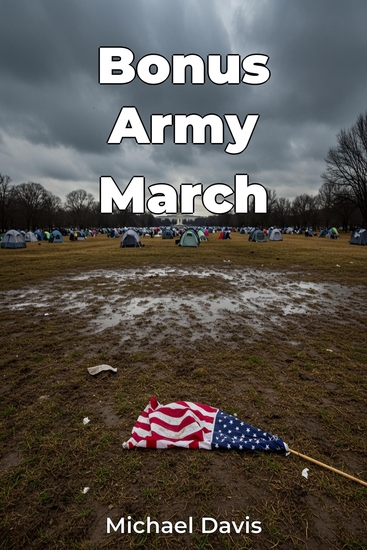
Bonus Army March - cover

Bonus Army March

Michael Davies

Übersetzer A AI

Verlag: Publifye

  • 0
  • 0
  • 0

Beschreibung

"Bonus Army March" examines the 1932 protests in Washington D.C., where World War I veterans sought early payment of their promised bonuses amid the Great Depression. This book uniquely connects the economic desperation of veterans, the political debates surrounding the bonus bill, and the severe consequences of the government's response. The narrative reveals how the Hoover administration's actions contributed to its unpopularity. The book traces the veterans' journey to Washington, their establishment of encampments, and their interactions with Congress. It highlights that the initial bonus legislation was the World War Adjusted Compensation Act in 1924, but as economic hardship intensified, veterans demanded immediate relief. Supported by primary sources like letters and government documents, the book progresses from establishing the historical context of WWI, through the march on Washington, and culminates in the government's controversial eviction of the veterans. It provides a comprehensive account of a pivotal moment in American history, detailing the social movements, veterans' affairs, and the government’s handling of the economic hardship. The book provides a balanced perspective on the events and encourages readers to consider the ongoing debate about the government’s responsibility to its veterans.
Verfügbar seit: 27.02.2025.
Drucklänge: 62 Seiten.

Weitere Bücher, die Sie mögen werden

  • How to Save a Constitutional Democracy - cover

    How to Save a Constitutional...

    Tom Ginsburg, Aziz Z. Huq

    • 0
    • 0
    • 0
    Democracies are in danger. Around the world, a rising wave of populist leaders threatens to erode the core structures of democratic self-rule. In the United States, the tenure of Donald Trump has seemed decisive turning point for many. What kind of president intimidates jurors, calls the news media the “enemy of the American people,” and seeks foreign assistance investigating domestic political rivals? Whatever one thinks of President Trump, many think the Constitution will safeguard us from lasting damage. But is that assumption justified?How to Save a Constitutional Democracy mounts an urgent argument that we can no longer afford to be complacent. Drawing on a rich array of other countries’ experiences with democratic backsliding, Tom Ginsburg and Aziz Z. Huq show how constitutional rules can both hinder and hasten the decline of democratic institutions. The checks and balances of the federal government, a robust civil society and media, and individual rights—such as those enshrined in the First Amendment—often fail as bulwarks against democratic decline. The sobering reality for the United States, Ginsburg and Huq contend, is that the Constitution’s design makes democratic erosion more, not less, likely. Its structural rigidity has had unforeseen consequence—leaving the presidency weakly regulated and empowering the Supreme Court conjure up doctrines that ultimately facilitate rather than inhibit rights violations. Even the bright spots in the Constitution—the First Amendment, for example—may have perverse consequences in the hands of a deft communicator who can degrade the public sphere by wielding hateful language banned in many other democracies. We—and the rest of the world—can do better. The authors conclude by laying out practical steps for how laws and constitutional design can play a more positive role in managing the risk of democratic decline.
    Zum Buch
  • Narrative of the Life of Frederick Douglass: The Original 1845 Edition (The Autobiography Classics Of Frederick Douglass) - cover

    Narrative of the Life of...

    Frederick Douglass

    • 0
    • 0
    • 0
    Narrative of the Life of Frederick Douglass, an American Slave is a powerful and harrowing autobiography that chronicles the early life of Frederick Douglass, who was born into slavery and rose to become one of the most influential voices in the fight for abolition. First published in 1845, the book offers a firsthand account of the brutality and inhumanity of slavery, detailing Douglass’s experiences on plantations, his struggle to learn to read and write, and his courageous escape to freedom. With eloquence and moral clarity, Douglass exposes the hypocrisy of a nation that proclaimed liberty while upholding slavery, making this memoir not only a personal testament but also a foundational work in American literature and civil rights history.
    Zum Buch
  • The Fourth History of Man - cover

    The Fourth History of Man

    MD John Bershof

    • 0
    • 0
    • 0
    In the spirit of medieval writer Chaucer, all human activity lies within the artist’s scope, the History of Man Series uses medicine as a jumping off point to explore precisely that, all history, all science, all human activity since the beginning of time. The jumping off style of writing takes the reader, the listener into worlds unknown, always returning to base, only to jump off again. History of Man are stories and tales of nearly everything. 
    The Fourth History of Man continues with virus infections where The Third History of Man left off hashing-out those specks of genetic schmutz, covering the R-naught of those naughty infectious scoundrels. Some big hitters will be considered, from polio and the famous celebrities that had it, through fifty shades of hepatitis, rabies and the hair of the dog, and the monkey business of HIV and AIDS. Leaving viruses, we’ll delve into a study of parasites, including the parasite of all parasites, Sigourney Weaver’s alien. Opening up a can-of-worms we’ll launch a nerd rumble: who would win between Weaver’s Alien and Schwarzenegger’s Predator. Other topics include the sociology of a social death preceding the actual death, the sociology of sexual cannibalism, and the sociology of colors, not just of yellow fever, but of other emotions under the rainbow, hopefully not making you feel positively blue. On the science side we’ll flip the script on the infamous Krebs cycle fleeced of the boring jargon that usually flows from the lecture hall and our road will scrutinize nuclear bombs, nuclear footballs and weapons of mass destruction, the secret of Ondine’s curse, and lessons in global warming.
    Zum Buch
  • How to Abolish Prisons - Lessons from the Movement against Imprisonment - cover

    How to Abolish Prisons - Lessons...

    Rachel Herzing, Justin Piché,...

    • 0
    • 0
    • 0
    Critics of abolition sometimes castigate the movement for its utopianism, but in How to Abolish Prisons, long-time organizers Rachel Herzing and Justin Piché reveal a movement that has made the struggle for abolition as real as the institutions they are fighting against. 


    Drawing on extensive interviews with abolitionist crews all over North America, Herzing and Piché provide a collective reconstruction of what the grassroots movement to abolish prisons actually is, what initiatives it has launched, how it organizes itself, and how its protagonists build the day-to-day practice of politics. Listeners sit in on the Winnipeg rideshares of Bar None and the meetings of the Chicago Community Bail Fund as they assess the utility of politicized mutual aid. They follow the campaigns and coalitions of Critical Resistance in Oakland and San Francisco and Survived and Punished in New York City, and learn about the prisoner correspondence projects that keep activists behind bars and outside them in constant coordination. 


    Abolitionist campaigns are constructing on-the-ground initiatives across North America to deconstruct carceral society and build resistant communities. Through the words, deeds, and personalities of this beautifully peopled movement, How to Abolish Prisons emerges as a stunning snapshot of a movement's thinking in motion.
    Zum Buch
  • Ukraine and the Art of Strategy - cover

    Ukraine and the Art of Strategy

    Lawrence Freedman

    • 0
    • 0
    • 0
    The Russian invasion of Crimea in 2014, subsequent war in Eastern Ukraine, and economic sanctions imposed by the West transformed European politics. The conflict did not escalate to the levels originally feared but nor was either side able to bring it to a definitive conclusion. Ukraine suffered a loss of territory but was not forced into changing its policies away from the Westward course adopted as a result of the EuroMaidan uprising of February 2014. President Putin was left supporting a separatist enclave as Russia's economy suffered significant damage. 


    Ukraine and the Art of Strategy provides an account of the origins and course of the Russia-Ukraine conflict through the lens of strategy. Lawrence Freedman describes the development of President Putin's anxieties that former Soviet countries were being drawn towards the European Union, the effective pressure he put on President Yanokvych of Ukraine to turn away from the EU, and the resulting "EuroMaidan Revolution" which led to Yanukovych fleeing. He explores the reluctance of Putin to use Russian forces to do more that consolidate the insurgency in Eastern Ukraine, the failure of the Minsk peace process, and the limits of the international response. Putin's strategic-making is kept in view at all times, including his use of "information warfare" and attempts to influence the American election.
    Zum Buch
  • Biafra - History and Atrocities of the Nigerian Civil War - cover

    Biafra - History and Atrocities...

    Kelly Mass

    • 0
    • 0
    • 0
    Biafra, known officially as the Republic of Biafra, emerged as a separatist state in West Africa, enduring from May 1967 to January 1970 when it seceded from Nigeria. 
    Its territory encompassed the former eastern region of Nigeria, predominantly inhabited by the Igbo population, now divided into the present south-south and southeastern regions of Africa. Founded by Igbo nationalists, Biafra arose in response to a series of ethnic hostilities that erupted immediately after Nigeria gained independence in 1960, culminating in the 1966 massacres of Igbos and other southern ethnic groups residing in northern Nigeria. Following Biafra's declaration of independence in 1967, Nigeria's military initiated an attack on the country, sparking the Nigerian Civil War, also known as the Nigerian-Biafran War. 
    Gabon, Haiti, the Ivory Coast, Tanzania, and Zambia have all officially acknowledged Biafra. France, Spain, Portugal, Norway, Rhodesia, South Africa, and the Vatican City were among the countries that withheld recognition from Biafra but provided support and assistance. 
    Biafra received aid from non-state entities such as Joint Church Aid, foreign mercenaries, the Holy Ghost Fathers of Ireland, and Caritas International under their guidance, as well as the United States Catholic Relief Services. In response to the suffering, Médecins Sans Frontières was founded.
    Zum Buch