
Begleiten Sie uns auf eine literarische Weltreise!
Buch zum Bücherregal hinzufügen
Grey
Einen neuen Kommentar schreiben Default profile 50px
Grey
Jetzt das ganze Buch im Abo oder die ersten Seiten gratis lesen!
All characters reduced
Arctic Oil - cover

Arctic Oil

Michael Davies

Übersetzer A AI

Verlag: Publifye

  • 0
  • 0
  • 0

Beschreibung

Arctic Oil examines the multifaceted issues surrounding oil exploration in the Arctic, focusing on the environmental risks, political conflicts, and the exploitation of energy resources. This exploration has significant global implications, affecting not just the fragile ecosystems and indigenous communities, but also international relations and energy security. The book highlights the tension between short-term economic gains and the long-term commitment to environmental sustainability, presenting a critical perspective on current approaches to resource exploitation.

 
The book progresses methodically to build its argument. It begins with a historical overview of Arctic exploration, then examines the environmental risks, such as potential oil spills and greenhouse gases, using scientific data and case studies. It analyzes the political conflicts arising from territorial disputes, competing national interests, and the rights of indigenous communities. Ultimately, it proposes alternative energy strategies to balance environmental sustainability with the needs of various stakeholders.

 
Through scientific research, government reports, and accounts from indigenous communities, the book offers a comprehensive view. It emphasizes the complex interplay between environmental science, political science, economics, and indigenous studies, providing a nuanced understanding of the challenges and opportunities related to Arctic oil and its impact on climate change.
Verfügbar seit: 20.03.2025.
Drucklänge: 69 Seiten.

Weitere Bücher, die Sie mögen werden

  • René Descartes - Rationalism and Meditations on First Philosophy - cover

    René Descartes - Rationalism and...

    Hector Davidson

    • 0
    • 0
    • 0
    René Descartes, often regarded as the father of modern philosophy, revolutionized the intellectual landscape of the seventeenth century. His groundbreaking ideas in mathematics, metaphysics, and epistemology laid the foundation for a new way of thinking, challenging the dominance of Aristotelian scholasticism. Born in 1596 in La Haye en Touraine, France, Descartes displayed an early aptitude for learning. He was educated at the Jesuit College of La Flèche, where he received a rigorous grounding in classical philosophy and mathematics. However, dissatisfied with the prevailing methods of acquiring knowledge, he sought a more systematic and rational approach, leading to his development of the Method of Doubt. 
    Descartes' intellectual pursuits extended beyond philosophy. His contributions to mathematics were equally significant, particularly in the creation of Cartesian geometry, which established a link between algebra and geometry through the use of coordinate planes. This innovation became a cornerstone of modern mathematics and physics, influencing generations of scientists. His emphasis on deduction and reason over mere observation shaped the trajectory of scientific inquiry, reinforcing the idea that true knowledge must be derived from fundamental principles. 
    His most famous philosophical work, Meditations on First Philosophy, published in 1641, sought to establish an unshakable foundation for human knowledge. In this work, he introduced the concept of radical skepticism, questioning the reliability of sensory perception and challenging assumptions about reality. Through this process, he arrived at his famous conclusion, "Cogito, ergo sum" (I think, therefore I am), which he considered the first indubitable truth. From this foundation, Descartes attempted to prove the existence of God and the distinction between mind and body, a theory known as Cartesian dualism.
    Zum Buch
  • The Gospel Crux - The Hidden Torah of Jesus - cover

    The Gospel Crux - The Hidden...

    J K Vaidyan

    • 0
    • 0
    • 0
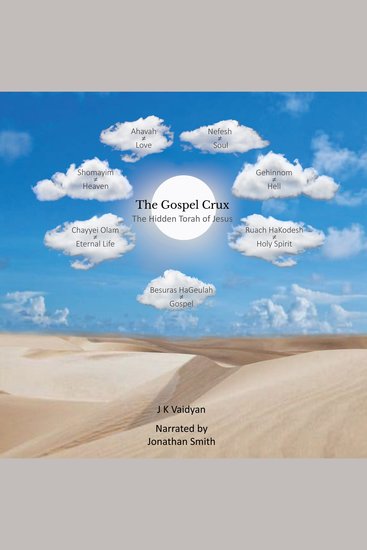
    The Gospel Crux is a fresh look at the teachings of Jesus in the context of their Hebrew origins.The current versions are not working. If they were, the world around us would not keep going to pieces every now and then. Lost in translation, disoriented through cultural appropriation and transmitted across millennia, the versions handed down to us are both enhanced and redacted, far removed from its original context and blurred by the passage of time.Hebrew is a language rich in metaphors and literary devices like synonymous parallelism and hyperbole that emphasize and reinforce key messages. It does not easily lend itself to translation into Greek, Latin or English. The Gospel Crux re-interprets Hebrew words and metaphors used by Jesus to explore what his teachings would have meant to those hearing him firsthand. Words and phrases like Gospel, Heaven, Hell, Love, Soul, Holy Spirit and Eternal Life take on new meanings when viewed from this frame of reference.A key example is the command to love your neighbor as yourself. When asked “who is my neighbor”, Jesus relates the parable of the Good Samaritan. All the characters are strangers to each other. Love does not show up in this parable. Acts of service and of going the extra mile for a stranger are our takeaways. Jesus tops it up with the instruction to go and do likewise.This brings us to the concept of self. “Deny yourself. Take up your cross and follow me.” This is our understanding of what Jesus had said. “Deny yourself” is not two words. “Deny your Self” has three words. And the cross is the execution stake of self-negation. When all of this is read and understood together it reveals a well-kept secret of Jewish, Buddhist, Hindu and Lao Tzu’s philosophies. That our “I” is a story we tell ourselves.Through this alternate rendering of the words of Jesus, The Gospel Crux explores how we can find the peace of God that surpasses all understanding in our lives; the truth that will set your “I” free.
    Zum Buch
  • The Future of the Factory - How Megatrends are Changing Industrialization - cover

    The Future of the Factory - How...

    Jostein Hauge

    • 0
    • 0
    • 0
    For centuries, industrialization and factory-based production have been core ingredients in economic growth, development, and innovation. This symbiotic relationship between industrialization and economic prosperity is now changing. "Megatrends"—trends within the domains of technology, economy, society, and ecology that have a global impact—are changing the ability of the manufacturing sector to serve as the engine of growth, changing traditional ideas of technological progress, and changing growth and development opportunities in both the global South and the global North. 


    Four megatrends are particularly worthy of note: the rise of services, digital automation technologies, globalization of production, and ecological breakdown. In this book, Jostein Hauge provides a novel analysis of how these megatrends are changing industrialization, and charts new pathways for industrial policy and global governance. He also offers a wide-ranging account of the role of technology, globalization, and ecology in shaping the world economy. The Future of the Factory shows that industrialization remains a cornerstone of economic prosperity, but that power asymmetries in the world economy create uneven opportunities for achieving economic growth, development, and industrialization.
    Zum Buch
  • The Zen of Climbing - cover

    The Zen of Climbing

    Francis Sanzaro

    • 0
    • 0
    • 0
    "Outstandingly good … It may be the single most insightful book about climbing ever written."  Paul Sagar, Climber, writer, thinker 
    What do Zen masters, sixteenth-century Samurai, and the world’s elite climbers have in common? 
    They have perfected the of awareness, of being in the moment, of trusting the process. 
    Climbing is a sport of perception, and our successes and failures are matters of mind as much as body. 
    Written by philosopher, essayist, and lifelong climber Francis Sanzaro, The Zen of Climbing explores the fundamentals of successful climbing, delving into sports psychology, neuroscience, philosophy, and Taoism. Awareness, he argues, is the alchemy of climbing, allowing us to merge mental and physical attributes in one embodied whole. 
    This compact volume puts the climber’s mind at the forefront of practice.
    Zum Buch
  • Gujarat Files - Pardaposhi Di Cheerpharh - cover

    Gujarat Files - Pardaposhi Di...

    Rana Ayyub

    • 0
    • 0
    • 0
    "Gujarat Files" by Rana Ayyub is a groundbreaking investigative book that exposes the dark underbelly of the Gujarat riots, fake encounters, and political assassinations. Through a daring covert operation, journalist Rana Ayyub disguised herself as a filmmaker from the American Film Institute Conservatory, adopting the alias Maithili Tyagi. In "Gujarat Files," she interviews high-ranking bureaucrats and senior police officers who held critical roles in Gujarat between 2001 and 2010. These candid conversations reveal shocking details about the state's administration, implicating key figures in controversial events during that period. 
    "Gujarat Files" offers readers an eye-opening account of the power dynamics, the political manipulation, and the systemic corruption that surrounded the Gujarat riots and their aftermath. With gripping revelations, this book has become essential reading for those interested in Indian politics, human rights, and investigative journalism. "Gujarat Files" provides a rare insider's perspective, making it a must-read for anyone seeking to understand the intricacies of the Gujarat riots. Available for worldwide delivery, "Gujarat Files" continues to be a powerful tool for truth-seekers and a reminder of the importance of fearless journalism. 
    You can order it from Sikh Siyasat and get it delivered anywhere in the world.
    Zum Buch
  • On Nothing & Kindred Subjects - cover

    On Nothing & Kindred Subjects

    Hilaire Belloc

    • 0
    • 0
    • 0
    In On Nothing & Kindred Subjects, Hilaire Belloc masterfully blends humor, philosophy, and social commentary in a series of essays that explore seemingly trivial or abstract topics—what he playfully calls "Nothing." With wit and wisdom, Belloc delves into themes like idleness, the absurdities of conversation, and the fleeting nature of modern trends, all while revealing deeper truths about human nature and society. Though lighthearted in title and tone, the book offers sharp critiques of contemporary culture and the loss of enduring values. Rooted in Belloc’s Catholic worldview and love for reason, these reflections encourage readers to see significance in the mundane and to question the emptiness of superficial pursuits. A delightful and thought-provoking read.
    Zum Buch