Join us on a literary world trip!
Add this book to bookshelf
Grey
Write a new comment Default profile 50px
Grey
Subscribe to read the full book or read the first pages for free!
All characters reduced
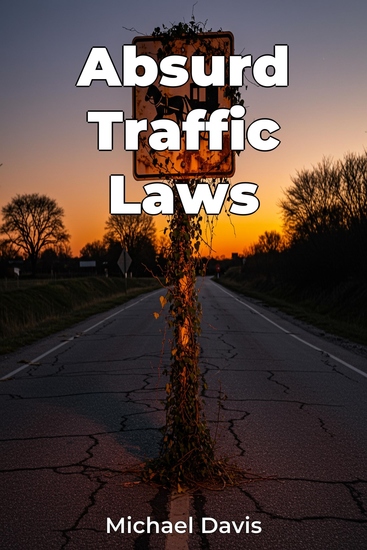
Absurd Traffic Laws - cover

Absurd Traffic Laws

Michael Davies

Translator A AI

Publisher: Publifye

  • 0
  • 0
  • 0

Summary

Absurd Traffic Laws explores the peculiar world of traffic regulations, revealing how historical accidents, political influence, and bureaucratic inertia have led to rules that often defy logic. Many seemingly nonsensical regulations, such as rules about animals crossing roads or outdated speed limits, stem from historical precedents enshrined in legal codes. Political dynamics also play a crucial role; lobbying efforts by various interest groups can result in inefficient or even dangerous traffic laws. The book argues that existing traffic regulations aren't always based on safety or fairness but are unintended consequences of various pressures. Once a law is passed, bureaucratic inertia makes it difficult to change.

 
The book progresses by first introducing traffic law's history and principles, then examining specific examples of absurd laws and their origins, structured around historical legacies, political influences, and bureaucratic processes. This analysis offers a unique perspective by combining historical insights with political commentary, providing practical recommendations for a more rational and effective transportation system. By understanding these underlying causes, readers can advocate for traffic law reform and contribute to a more equitable system.
Available since: 03/29/2025.
Print length: 64 pages.

Other books that might interest you

  • Palmistry - Your Plain & Simple Guide to Reading Destiny in Your Hands - cover

    Palmistry - Your Plain & Simple...

    Sasha Fenton

    • 0
    • 0
    • 0
    Your Plain & Simple Guide to Reading Destiny in Your Hands.   This delightful and practical guide demonstrates how easy it is to read hands for fun and insight. The basic premise here is that our hands provide a glimpse of our personalities, health, strengths, and weaknesses—and even what may happen to us in the future. Each line, mound, and finger is a clue that can easily be deciphered if you have the right information.   In Palmistry, Fenton covers the basics of hand reading, including the lines, mounts, fingers, and thumb. She shows readers how to judge someone’s character, health, love and relationship interests, moneymaking ability, and long-term destiny.   Chapters include:  The Map of the Hand  The Phalanges (bones between the fingers and joints)  The Major Lines  The Minor Lines  Love and Relationships  How to Make Handprints    With this plain and simple guide, you’ll be reading hands like a pro in no time!   This book was previously published as Palmistry Plain & Simple.
    Show book
  • The Meaning of Surah 71 Nuh (Prophet Noah AS) From Holy Quran (El Sagrado Coran) Bilingual Edition English Spanish - cover

    The Meaning of Surah 71 Nuh...

    Jannah Firdaus Mediapro

    • 0
    • 0
    • 0
    Audiobook The Meaning of Surah 71 Nuh (Prophet Noah AS) From Holy Quran (El Sagrado Corán) Bilingual Edition English Spanish. Surah 71 Nuḥ (Prophet Noah AS) is the seventy-first sura of The Holy Quran with 28 ayat. It is about the Islamic prophet Noah (Nuḥ) and his complaint about his people rejecting all warning God gave them through Prophet Noah AS (Nuh). 
     
    In Nuh, the seventy-first surah, The Holy Quran refers to Nuh’s prophethood in snippets. Prophet Nuh AS (Noah) is a messenger of God. When Prophet Nuh AS realizes the messages are not accepted by the community, he supplicated to God. God planned to flood the community of Nuh at a specified time. God commanded Prophet Noah AS (Nuh) to warn the people of the flood. God brings forth the water from the skies to prove Nuh’s message to be accurate. In The Holy Quran, the flood is a symbolization of the mercy of God to the believers. Allah SWT (God) gives the world a new beginning. 
     
    The disbelievers disbelieved God's message and messenger Nuh so they were drowned. Because his people are unable to grasp the idea of the existence of one God, the lives of Prophet Muhammad SAW and Prophet Nuh AS (Noah) are parallel to each other for the time of the revelation of this surah. The surah was used to increase the faith of the believers; it shows that Prophet Nuh AS (Noah) before Prophet Muhammad SAW had difficulties in dealing with the disbelievers of his time. 
     
    The surah is entirely Meccan meaning it was revealed while Prophet Muhammad SAW was trying to create a Muslim community in Mecca. According to the Tanzil version, it was the seventy-first surah revealed. It was revealed after the sixteenth surah, An-Nahl (“The Bee”) and before the fourteenth surah Ibrahim (“Prophet Abraham AS”). According to Noldeke’s version, Nuḥ was the fifty-third surah to be revealed. It was revealed after the thirty-seventh surah Saaffaat (“Those Who Set The Ranks”), and before the seventy-sixth surah, Insaan or Dahr (“Man” or “Time”). Main themes of Surah Nuh's include: belief in One God (Pure Monotheism), signs of God (the Earth, Sun, Moon), and punishment of denying Allah's message.
    Show book
  • British Empire The: A Captivating Guide to the Largest Empire in History and its Impact on the Age of Discovery Transatlantic Slave Trade the Americas India World War 1 and more - cover

    British Empire The: A...

    Captivating History

    • 0
    • 0
    • 0
    For better or worse, the British Empire was the largest empire in human history. Find out how the British cultivated their empire and raised it to magnificent heights. 
    In the Age of Exploration, the British began building an enormous and highly profitable foreign empire. While the British Empire initially lagged behind other European powers such as Spain and Portugal, it still managed to colonize the New World and discover highly-lucrative trade routes. 
    British colonies could be found on virtually any continent. For decades, colonialism was painted as the duty of the more advanced European civilizations. However, a darker truth lurked under the surface. Find out how Britain invaded, colonized, and ruled almost a quarter of the world’s land mass. 
    This audiobook will guide you through the rise and the fall of the mighty British Empire, including:The Age of Exploration and how Britain expanded its empireBritish involvement in the slave tradeThe mystery behind the lost colony of RoanokeThe English civil wars and their impact on the empireA brief look at the Thirteen Colonies and how they achieved independenceA guide to Britain’s role in the Napoleonic WarsThe impact of both world wars on the British empireThe Suez Crisis and its aftermathRising nationalist movements in the 20th centuryA comprehensive explanation of the fall of the British EmpireAnd much, much more! 
    If you want to learn more about the British Empire, then scroll up and click the “add to cart” button!
    Show book
  • Krishna - cover

    Krishna

    Amol Raikar

    • 0
    • 0
    • 0
    In 3228 BCE in Mathura, India, a child was born who was destined to reshape the spiritual and temporal destiny of mankind, Sri Krishna. Mother Earth, unable to bear the burden of sins committed by evil kings and rulers, appealed to Brahma, the Creator for help. Brahma prayed to the Supreme Lord Vishnu, who assured him that he would soon be born on earth to end all the tyranny. Krishna appears as an avatar to free his devotees from material existence and to vanquish evil.
    Show book
  • My First Communal Shower - cover

    My First Communal Shower

    Finn Meller

    • 0
    • 0
    • 0
    When I walked into the newly reconstructed gym, I expected an hour of straightforward exercise—a quick workout to make up for a lazy session earlier that week. The shiny equipment gleamed under the bright lights, promising efficiency. I stuck to what I knew: bicep curls and tricep dips, not venturing into the rest of the mysterious, state-of-the-art machines right away. 
    But when it was time to shower, it was a completely different story. I tried the individual shower but the water was freezing cold, I was about to leave stinky as I noticed the big communal shower where men didn't seem to rush. I was nervous at first, but after what I experienced there... I don't think I'll ever use the shower cabin ever again.
    Show book
  • Political Economy - cover

    Political Economy

    John Ruskin

    • 0
    • 0
    • 0
    John Ruskin was a Victorian-era writer, art critic, and social thinker who wrote extensively on political economy. He was critical of the industrialization and capitalism that were taking hold in Britain during his time, and he believed that these developments were causing great harm to both the natural environment and human society. 
    Ruskin believed that the capitalist system was inherently flawed because it focused solely on maximizing profits and disregarded the well-being of workers, the environment, and society as a whole. He argued that the pursuit of wealth at all costs led to the exploitation of labor, the destruction of natural resources, and the degradation of art and culture. 
    In response to these problems, Ruskin advocated for a different economic system that was more in tune with the needs of people and the environment. He believed that the economy should be organized around the principles of social justice, sustainability, and community. 
    Ruskin's ideas were influential in the development of the Arts and Crafts movement, which sought to promote traditional crafts and design in opposition to the mass-produced goods of industrial capitalism. His critique of the capitalist system also influenced later socialist and environmental movements.
    Show book