Begleiten Sie uns auf eine literarische Weltreise!
Buch zum Bücherregal hinzufügen
Grey
Einen neuen Kommentar schreiben Default profile 50px
Grey
Jetzt das ganze Buch im Abo oder die ersten Seiten gratis lesen!
All characters reduced
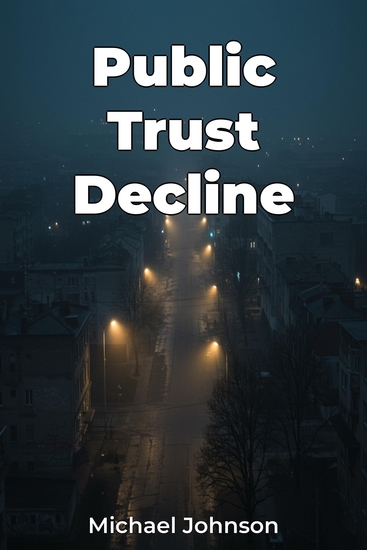
Public Trust Decline - cover

Public Trust Decline

Michael A Johnson

Übersetzer A AI

Verlag: Publifye

  • 0
  • 0
  • 0

Beschreibung

Public Trust Decline examines the widespread erosion of confidence in institutions like government and media, a crucial issue as societal health depends on trust. The book uniquely offers a comparative analysis across different countries, revealing that declining public trust isn't a singular issue but a complex mix of perceived corruption, lack of transparency, and a disconnect between citizens and those in power. Intriguingly, the rise of social media and economic inequality significantly contribute to this decline, fueling political polarization and hindering effective governance. 

 
The book adopts an analytical and objective approach, drawing from diverse sources like public opinion surveys and case studies. Initially, it establishes a historical context, then analyzes survey data to compare trends across various institutions. Subsequent chapters explore specific factors like the role of media, political polarization, and economic inequality. 

 
The final chapters propose actionable solutions, emphasizing transparency, accountability, and ethical leadership to restore faith in institutions, aiming to inform policymakers, journalists, and engaged citizens.
Verfügbar seit: 21.02.2025.
Drucklänge: 85 Seiten.


Weitere Bücher, die Sie mögen werden

  • Theory of Justice A: Book Summary & Analysis - cover

    Theory of Justice A: Book...

    Briefly Summaries

    • 0
    • 0
    • 0
    This is a concise summary and analysis of A Theory of Justice, by John Rawls.
    It is not the original book and is not affiliated with or endorsed by John Rawls.
    Ideal those seeking a quick and insightful overview.
     
    This groundbreaking work reimagines the foundations of modern political philosophy, offering a compelling vision of a fair and just society. Through the innovative concept of the "original position" and the "veil of ignorance," the book argues for principles of justice that prioritize equality, individual rights, and social cooperation. It has become a cornerstone in debates about democracy, ethics, and public policy, influencing generations of thinkers and leaders.
    Zum Buch
  • Lying - Communicating False Information Deliberately - cover

    Lying - Communicating False...

    Cito Harder

    • 0
    • 0
    • 0
    Lying, the deliberate act of communicating false information, has been a part of human behavior for centuries. It is a complex and multifaceted phenomenon that plays a role in many aspects of life, from personal relationships to politics, business, and beyond. While most people recognize lying as morally wrong, it remains a pervasive and unavoidable part of the human experience. This chapter will explore the nature of lying, the different types of lies, and why people engage in this behavior. 
    At its core, lying involves providing information that the speaker knows to be false, with the intent to deceive the listener. Unlike mistakes or misunderstandings, lies are intentional and often involve a conscious decision to mislead. Lying can take many forms, ranging from small, seemingly harmless "white lies" to more harmful and deliberate fabrications designed to achieve personal gain or avoid consequences. While some lies may appear trivial, others can have significant consequences, leading to broken trust, damaged relationships, or even harm to others. 
    The act of lying is not limited to individuals but can also be embedded in larger societal and cultural practices. From politicians who manipulate public opinion to corporations that mislead consumers about the quality of their products, deception is often employed as a tool to achieve power, influence, or financial success. Understanding the motivations behind lying is key to understanding its prevalence and persistence in society. People lie for various reasons: to protect themselves, to avoid punishment, to gain an advantage, or to spare others' feelings. The reasons behind a lie often depend on the context and the perceived consequences of telling the truth.
    Zum Buch
  • Deer Hunting with Jesus - Dispatches from America's Class War - cover

    Deer Hunting with Jesus -...

    Joe Bageant

    • 0
    • 0
    • 0
    By turns tender, incendiary, and seriously funny, this book is a call to arms for fellow progressives with little real understanding of "the great beery, NASCAR-loving, church-going, gun-owning America that has never set foot in a Starbucks." 


    Deer Hunting with Jesus is Joe Bageant's report on what he learned when he moved back to his hometown of Winchester, Virginia. Like countless American small towns, it is fast becoming the bedrock of a permanent underclass. Two in five of the people in his old neighborhood do not have high school diplomas or health care. Alcohol, overeating, and Jesus are the preferred avenues of escape. 


    He writes of: 


    ● His childhood friends who work at factory jobs that are constantly on the verge of being outsourced 


    ● The mortgage and credit card rackets that saddle the working poor with debt 


    ● The ubiquitous gun culture—and why the left doesn't get it 


    ● Scots Irish culture and how it played out in the young life of Lynddie England
    Zum Buch
  • Unequal - How extreme inequality is damaging democracy and what we can do about it - cover

    Unequal - How extreme inequality...

    David Buckham, Robyn Wilkinson,...

    • 0
    • 0
    • 0
    ‘Twenty-first-century capitalism and the democracies that enabled it are self-destructing... a sobering ― and impeccably researched ― warning of what is likely to come next’ Bruce Whitfield  
    The leading lights of the tech revolution – Gates, Bezos, Zuckerberg, Musk – have been hailed as savants and saviours of the modern age. And yet they are at the forefront of wealth inequality not seen since the heyday of the robber barons in the late 19th century, part of the slide to the First World War. Today, rampant inequality is inciting social unrest and undermining faith in the institutions of the democratic state. Citizens have been left at the mercy of unfettered capitalism – mere data subjects, endlessly surveilled, marshalled and increasingly angry and polarised. 
    The decoupling of capitalism from democracy has fostered an economic system seemingly powered by greed alone, with the marginalisation of democratic principles facilitating the rise of authoritarians and populists like Putin, Xi Jinping, Trump and Boris Johnson. 
    How has it come to this? And does the unanticipated fightback in Ukraine, with support from the West, show us the way to reclaiming the lost spirit of freedom inherent in liberal democracy?
    Zum Buch
  • World War III: Humanity Sacrificed - The Hidden Architecture of Global Collapse - cover

    World War III: Humanity...

    Murat Aibassov

    • 0
    • 0
    • 0
    World War III: Humanity Sacrificed is a chilling yet deeply analytical exploration of how the modern world collapsed into global conflict — and why it was inevitable. Written by Murat Aibassov, an engineer who predicted the war more than a decade before it began, the book exposes the hidden architecture of global systems, the cyclic nature of civilizational collapse, and the elite mechanisms that shape history behind the scenes. 
    Blending geopolitics, economics, technology, and ritual dynamics, Aibassov reveals why global crises unfold with mathematical precision — and what humanity must understand to survive what comes next. 
    This is not a book of fear. 
    This is a book of patterns, truth, and the last chance to prepare for the world after the catastrophe.
    Zum Buch
  • The White Allies Handbook - 4 Weeks to Join the Racial Justice Fight for Black Women - cover

    The White Allies Handbook - 4...

    Lecia Michelle

    • 0
    • 0
    • 0
    You've read White Fragility and How to Be an Antiracist, but what comes next? The answer lies in this clear, actionable guide providing an invaluable four-week program for becoming an ally who makes a real difference in the racial justice fight. 


    Black women have always been the driving force behind real change in this country—especially when it comes to racial justice work. But they shouldn't have to do it alone. If you're ready to stop standing on the sidelines and become anti-racist instead of passively "not racist," then this book is what you need. You'll discover: how to have difficult conversations about white supremacy, racism, and white privilege; how to listen to criticism without defensiveness; why it's harmful to ignore race or claim to be colorblind; and how to expand your racial justice circle by joining groups led by Black women and cultivating a group of like-minded allies. 


    Racism can only be defeated if white people educate themselves and actively engage in antiracism work, especially in their inner circles. With this book, you'll learn how to change from someone who defends and protects racism to someone who fights against it. And you'll become an example to others that true allies are made, not born.
    Zum Buch