Begleiten Sie uns auf eine literarische Weltreise!
Buch zum Bücherregal hinzufügen
Grey
Einen neuen Kommentar schreiben Default profile 50px
Grey
Jetzt das ganze Buch im Abo oder die ersten Seiten gratis lesen!
All characters reduced
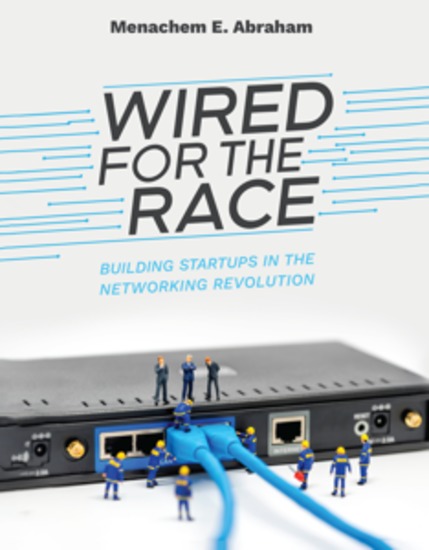
Wired For The Race - Building Startups In The Networking Revolution - cover

Wired For The Race - Building Startups In The Networking Revolution

Menachem E. Abraham

Verlag: Spines

  • 0
  • 0
  • 0

Beschreibung

Step into the thrilling early days of the digital age — a time when "dumb terminals" gave way to personal computers and the modern Internet was just a glimmer on the horizon. In this firsthand account, electrical engineer and entrepreneur Menachem E. Abraham takes you behind the scenes of the networking revolution that transformed the world.Follow the rise of three trailblazing Massachusetts-based startups — Chipcom, Prominet, and Mintera — each founded during pivotal moments in computer networks and Internet history. With gripping insights and honest reflections, Abraham explores the challenges, breakthroughs, and lessons learned while helping to shape the future of this industry.Whether you're an aspiring entrepreneur, a business student hungry for real-world case studies, or a tech enthusiast curious about the origins and evolution of the connected world we live in today, “Wired for the Race”offers a compelling blend of history, entrepreneurship, innovation, and inspiration. A must-read for anyone who’s ever wondered how the world got wired.
Verfügbar seit: 30.06.2025.
Drucklänge: 228 Seiten.

Weitere Bücher, die Sie mögen werden

  • Can Human Problems Be Solved? - Brockwood Park 1980 - Dialogue 15 - cover

    Can Human Problems Be Solved? -...

    Jiddu Krishnamurti

    • 0
    • 0
    • 0
    "Can human problems be solved? - 27 September 1980 
    • Why have human beings throughout the world not been able to resolve human, 
    daily problems of life? What are the things that prevent the solution of these 
    problems completely? 
    • When there is attention there is no centre from which I attend. 
    • A poor man wants to be rich and a rich man wants to be richer. It is a movement 
    of becoming, becoming, both outwardly and inwardly. Though it brings a great deal of pain and sometimes pleasure, this sense of becoming, fulfilling, achieving psychologically has made my life into all that it is. 
    • Is love something that is common to all of us? 
    • From the particular move to the general, from the general move away still 
    deeper, and there perhaps is this purity of that thing called compassion, love and intelligence. But that means giving your mind and heart to this. Your whole being must be involved in this."
    Zum Buch
  • Jeremiah - The World English Bible Book 24 (Unabridged) - cover

    Jeremiah - The World English...

    Various Authors

    • 0
    • 0
    • 0
    Jeremiah (c. 650 - c. 570 BC), also called the "weeping prophet", was one of the major prophets of the Hebrew Bible. According to Jewish tradition, Jeremiah authored the Book of Jeremiah, the Books of Kings and the Book of Lamentations, with the assistance and under the editorship of Baruch ben Neriah, his scribe and disciple. In addition to proclaiming many prophecies of Yahweh, the God of Israel, the Book of Jeremiah goes into detail regarding the prophet's private life, his experiences, and his imprisonment. Judaism and Christianity both consider the Book of Jeremiah part of their canon. Judaism regards Jeremiah as the second of the major prophets. Christianity holds him to be a prophet and his words are quoted in the New Testament. Islam also regards Jeremiah as a prophet and his narrative is recounted in Islamic tradition.
    Zum Buch
  • Demetrius - Sacker of Cities - cover

    Demetrius - Sacker of Cities

    James Romm

    • 0
    • 0
    • 0
    A portrait of one of the ancient world’s first political celebrities, who veered from failure to success and back again 
     
    The life of Demetrius (337–283 BCE) serves as a through-line to the forty years following the death of Alexander (323–282 BCE), a time of unparalleled turbulence and instability in the ancient world. With no monarch able to take Alexander’s place, his empire fragmented into five pieces. 
     
    Capitalizing on good looks, youth, and sexual prowess, Demetrius sought to weld those pieces together and recover the dream of a single world-state, with a new Alexander—himself—at its head. He succeeded temporarily, but in crucial, colossal engagements—a massive invasion of Egypt, a siege of Rhodes that went on a full year, and the Battle of Ipsus—he came up just short. He ended his career in a rash invasion of Asia, and he became the target of a desperate manhunt only to be captured and destroyed by his own son-in-law.
    Zum Buch
  • "Are You Calling Me a Racist?" - Why We Need to Stop Talking about Race and Start Making Real Antiracist Change - cover

    "Are You Calling Me a Racist?" -...

    Sarita Srivastava

    • 0
    • 0
    • 0
    Despite decades of anti-racism workshops and diversity policies in corporations, schools, and nonprofit organizations, racial conflict has only increased in recent years. "Are You Calling Me a Racist?" reveals why these efforts have failed to effectively challenge racism and offers a new way forward. 


    Drawing from her own experience, as well as extensive interviews and analyses of contemporary events, Sarita Srivastava shows that racial encounters among well-meaning people are ironically hindered by the emotional investment they have in being seen as good people. Diversity workshops devote energy to defending, recuperating, educating, and inwardly reflecting, with limited results, and often make things worse. These "Feel-Good politics of race," Srivastava explains, train our focus on the therapeutic and educational, rather than on concrete practices that could move us towards true racial equity. In this type of approach to diversity training, people are more concerned about being called a racist than they are about changing racist behavior. 


    "Are You Calling Me a Racist?" is a much-needed challenge to the status quo of diversity training, and will serve as a valuable resource for anyone dedicated to dismantling racism in their communities, educational institutions, public or private organizations, and social movements.
    Zum Buch
  • EU-Africa digital partnership - Strategic pathways through the Mattei plan and global gateway - cover

    EU-Africa digital partnership -...

    Marianna Lunardini, Darlington...

    • 0
    • 0
    • 0
    By 2050, Africa's population is projected to reach approximately 2.5 billion people. By the end of the 21st century, the African continent will account for 40.6 per cent of the world's working age population, underscoring an urgent need to create at least 20 million new jobs annually. These demographic transformations present both opportunities and challenges for EU-Africa cooperation under both the Mattei Plan and Global Gateway frameworks. For Africa in particular, the digital sector has the potential to drive innovation, spur economic growth, empower rural communities, foster continental integration and accelerate progress towards achieving Sustainable Development Goals (SDGs) and Agenda 2063. At the same time, Africa's digital transformation is sparking discussion over asymmetric power relations that mirror past historical injustices. With majority of digital infrastructure, platforms and services originating either in China, North America and to a lesser extent Western Europe, questions around technological dependency, lack of transparency, data sovereignty and the risks of perpetuating "digital colonialism" have come to the fore. The EU-Africa digital partnership under Mattei Plan and Global Gateway frameworks can serve as catalysts for strengthening African agency by enhancing digital governance frameworks, investing in targeted capacity-building programmes and mobilising resources to bridge infrastructure and financing gaps.
    This edited volume aims to provide rigorous analysis of the main challenges and opportunities for digital cooperation and partnership between the EU and Africa through two key European policy instruments, the EU Global Gateway and Italy's Mattei Plan. The volume situations EU-Africa digital partnership within a broader digital landscape increasingly being shaped by geopolitical and geo-economic rivalry among global powers enabling informed analysis of the EU-Africa partnership on the global geopolitical chessboard. The analysis focuses on four macro-themes: (i) digital governance frameworks and policy, (ii) technological control and data sovereignty, (iii) digital infrastructure gaps, and (iv) opportunities and challenges for Italy-EU-Africa digital partnership going into the future. Furthermore, the book delves into the current state of global digital landscape from the perspectives of both Africans and Europeans and contains nuanced and targeted recommendations for strengthening the EU-Africa digital partnership.
    Zum Buch
  • The Existentialist's Survival Guide - How to Live Authentically in an Inauthentic Age - cover

    The Existentialist's Survival...

    Anonym

    • 0
    • 0
    • 0
    Existentialism offers enduring lessons and insight on how to understand ourselves and improve our lives. 
    Your existence is not the result of a pre-determined set of events, it’s the direct result of your thinking and your actions, and therefore, according to Soren Kierkegaard, Frederick Nietzsche, Albert Camus, and other Existentialist philosophers, you have the freedom to control the outcome of your existence—sophisticated ""philosophy meets psychology"" self-help for the twenty-first-century. 
    As Kierkegaard and his ilk made clear in their respective works, human beings are moody creatures. Rather than understanding moods such as anxiety and depression as afflictions that can only be treated with a pill, the Existentialists regard these troublesome feelings as instructive, something revealing about what it means to be human. The Existentialists believed that how we negotiate our emotional ups-and-downs plays an important hand in the lives we sculpt for ourselves. 
    While offering listeners a useful primer on Existentialism as an animating body of thought, Marino distills and delivers the life-altering and, in some cases, life-saving insights Kierkegaard, Nietzsche, Camus, and other Existentialists articulate for becoming more emotionally attuned human beings. Enhancing our sense of meaning in the midst of an uncertain world, Marino interjects gripping anecdotes from his own experiences to demonstrate how we can use existentialist thought to ignite truly transformative experiences.
    Zum Buch