Rejoignez-nous pour un voyage dans le monde des livres!
Ajouter ce livre à l'électronique
Grey
Ecrivez un nouveau commentaire Default profile 50px
Grey
Abonnez-vous pour lire le livre complet ou lisez les premières pages gratuitement!
All characters reduced
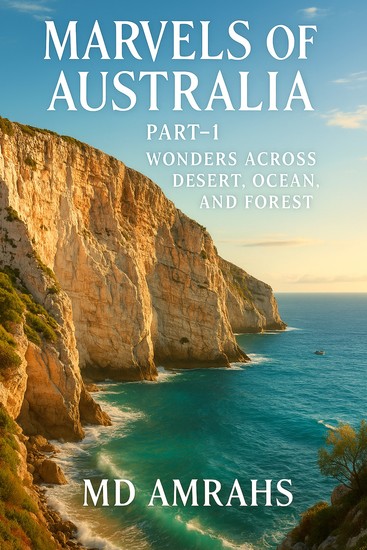
Marvels of Australia - Part-1 - cover

Marvels of Australia - Part-1

MD Amrahs

Maison d'édition: Publishdrive

  • 0
  • 0
  • 0

Synopsis

This book series invites readers on a vivid journey through Australia’s lesser-known natural and historical wonders. From fiery desert rocks and shipwrecks on remote coasts to ancient trees and hidden caves, each site is a story waiting to be discovered. Through friendly, accessible language, the book blends nature, history, and culture—explaining geological marvels, ecological secrets, and human connections without heavy jargon. Readers will encounter passionate local guides, Indigenous custodians, and rangers who bring these places to life with real voices and useful insights. Whether you’re planning a trip, studying Australian geography, or simply exploring from your armchair, the book offers inspiration and practical tips alike. Each chapter stands alone, offering flexible reading across regions—from Tasmania’s islands to the Wollemi wilderness. By revealing the beauty and depth of places often overlooked, the series opens doors to Australia’s heart—raw, majestic, and full of quiet surprises.
Disponible depuis: 24/06/2025.
Longueur d'impression: 200 pages.

D'autres livres qui pourraient vous intéresser

  • Through a Crooked Lens - cover

    Through a Crooked Lens

    Monte Dwyer

    • 0
    • 0
    • 0
    “He views life with a Jack Nicholson like, quizzical overview, a Why is this thus? disdain.” Ted Egan 
    Entertaining account of Monte struggling to come to grips with Sunrise, technology and a newly-acquired 4WD bus determined to kill him. 
    Monte’s amusing transition from mainstream television to freelance multimedia something-or-other; stories edgier and more chaotic than the first book, a touch of restrained madness here.
    Voir livre
  • You Like a Pho? and Other Itchy Feet Travel Tales - A Whimsical Walkabout in Asia - cover

    You Like a Pho? and Other Itchy...

    Sam Letchworth

    • 0
    • 0
    • 0
    Have you ever wondered where horse milk vodka comes from? Or how to fight off a mob of Malaysian monkeys? Is it bad luck to wash cow poop off of your shoe? Travel vicariously with Sam across the Orient to find the funny but true answers. 
    Sam savors every local culture he encounters much like Conan O’Brian and the late Anthony Bourdain—embracing the people, their food, and especially their curiosities. His humor and infatuation with humanity’s diversity fuel each story. 
    Teaching in Korea and Vietnam since 2015, Sam uses his time out of the classroom to explore the rest of Asia. His five-book series, Itchy Feet Travel Tales in Asia, covers his adventures (and misadventures) in Cambodia, China, India, Indonesia, Japan, Korea, Malaysia, Mongolia, Myanmar, Russia, South Korea, Thailand, and Vietnam. 
    Narrated by the author, these stories of the sublime and the surreal will have you giggling and gawking as you follow Sam through the weird and wonderful world of the East.
    Voir livre
  • Ancient Egypt - Pharaohs Pyramids and the Cradle of Civilization - cover

    Ancient Egypt - Pharaohs...

    Rolf Hedger

    • 0
    • 0
    • 0
    The Nile River was the lifeblood of ancient Egypt, shaping its civilization, economy, and culture. Flowing over 4,000 miles from the heart of Africa to the Mediterranean Sea, the river provided a reliable source of water in an otherwise arid landscape. Without the Nile, Egypt as we know it would not have existed. 
    Each year, the river’s annual flooding deposited nutrient-rich silt onto the surrounding land, creating fertile soil ideal for agriculture. This natural cycle allowed the Egyptians to grow crops such as wheat, barley, and flax, sustaining a thriving population. The predictability of the flooding led to the development of an agricultural calendar, which played a crucial role in the organization of society. Farmers planted their crops after the waters receded and harvested them before the next flood, ensuring a steady food supply. 
    Beyond agriculture, the Nile was also Egypt’s main highway. With deserts on either side of the river, travel by land was difficult, but the Nile provided an efficient means of transportation. Boats carried goods, people, and even large stone blocks for temple and pyramid construction. Trade flourished as the Egyptians exchanged gold, papyrus, and linen for exotic products from neighboring regions, including spices from the east and cedarwood from Lebanon.
    Voir livre
  • Pages From My Passport - cover

    Pages From My Passport

    Amelia Dalton

    • 0
    • 0
    • 0
    Amelia Dalton, fresh from touring the Scottish islands, takes on the world and sets up exclusive holidays in remote places for a new cruise ship. As she scopes out her itineraries, she explores inaccessible islands and survives a hotel fire, a bomb in a palace, being stung by a scorpion and thrown into jail. Meanwhile, she’s being wooed from afar by a mysterious stranger who turns up in the most unexpected places.
    Voir livre
  • Becoming a Travel Nurse - Everything You need to Know - cover

    Becoming a Travel Nurse -...

    Patrice M Foster

    • 0
    • 0
    • 0
    Have you always wondered if travel nursing would be a good fit for you as an RN? Have you had questions about how to become a travel nurse, and what it takes to become a successful and fulfilled one? 
    Have you been wondering about the other side of travel nursing that no one talks about, and you want to know everything before you commit to this career path? 
    Have you been experiencing difficulties with settling in your assignments and seeking advice, on what you can do better? 
    In this book, you will learn everything there is to know about travel nursing – most of which is never said out loud. Written by an experienced travel nurse, who has been on this journey and knows the path so well, the lessons are invaluable; they are real and practical in the real world of a traveling nurse! 
    If you have been looking for the truth regarding this career path, and only getting bread cramps of truth, then this book is a honest blueprint for the journey of a travel nurse. 
    Have you been wondering; 
    What does it take to become a travel nurse? 
    What is the negative side of this career path, and how can I survive it? 
    How do I ensure that I work with the right agency and sign contracts that fulfill my needs? 
    How do I make settling down in new locations smooth and save money and time? 
    How do I handle the downsides such as housing issues, license troubles, hostile environments, socializing problems etc. that are common in a travel nurses ‘nomad’ life? 
    If you have these and other related questions, you will find legitimate answers in this book.
    Voir livre
  • Egyptian Symbolism - The Meaning and Use of Symbols in Ancient Culture - cover

    Egyptian Symbolism - The Meaning...

    Omar Khalil

    • 0
    • 0
    • 0
    Egyptian symbolism is one of the most captivating aspects of ancient Egyptian culture, reflecting their deeply spiritual worldview and providing insight into their daily lives, religious practices, and understanding of the universe. From the majestic pyramids to the intricate hieroglyphs on temple walls, symbolism played a crucial role in conveying meanings that went beyond the literal. It was a tool to communicate with the gods, mark divine power, and ensure continuity in both life and the afterlife. 
    At the heart of Egyptian symbolism was the belief that the world was filled with hidden meanings and spiritual forces, each symbol carrying its own power. This belief was manifested in art, architecture, rituals, and even the everyday objects used by the ancient Egyptians. Symbols were not just representations; they were believed to hold an active force that could influence the material world and the spiritual realm. For example, the Ankh, a symbol resembling a cross with a loop at the top, represented life and was often used in funerary texts to ensure immortality for the deceased. 
    In Egyptian society, symbols were central to religious practices. The gods and goddesses, each represented by specific symbols and animal forms, embodied different aspects of life, death, and the cosmos. The sun god Ra, for instance, was depicted as a falcon, symbolizing both the sun’s power and the bird's dominance in the sky. The scarab beetle, a symbol of rebirth and protection, was commonly used in amulets and artifacts, signifying the cyclical nature of life and the hope for resurrection.
    Voir livre