Begleiten Sie uns auf eine literarische Weltreise!
Buch zum Bücherregal hinzufügen
Grey
Einen neuen Kommentar schreiben Default profile 50px
Grey
Jetzt das ganze Buch im Abo oder die ersten Seiten gratis lesen!
All characters reduced
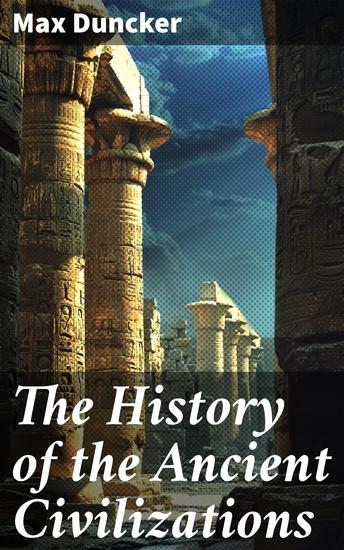
The History of the Ancient Civilizations - Egypt Assyria Phoenicia Israel Babylon Lydia Arians Buddhists and Brahmans The Medes and Persians… - cover

The History of the Ancient Civilizations - Egypt Assyria Phoenicia Israel Babylon Lydia Arians Buddhists and Brahmans The Medes and Persians…

Max Duncker

Übersetzer Evelyn Abbott

Verlag: Good Press

  • 0
  • 0
  • 0

Beschreibung

In "The History of the Ancient Civilizations," Max Duncker offers a comprehensive exploration of the formative cultures that shaped human history. Through a meticulous synthesis of archaeological findings and historical narratives, Duncker delves into the intricate social, political, and economic frameworks of ancient societies, including Mesopotamia, Egypt, and the Indus Valley. His scholarly approach is characterized by a clear and engaging narrative style, making complex information accessible while maintaining rigorous academic standards. Positioned within the 19th-century historiographical context, this work reflects a burgeoning interest in empirical research and the development of comparative history, situating ancient civilizations within a broader narrative of human achievement and progress. Max Duncker, a distinguished historian of his time, drew on his extensive studies across various disciplines, including archaeology, anthropology, and philology, to craft this seminal text. His passion for understanding the interconnections between cultures and the evolution of societies likely influenced his comprehensive perspective. Duncker'Äôs commitment to academic rigor and the accessibility of historical inquiry paved the way for future scholars in the field. This book is highly recommended for both students and aficionados of history, offering invaluable insights into the complexities of ancient civilizations. Duncker'Äôs engaging prose not only enlightens readers about the past but invites reflection on the enduring legacies of these foundational cultures in contemporary society.
Verfügbar seit: 17.12.2023.
Drucklänge: 2119 Seiten.

Weitere Bücher, die Sie mögen werden

  • A Beginner's Guide to Learning Spanish - Spanish Made Easy: Language Lessons from Beginner or Basic Spanish to Intermediate Common Phrases Sentences and Vocabulary - cover

    A Beginner's Guide to Learning...

    Jackson Miller

    • 0
    • 0
    • 0
    Embark on a thrilling language-learning journey with "Spanish Mastery," 
    "Spanish Mastery" adopts a carefully structured approach, starting with fundamental concepts for beginners and gradually progressing to more complex topics for intermediate learners. Each chapter builds upon the previous one, ensuring a smooth transition through the language-learning process. 
    Interactive Exercises and Activities: 
    Reinforce your understanding of Spanish through a variety of interactive exercises and activities. From vocabulary-building games to real-life scenarios, these hands-on tasks make learning enjoyable and effective, allowing you to apply your knowledge in practical situations. 
    Cultural Insights: 
    Immerse yourself in the Spanish-speaking world by exploring the cultural nuances embedded in the language. Discover the customs, traditions, and idioms that deepen your understanding, making your language skills more authentic and culturally aware. 
    Grammar Made Simple: 
    Tackle the often intimidating realm of grammar with user-friendly explanations and examples. From verb conjugations to sentence structure, "Spanish Mastery" breaks down complex grammar rules into manageable segments, empowering learners to grasp these essential elements quickly. 
    Comprehensive Vocabulary Lists: 
    Build a strong foundation in Spanish vocabulary with extensive word lists categorized by themes and difficulty levels. Whether you're a beginner looking to expand your basic vocabulary or an intermediate learner aiming for fluency, these lists are invaluable resources.: 
    Dive into authentic dialogues and conversations that mirror real-life scenarios. This approach helps you develop practical communication skills, enabling you to converse confidently with native speakers.
    Zum Buch
  • A Book of Balance - Kogi Wisdom for a Good Life and Thriving Earth - cover

    A Book of Balance - Kogi Wisdom...

    Lucas Buchholz

    • 0
    • 0
    • 0
    2025 NAUTILUS BOOK AWARDS GOLD WINNER 
    “A Book of Balance should be read by every architect, engineer, manager, leader, and anyone with authority in the creation of our modern world... Everyone can benefit from this book and the ancient wisdom it offers."" — Garden Marcus, author of How to Grow 
    We all need answers for how to live our best lives. We want to settle our souls. 
    For centuries, the Kogi have lived in seclusion in Colombia’s remote Sierra Nevadas, known as “the heart of the world.” Now a few emissaries from the tribe have emerged to bring an urgent and loving message to the West—advice on how to live in harmony with the earth. 
    Lucas Buchholz was invited to their home to receive and transcribe this message and guidance. A Book of Balance takes us on a journey into a startlingly beautiful landscape and into a sacred fireside circle where members consider key questions, including:What Did You Plant? What Did You Harvest?How Will We Pass the Knowledge On to Our Children?What Does It Mean to the World That I Am Here? 
    In this slim volume of spiritual introspection, they ask us to share in their practice, posing nine questions that focus our minds and hearts on who we are, who we can become. 
    A beautiful book to own, to share with friends, and discuss in community. For readers of The Book of Hygge and Ikigai—books that bring the wisdom of other cultures to our own.
    Zum Buch
  • Avoiding the Worst - How to Prevent a Moral Catastrophe - cover

    Avoiding the Worst - How to...

    Tobias Baumann

    • 0
    • 0
    • 0
    How can we avoid worst-case scenarios? 
    From Nineteen Eighty-Four to Black Mirror, we are all familiar with the tropes of dystopian science fiction. But what if worst-case scenarios could actually become reality? And what if we could do something now to put the world on a better path? 
    In Avoiding the Worst, Tobias Baumann lays out the concept of risks of future suffering (s-risks). With a focus on s-risks that are both realistic and avoidable, he argues that we have strong reasons to consider their reduction a top priority. Finally, he turns to the question of what we can do to help steer the world away from s-risks and towards a brighter future.
    Zum Buch
  • Working with Emotional Intelligence - cover

    Working with Emotional Intelligence

    Richard Menk

    • 0
    • 0
    • 0
    Working with Emotional Intelligence: Understand How Emotional Intelligence Plays a Crucial Part in the Success of Businesses Today!Emotional intelligence plays a significant role in the professional success of a person. It is directly linked to performance and serves a powerful purpose in enabling you to focus your energy in a single direction to produce massive results. Emotional intelligence is believed to be the best indicator of workforce success when compared to other important workplace skills.This audiobook will teach you about emotional intelligence and how it relates to a person’s ability to achieve success and how it can affect the success of businesses these days.Topics that will be covered are the following:- What is Emotional Intelligence- Why is EQ Important?- Why is EQ Important in Business?- How to Improve Your EQ- And many more!Fortunately, even if you weren’t naturally born with a high EQ, you will be able to manage your emotions productively and healthily with some practice. To learn more, scroll up and click “add to cart” now!
    Zum Buch
  • Mamerto Gueritz - A Country Catholic 1823–1912 - cover

    Mamerto Gueritz - A Country...

    David Gunn-Johnson

    • 0
    • 0
    • 0
    This is the story of Mamerto Gueritz, a country priest in the second half of the nineteenth century. His is a fascinating tale, with the adventures of his father and grandfather in Spain and the subsequent deeds of his children, framing the story of the man himself.
    
     
    However, Mamerto Gueritz also offers an illustration of the ways in which the Catholic Revival in the Church of England, the Oxford Movement, spread and took root in the remotest corners of the kingdom. His story tells a much wider tale of the renewal of the Church, the revival of a glorious liturgical heritage and the search for holiness which, for Gueritz and many of his peers, was the driving force behind it all.
    
     
    Mamerto’s father had been an officer in the Royal Guard of Spain but his opposition to the absolutism of Ferdinand VII meant that he and his family had to flee. The period between the time of Gueritz’ arrival as an infant refugee from Spain in 1823 and his death in 1912 may indeed be seen as the time of the emergence and flowering of what became known as the Oxford Movement. However, it was also a time of great conflict and change both in the Church and in society. Such change was not without cost and Mamerto Gueritz shared in it all, both in the battles in London and in his country parish, which proved anything but a safe haven.
    
     
    The reader with a straightforward love of history will find Mamerto’s story a significant addition to their store of knowledge. Those who read widely in Church history, particularly that of the nineteenth century, may find that what seems like familiar ground can be anything but!  The student of the Oxford Movement and the catholic heritage of the Church of England may yet find some further insight from hitherto unreported events and in Mamerto Gueritz find also an encouragement for the work of today.
    Zum Buch
  • Evolution Is Wrong - A Radical Approach to the Origin and Transformation of Life - cover

    Evolution Is Wrong - A Radical...

    Erich von Däniken

    • 0
    • 0
    • 0
    A Fascinating Exploration on Why the Darwinists’ Theory No Longer Explains EverythingThere was once a set of ideas called the theory of evolution, conceived by clever people and confirmed by countless scientists. Then people discovered the electron microscope. This made it possible to make the molecules within the cell visible, and suddenly questions about evolution arose that were not possible before. Which force actually bundles the atoms in the right order? What moves the molecular chains into the correct position? How did the first living unit within the cell actually come about? How does inheritance work, how does information pass on to the next generation? Did humans descend only and exclusively from primates—as Charles Darwin and countless other great minds assumed—or did additional “engines” intervene in evolution? Today it is clear: countless questions can no longer be answered with the previous theory of evolution. There is a form of life called “Blob” (Physarum polycephalum). The “thing” has neither eyes nor ears, neither a mouth nor a nose or even a brain. Nevertheless, it takes in food, overcomes obstacles by the shortest route and exchanges information with other “blobs.” The “blob” contradicts any evolutionary thought that one develops from the other. Or the “gastric-brooding frogs” (Rheobatrachus) found in Australia. They hatch their young in the stomach. Impossible in a slow, evolutionary process. Everywhere there are characteristics of animals that do not want to fit into the theory of evolution anywhere. And man? Are we really the most adapted life-form on this planet? Today, more and more scientists who contradict the previous theory of evolution speak out. The theory fits the changes within the species, but it can no longer be reconciled with the inner workings of the cell. Some other influence that has so far escaped us is affecting evolution. It is called “Intelligent Design.” Intelligent planning is suspected behind this. Anyone or anything—a spirit of the universe? Aliens?—could be behind this planning. Erich von Däniken uses countless examples to demonstrate the impossibility of the previous evolutionary idea. He quotes scientists who argue against the previous teaching, but also those who defend it. Unfortunately, established science still refuses to look at discrepancies and holes in the theory of evolution, even though it is quite obvious that there is more going on with regard to the development of all species, as well as human culture, than could be explained by the theory of evolution alone.
    Zum Buch