Begleiten Sie uns auf eine literarische Weltreise!
Buch zum Bücherregal hinzufügen
Grey
Einen neuen Kommentar schreiben Default profile 50px
Grey
Jetzt das ganze Buch im Abo oder die ersten Seiten gratis lesen!
All characters reduced
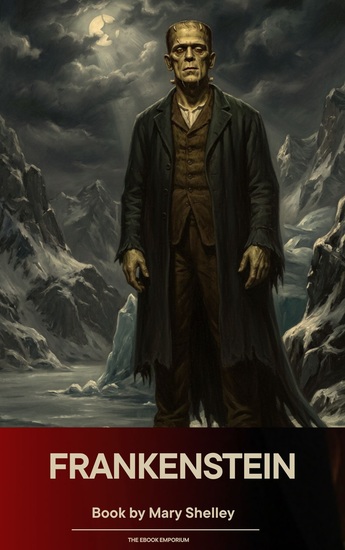
Frankenstein - cover

Frankenstein

Mary Shelley

Verlag: The Ebook Emporium

  • 0
  • 0
  • 0

Beschreibung

"Beware; for I am fearless, and therefore powerful."

Victor Frankenstein, a brilliant and obsessed scientist, discovers the secret of imparting life to inanimate matter. From a collection of scavenged parts, he assembles a being—but upon its awakening, he is struck by horror at the "miserable monster" he has created. Abandoned by his maker and shunned by a fearful society, the Creature wanders the world in search of kindness, only to find rejection. What follows is a tragic game of cat-and-mouse that stretches from the halls of Ingolstadt to the icy wastes of the Arctic, as the creator and the created battle for dominance, revenge, and understanding.

The Modern Prometheus: Shelley draws a parallel to the Greek myth of Prometheus, who stole fire from the gods. Victor's "fire" is the spark of life, and his tragedy lies in his inability to handle the consequences of playing God. The novel poses a question that remains vital in the age of AI and genetic engineering: just because we can create life, should we?

The Human Monster: While popular culture often depicts "Frankenstein" as a mindless brute, Shelley's original Creature is articulate, sensitive, and deeply philosophical. His descent into violence is a searing critique of how society creates its own monsters through cruelty and isolation.

Why It Endures: Frankenstein is a multifaceted gem of literature. It is a cautionary tale, a psychological thriller, and a heartbreaking tragedy all in one. It challenges our definitions of beauty and humanity, leaving readers to wonder: who is the true monster—the creature, or the man who gave him life and then turned away?

Face the creation that changed literature forever. Purchase "Frankenstein" today.
Verfügbar seit: 15.01.2026.
Drucklänge: 113 Seiten.


Weitere Bücher, die Sie mögen werden

  • A Country Doctor - The plight of a doctor to save a sick boy meets many osbstacles - cover

    A Country Doctor - The plight of...

    Franz Kafka

    • 0
    • 0
    • 0
    Franz Kafka was born on 3rd July 1883 in Prague, then in Bohemia, the eldest of 6, into a middle-class Jewish family. 
     
    Life for the young Kafka and his passion for literature was often made an ordeal by his over-bearing and domineering entrepreneur of a father.   
     
    In 1889 Kafka was sent to the Deutsche Knabenschule, an elementary school in Prague. His father would only allow him to be educated in German-speaking schools and even went so far as to limit visits to the synagogue to four a year. 
     
    In 1901 he graduated from the classics-oriented Altstädter Gymnasium. Kafka did well there and across a large range of subjects.  He now enrolled at the Charles Ferdinand University, to study chemistry, but quickly switched to law for which he obtained his degree in June 1906 and then performed the mandatory year of unpaid service as clerk at the civil and criminal courts. 
     
    A job at an Italian insurance company left him little time to write and after a year he took another job with the Worker's Accident Insurance Institute for the Kingdom of Bohemia where he stayed until ill health led to his resignation in 1922. 
     
    Although he saw work as a means to pay the bills and to allow him time to write, he received several promotions and was noted as a good employee. 
     
    By 1917 Kafka was suffering from tuberculosis, which required frequent periods of convalescence. Interspersed with this, were several intense affairs before he settled in Berlin with Dora Diamant, a 25-year-old kindergarten teacher who herself having left the ghetto now influenced Kafka's interest in the book of Jewish law, the Talmud. 
     
    Kafka’s on-going health was littered with problems. Apart from TB there were several other ailments, including migraines, insomnia, boils, depression, all usually brought on by excessive stresses and strains. He attempted to counteract all of this by naturopathic treatments, a vegetarian diet and consuming large quantities of unpasteurized milk. 
     
    His tuberculosis still worsened. He returned to Prague, where he died on 3rd June 1924. He was 40. 
     
    His literary works are few in number but towering in influence.  His masterpieces include ‘The Trial’, ‘The Metamorphosis’ as well as a number of short stories which reveal facets of humankind that truthfully could only be born from Kafka’s brain and pen.
    Zum Buch
  • The Mystery of the Blue Train - cover

    The Mystery of the Blue Train

    Agatha Christie

    • 0
    • 0
    • 0
    A rich American heiress gets murdered, and her jewels get stolen, in this fast paced Agatha Christie mystery novel, set on the luxury "Blue Train" also known in the story as the the Millionaires Train. None other than famous French detective Hercules Poirot happens to be traveling on the train at the same time, and he quickly applies his immense crime-solving skills to the task of tracking down the perpetrators. This is no easy task however, and the story bobs and weaves to a fascinating conclusion.
    Zum Buch
  • Tickets Please - cover

    Tickets Please

    D H Lawrence

    • 0
    • 0
    • 0
    'Tickets Please' returns Lawrence to his  native Nottingham during the first world war. The social revolution of women doing jobs previously done by men, also begins to change the relationship between the sexes and the women in the story are aggressive and wanting their rights. But are they happier for conquering the flighty male in the story or is the domination of man by woman one step too far only generating hate and unhappiness?
    Zum Buch
  • Don Quixote - The Lost Manuscript - cover

    Don Quixote - The Lost Manuscript

    Miguel de Cervantes

    • 0
    • 0
    • 0
    Miguel de Cervantes Saavedra was born September 29, 1547, was a Spanish writer widely regarded as the greatest writer in the Spanish language and one of the world's pre-eminent novelists. He is best known for his novel Don Quixote, a work often cited as both the first modern novel and one of the pinnacles of world literature. Much of his life was spent in poverty and obscurity, many of its details are disputed or unknown, and the bulk of his surviving work was produced in the three years preceding his death. Despite this, his influence and literary contribution are reflected by the fact that Spanish is often referred to as "the language of Cervantes".[12] An incident in the story of Don Quixote (1870), by English painter Robert Hillingford, depicts a scene from Cervantes' magnum opus. In 1569, Cervantes was forced to leave Spain and moved to Rome, where he worked in the household of a cardinal. In 1570, he enlisted in a Spanish Navy infantry regiment and was badly wounded at the Battle of Lepanto in October 1571. He served as a soldier until 1575 when he was captured by Barbary pirates; after five years in captivity, he was ransomed and returned to Madrid. His first significant novel, titled La Galatea, was published in 1585, but he continued to work as a purchasing agent, then later a government tax collector. Part One of Don Quixote was published in 1605, Part Two in 1615. Other works include the 12 Exemplary Novels a long poem, Journey to Parnassus); and Eight Plays and Eight Entr'actes. The Travails of Persiles and Sigismunda, was published posthumously in 1616.
    Zum Buch
  • Value of System In Home Life The (Unabridged) - cover

    Value of System In Home Life The...

    Booker T. Washington

    • 0
    • 0
    • 0
    Booker Taliaferro Washington (April 5, 1856 - November 14, 1915) was an American educator, author, orator, and adviser to several presidents of the United States. Between 1890 and 1915, Washington was the dominant leader in the African American community and of the contemporary black elite. Washington was from the last generation of black American leaders born into slavery and became the leading voice of the former slaves and their descendants. They were newly oppressed in the South by disenfranchisement and the Jim Crow discriminatory laws enacted in the post-Reconstruction Southern states in the late 19th and early 20th centuries.
    THE VALUE OF SYSTEM IN HOME LIFE: Most of you are going out from Tuskegee sooner or later to exert your influence in the home life of our people. You are going to have influence in homes of your own, you are going to have influence in the homes of your mothers and fathers, or in the homes of your relatives.
    Zum Buch
  • Robinson Crusoe - cover

    Robinson Crusoe

    Daniel Defoe

    • 0
    • 0
    • 0
    "Robinson Crusoe" is one of the earliest novels in the English language, written by Daniel Defoe and first published in 1719. It tells the story of a young man named Robinson Crusoe who desires to go to sea, against the wishes of his family. After several voyages and misadventures, he finds himself shipwrecked on a deserted island. With only a few salvaged items from the ship, Crusoe learns to create a life for himself, building shelter, hunting, and planting crops. He remains on the island for 28 years, experiencing encounters with cannibals, mutineers, and even befriending a man whom he names Friday. The novel delves deep into themes of survival, civilization versus nature, and the human drive for mastery and control.
    Zum Buch