¡Acompáñanos a viajar por el mundo de los libros!
Añadir este libro a la estantería
Grey
Escribe un nuevo comentario Default profile 50px
Grey
Suscríbete para leer el libro completo o lee las primeras páginas gratis.
All characters reduced
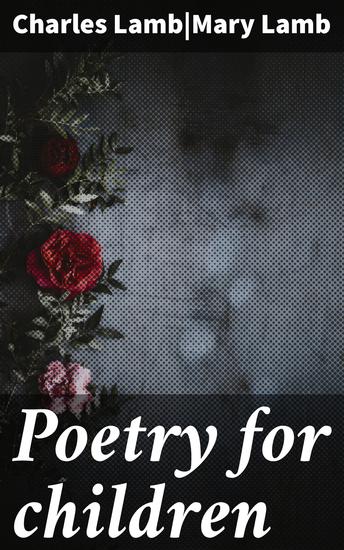
Poetry for children - An Anthology of Childhood Verse and Literary Classics for Young Readers - cover

Poetry for children - An Anthology of Childhood Verse and Literary Classics for Young Readers

Mary Lamb, Charles Lamb

Editorial: Good Press

  • 0
  • 0
  • 0

Sinopsis

In "Poetry for Children," the harmonious collaboration between Charles and Mary Lamb is masterfully curated to capture the whimsical and didactic spirits of poetic storytelling for young audiences. This collection artfully balances innocence with intellect, weaving together nursery rhymes and moral fables that delight as they instruct. The anthology transcends mere entertainment, offering a reflective lens on childhood perceptions and parental inculcations of the early 19th century. Standout pieces engage young minds with vivid imagery and captivating rhythm, deftly bridging the realms of playfulness and wisdom. Charles and Mary Lamb, figures of notable literary influence, are celebrated for their deft interpretations and contributions to accessible literature. Their backgrounds in the rich tapestry of Romantic-era England informed their dedication to making literature approachable for younger audiences. Leveraging their expertise, the Lambs capture the zeitgeist of their age while contributing to evolving educational norms. Their anthology aligns with burgeoning awareness of children's literary needs, offering a palette enriched by their narrative craftsmanship and the pedagogical intent to blend joy with learning. This anthology stands as a seminal piece for those eager to explore how literature can shape young minds. "Poetry for Children" provides a kaleidoscope of insights and creative expressions, inviting readers into a dialogue with past literary traditions and the timeless narratives of childhood exploration. Ideal for educators, literary historians, and enthusiasts, this collection serves as a formative tool that broadens perspectives not only through its content but also through its dialogic structure, bridging generations, and illustrating the power of verse in the growth and education of children. Experience an anthology where every turn of the page reveals new wonders and reflective commentary on the human condition.
Disponible desde: 21/08/2022.
Longitud de impresión: 76 páginas.

Otros libros que te pueden interesar

  • Medea - cover

    Medea

    Euripides

    • 0
    • 0
    • 0
    The story of Medea is only one part of a myth about the Argonauts' campaign. It portrays Jason joining a battle with fire-breathing bulls and a dragon guarding the Golden Fleece, Medea is helping him tame the beasts. She then follows him to Greece, because she falls in love.
    It is also a story of how a once young, beautiful and joyful woman, transforms into a monster, hungry for revenge, she kills even her own children. A long trail of horrible deaths, tied to her life path, is hard to imagine.
    Ver libro
  • My Land of Freedom - A poem of war and freedom - cover

    My Land of Freedom - A poem of...

    Ifeanyi Njoku

    • 0
    • 0
    • 0
    This poem is a powerful reflection on war, displacement, and the struggle for freedom. It tells the tragic story of a people who fought for liberation but were met with violence, loss, and eventual surrender. Likely referencing the Igbo experience during the Nigerian Civil War, it captures the pain of oppression and the resilience of those who endured it. 
    The poem begins with a contradiction: "In my land of freedom, I walked with fear." This highlights the irony of living in a place meant to be free but being consumed by anxiety. The people demand justice, yet their cries are silenced by violence. The line "Killing our brothers, and leaving us undone" conveys both physical loss and emotional devastation. 
    The imagery of "scorching soil" and "separated from families" paints a picture of suffering and displacement. War does not just take lives—it tears families apart and leaves hearts unable to thrive. The mention of "refugee camps" emphasizes how many were forced from their homes, left to question their identity: "Are we unlucky, to be Igbo?" This speaks to a deep sense of abandonment and injustice. 
    The poem also highlights betrayal, as leaders fail to protect their people. "Everyone was a soldier, in this war we couldn't win." This line captures the grim reality of a war where survival itself was a battle. Despite their bravery, they were up against overwhelming forces. 
    The final lines are heartbreaking: "We had to surrender, and say goodbye to our pride." This is not just a loss of battle but a loss of dignity. Yet, even in surrender, their story lives on. This poem is a tribute to resilience, a reminder of suffering, and a call to remember those who fought, even when the world turned away.
    Ver libro
  • Not Enough Time - My Poetry Book - cover

    Not Enough Time - My Poetry Book

    Etanie Samuels

    • 0
    • 0
    • 0
    Not Enough Time is written in the form of a mini bio in a poetry form. Each chapter is designed with life, purpose, motivation, and reality.
    Ver libro
  • Lemon - Poems - cover

    Lemon - Poems

    Isabella J Mansfield

    • 0
    • 0
    • 0
    lemon is an exploration of body and health. The poems in this chapbook come from learning to navigate life with a disability, anxiety and depression, bodily changes, illness and associated medical trauma, and the intersection of physical and mental health.
    Ver libro
  • The Satires - cover

    The Satires

    Juvenal

    • 0
    • 0
    • 0
    The Roman poet Juvenal was the greatest satirist of Imperial Rome. His 16 satires encompass attacks on the immorality, abuses and hypocrisy of the Romans of his day. The last of the great Roman poets, he wrote between CE 110 and 130, his approach to satire coming close to modern expectations of the genre.
    Today, Juvenal is best known for the Latin quotations panem et circenses (‘bread and races’ – he stated that this was all the Roman populace desired) and mens sana in corpore sano (‘a healthy mind in a healthy body’).
    This audiobook, deftly delivered by David Timson, uses Niall Rudd’s translation, which preserves the style and metrical effect of Juvenal’s hexameters.
    Ver libro
  • A Ballad of Death - A poetic examination of grief and lost love - cover

    A Ballad of Death - A poetic...

    Algernon Charles Swinburne

    • 0
    • 0
    • 0
    Algernon Charles Swinburne was born on April 5th, 1837, in London, into a wealthy Northumbrian family.  He was educated at Eton and at Balliol College, Oxford, but did not complete a degree.  
    In 1860 Swinburne published two verse dramas but achieved his first literary success in 1865 with Atalanta in Calydon, written in the form of classical Greek tragedy. The following year "Poems and Ballads" brought him instant notoriety. He was now identified with "indecent" themes and the precept of art for art's sake.  
    Although he produced much after this success in general his popularity and critical reputation declined. The most important qualities of Swinburne's work are an intense lyricism, his intricately extended and evocative imagery, metrical virtuosity, rich use of assonance and alliteration, and bold, complex rhythms.  
    Swinburne's physical appearance was small, frail, and plagued by several other oddities of physique and temperament. Throughout the 1860s and 1870s he drank excessively and was prone to accidents that often left him bruised, bloody, or unconscious. Until his forties he suffered intermittent physical collapses that necessitated removal to his parents' home while he recovered.  
    Throughout his career Swinburne also published literary criticism of great worth. His deep knowledge of world literatures contributed to a critical style rich in quotation, allusion, and comparison. He is particularly noted for discerning studies of Elizabethan dramatists and of many English and French poets and novelists. As well he was a noted essayist and wrote two novels. 
    In 1879, Swinburne's friend and literary agent, Theodore Watts-Dunton, intervened during a time when Swinburne was dangerously ill. Watts-Dunton isolated Swinburne at a suburban home in Putney and gradually weaned him from alcohol, former companions and many other habits as well.  
    Much of his poetry in this period may be inferior but some individual poems are exceptional; "By the North Sea," "Evening on the Broads," "A Nympholept," "The Lake of Gaube," and "Neap-Tide."  
    Swinburne lived another thirty years with Watts-Dunton. He denied Swinburne's friends access to him, controlled the poet's money, and restricted his activities. It is often quoted that 'he saved the man but killed the poet'.  
    Swinburne died on April 10th, 1909 at the age of seventy-two.
    Ver libro