Rejoignez-nous pour un voyage dans le monde des livres!
Ajouter ce livre à l'électronique
Grey
Ecrivez un nouveau commentaire Default profile 50px
Grey
Abonnez-vous pour lire le livre complet ou lisez les premières pages gratuitement!
All characters reduced
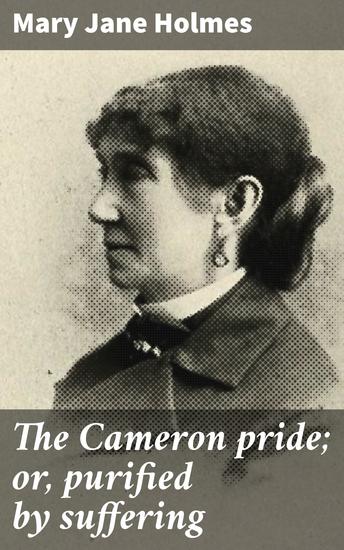
The Cameron pride; or purified by suffering - A Tale of Family Pride and Redemption in 19th-Century America - cover

The Cameron pride; or purified by suffering - A Tale of Family Pride and Redemption in 19th-Century America

Mary Jane Holmes

Maison d'édition: Good Press

  • 0
  • 0
  • 0

Synopsis

In "The Cameron Pride; or, Purified by Suffering," Mary Jane Holmes masterfully weaves a narrative that delves into themes of morality, social status, and personal redemption. Set against the backdrop of 19th-century America, the novel unfolds through richly drawn characters who navigate the intricacies of pride and prejudice within their societal roles. Holmes' dual narrative technique engages the reader, alternating between internal monologues and external action, allowing for an intimate exploration of the characters'Äô psyche as they grapple with their moral dilemmas, thereby creating a profound sense of empathy. The prose embodies a romantic sensibility, characterized by an emotional depth and moral earnestness that were hallmarks of the period'Äôs literature. Mary Jane Holmes, an influential female novelist of her time, often drew upon her own experiences and observations in writing. Known for her keen insights into the struggles of women and the dynamics of family life, Holmes championed themes of resilience and social justice through her characters. Her own position as a woman author in a predominantly male literary world during the Victorian era undoubtedly informed her exploration of female virtue and the redemptive power of suffering. This novel is highly recommended for readers interested in historical fiction that interrogates social norms and uplifts the human spirit. Holmes' skillful character development and insights into the complexities of human relationships make it a remarkable piece that resonates well beyond its time. The narrative'Äôs reflection on pride offers valuable lessons in humility and grace, making it essential reading for those who appreciate literature that champions personal growth in the face of adversity.
Disponible depuis: 11/07/2023.
Longueur d'impression: 376 pages.
D'autres livres qui pourraient vous intéresser

  • Great Gatsby The: Original 1925 Edition (An F Scott Fitzgerald Classic Novel - cover

    Great Gatsby The: Original 1925...

    Francis Scott Fitzgerald

    • 0
    • 0
    • 0
    The Great Jazz Age Novel_______The 1925 Original Version, with Classroom History_______The Great Gatsby is considered F. Scott Fitzgerald's magnum opus, exploring themes of decadence, idealism, social stigmas, patriarchal norms, and the deleterious effects of unencumbered wealth in capitalistic society, set against the backdrop of the Jazz Age and the Roaring Twenties. At its heart, it's a cautionary tale, a revealing look into the darker side to the American Dream."When I came back from the East last autumn I felt that I wanted the world to be in uniform and at a sort of moral attention forever; I wanted no more riotous excursions with privileged glimpses into the human heart. Only Gatsby, the man who gives his name to this book, was exempt from my reaction—Gatsby who represented everything for which I have an unaffected scorn. If personality is an unbroken series of successful gestures, then there was something gorgeous about him, some heightened sensitivity to the promises of life, as if he were related to one of those intricate machines that register earthquakes ten thousand miles away. This responsiveness had nothing to do with that flabby impressionability which is dignified under the name of the "creative temperament"—it was an extraordinary gift for hope, a romantic readiness such as I have never found in any other person and which it is not likely I shall ever find again. No—Gatsby turned out all right at the end; it is what preyed on Gatsby, what foul dust floated in the wake of his dreams that temporarily closed out my interest in the abortive sorrows and short-winded elations of men..."
    Voir livre
  • In the French-Flemish Country (Unabridged) - cover

    In the French-Flemish Country...

    Charles Dickens

    • 0
    • 0
    • 0
    Charles Dickens was a writer and social critic who created some of the world's best-known fictional characters and is regarded as the greatest novelist of the Victorian era. His works enjoyed unprecedented popularity during his lifetime, and by the twentieth century critics and scholars had recognised him as a literary genius. His novels and short stories enjoy lasting popularity.
    IN THE FRENCH-FLEMISH COUNTRY: What part in my decision was borne by Monsieur P. Salcy, is of no moment, though I own to encountering that gentleman's name on a red bill on the wall, before I made up my mind. Monsieur P. Salcy, 'par permission de M. le Maire,' had established his theatre in the whitewashed Hôtel de Ville, on the steps of which illustrious edifice I stood.
    Voir livre
  • Middlemarch Volume 3 - cover

    Middlemarch Volume 3

    George Eliot

    • 0
    • 0
    • 0
    Middlemarch, Volume 3 delves deeper into the intricate lives of its characters. Dorothea's path takes unexpected turns as she navigates the constraints of her past and seeks a more fulfilling future. Lydgate's professional and personal crises escalate, testing his ambition and integrity. The narrative expands to reveal the interconnectedness of the town's inhabitants, exposing the subtle power dynamics and social pressures that shape their destinies. Eliot masterfully portrays the nuances of human relationships and the challenges of moral choices.
    Voir livre
  • A Witch's Den - A look into the darker rituals of late 19th Century rural India - cover

    A Witch's Den - A look into the...

    Helena Blavatsky

    • 0
    • 0
    • 0
    Helena Petrovna Blavatsky, often known as Madame Blavatsky, was born on 12th August 1831 into an aristocratic family in present day Dnipro in Ukraine, then part of the Russian Empire.  She was the younger sister of the writer Vera Zhelikhovsky. 
     
    Much of Blavatsky’s life story relies on her own memories which changed much during her lifetime and therefore parts of it are unreliable.  What appears to be certain is that much of her life was lived first on family travels and postings and then on her journeys in an effort to further her own self-education and quest for knowledge. 
     
    As a teenager she developed an interest in Western esotericism and from there she claimed many travels including a trip to India where she encountered a group of spiritual adepts, the ‘Masters of the Ancient Wisdom’, who sent her to Shigatse, Tibet, where they trained her to develop a deeper understanding of the synthesis of religion, philosophy, and science.  
     
    By the early 1870s, Blavatsky was involved in the Spiritualist movement, which was then popular both in Britain and abroad, even though she argued against its main tenet that those ‘contacted’ were the spirits of the dead.  
     
    She moved to the United States in 1873 and became close to the journalist Henry Steel Olcott who helped her gain public attention as a spirit medium and then also became an adherent to her principles.   
     
    In 1875 in New York City she co-founded the Theosophical Society and two years later published ‘Isis Unveiled’, a book outlining her Theosophical world-view from its ancient roots to the modern day.  Her work was even more popular in Asia than elsewhere and is said to have influenced both Ghandi and Nehru amongst many others.  
     
    In 1880, she and Olcott moved to India, where the Society was allied to a Hindu reform movement.  That same year she converted to Buddhism.  However, she was often plagued with accusations of fraudulent paranormal phenomena.  
     
    With her health failing she returned to London and published ‘The Secret Doctrine’, her commentary on claimed ancient Tibetan manuscripts, and other books.  
     
    Helena Blavatsky died in London of influenza during the global pandemic on 8th May 1891.  She was 59.
    Voir livre
  • The Scarlet Plague - cover

    The Scarlet Plague

    Jack London

    • 0
    • 0
    • 0
    A grandfather tells his grandchildren of a previous world, one before a global pandemic wipes out nearly all mankind. Raw and melancholy, The Scarlet Plague is Jack London’s apocalyptic story about how one civilization rose and fell. Originally published in 1912 by London Magazine.
    Voir livre
  • After Twenty years - From their pens to your ears genius in every story - cover

    After Twenty years - From their...

    O Henry

    • 0
    • 0
    • 0
    William Sydney Porter was born on 11th September 1862 in Greensboro, North Carolina. At age 3 his mother died from tuberculosis. From an early age it was clear Porter had a large appetite for reading as he absorbed the world around him. 
    He first attended at a school run by his aunt before enrolling at the Lindsey Street High School and then worked at his uncle’s drugstore and gained a pharmacists’ license in 1881.  
    A persistent cough took him to Texas in the hope that a change of climate would help his symptoms. He took on various types of work, initially from ranch hand and cook and then as varied as pharmacist, draftsman, bank teller and journalist. He also began to write, though for now, purely as a hobby. 
    He was a member of several singing and dramatic groups when he met 17 year old Athol Estes, daughter of a wealthy Austin family. Despite her mother’s objection owing to Athol’s tuberculosis, they began courting and in July 1887, they eloped and soon married. 
    Athol, impressed by his writing, encouraged him to get them published. A job as a draftsman at the Texas General Land Office paid a healthy $100 dollars per month and life was good. 
    But then life turned cruel. His son died a few hours after birth although a daughter, Margaret, came the following year.  His job had to be vacated but another was found at the First National Bank of Austin. The bank operated informally and Porter was careless in keeping the books. He lost that job but began writing for the humourous weekly The Rolling Stone and the Houston Post. Some time later the federal Bank auditors went through his former accounts and he was arrested on charges of embezzlement. 
    Porter fled the day before his trial to Honduras. Holed up for several months he began to write.  Athol had become too ill to travel to meet him and learning that her health was deteriorating he surrendered to the court in February 1897.  Bail was obtained so that he could stay with Athol during her final days.  
    Porter was sentenced to five years at the Ohio Penitentiary in Columbus. His pharmacy qualifications got him the job of night druggist.  His sentence also gave him time to write and publish fourteen short stories. In December 1899 in McClure’s Magazine he published a short story as O Henry.  
    He was released two years early in July 1901, and reunited with Margaret, now 11, in Pittsburgh.  He now began his most prolific period of writing; a short story per week for the New York World, while also publishing works in other magazines.  Eventually over 600 of his short stories were published. 
    Porter was a heavy drinker and in 1908 his health, which had deteriorated for several years, took a dramatic turn for the worse, as did his writing. 
    O Henry died of cirrhosis of the liver complicated by diabetes and an enlarged heart on 5th June 1910.<
    Voir livre