Begleiten Sie uns auf eine literarische Weltreise!
Buch zum Bücherregal hinzufügen
Grey
Einen neuen Kommentar schreiben Default profile 50px
Grey
Jetzt das ganze Buch im Abo oder die ersten Seiten gratis lesen!
All characters reduced
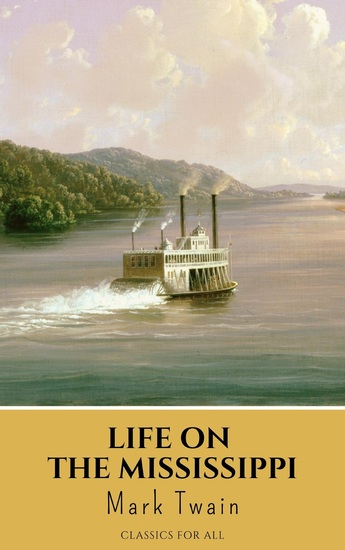
Life On The Mississippi - cover

Life On The Mississippi

Mark Twain, Classics for all

Verlag: Classics for all

  • 0
  • 0
  • 0

Beschreibung

Life on the Mississippi is a memoir by Mark Twain detailing his days as a steamboat pilot on the Mississippi River before and after the American Civil War. The book begins with a brief history of the river. It continues with anecdotes of Twain's training as a steamboat pilot, as the 'cub' of an experienced pilot. He describes, with great affection, the science of navigating the ever-changing Mississippi River. In the second half, the book describes Twain's return, many years later, to travel on a steamboat from St. Louis to New Orleans. He describes the competition from railroads, the new, large cities, and his observations on greed, gullibility, tragedy, and bad architecture. He also tells some stories that are most likely tall tales. Simultaneously published in 1883 in the U.S. and in England, it is said to be the first book composed on a typewriter. (Source: Wikipedia)
Verfügbar seit: 26.06.2022.
Drucklänge: 495 Seiten.

Weitere Bücher, die Sie mögen werden

  • Alice in wonderland - The Original 1865 Edition With Complete Illustrations By Chris Hartman A Classic Novel of Lewis Carroll - cover

    Alice in wonderland - The...

    Louis Carroll

    • 0
    • 0
    • 0
    Alice's Adventures in Wonderland is a timeless classic that has captivated generations of readers with it's whimsical characters, clever wordplay, and surreal adventures. With the original illustrations by John Tenniel, this edition brings the story to life in all its magical glory. 
    Follow Alice as she goes down the rabbit hole into a fantastical world of talking animals, playing cards, and mad hatters. Along the way, she encounters a host of unforgettable characters, from the Cheshire Cat to the Queen of Hearts, all rendered in Tenniel's iconic illustrations. 
    First published in 1865, Alice's Adventures in Wonderland has been enchanting readers for over 150 years. With its timeless themes of curiosity, imagination, and the power of the mind, this beloved classic continues to inspire and delight readers of all ages. 
    Experience the wonder and magic of Alice's Adventures in Wonderland with this beautifully illustrated edition featuring the original illustrations by John Tenniel. It's the perfect addition to any bookshelf and a must-read for anyone who loves a good adventure.
    Zum Buch
  • A Man with Two Lives - From their pens to your ears genius in every story - cover

    A Man with Two Lives - From...

    Ambrose Bierce

    • 0
    • 0
    • 0
    Ambrose Gwinnett Bierce was born on 24th June 1842 at Horse Cave Creek in Meigs County, Ohio. His parents were poor but they introduced him to literature at an early age, instilling in him a deep appreciation of books, the written word and the elegance of language.  
    Growing up in Koscuisko County, Indiana poverty and religion were defining features of his childhood, and he would later describe his parents as “unwashed savages” and fanatically religious, showing him little affection but always quick to punish. He came to resent religion, and his introduction to literature appears to be their only positive effect. 
    At age 15 Bierce left home to become a printer’s devil, mixing ink and fetching type at The Northern Indian, a small Ohio paper. Falsely accused of theft he returned to his farm and spent time sending out work in the hopes of being published. 
    His Uncle Lucius advised he be sent to the Kentucky Military Institute. A year later he was commissioned as an Officer.  As the Civil War started Bierce enlisted in the 9th Indiana Infantry Regiment.  
    In April 1862 Bierce fought at the Battle of Shiloh, an experience which, though terrifying, became the source of several short stories. Two years later he sustained a serious head wound and was off duty for several months. He was discharged in early 1865.  
    A later expedition to inspect military outposts across the Great Plains took him all the way to San Francisco. He remained there to become involved with publishing and editing and to marry, Mary Ellen on Christmas Day 1871.  They had a child, Day, the following year.  
    In 1872 the family moved to England for 3 years where he wrote for Fun magazine. His son, Leigh, was born, and first book, ‘The Fiend’s Delight’, was published.  
    They returned to San Francisco and to work for a number of papers where he gained admiration for his crime reporting. In 1887 he began a column at the William Randolph Hearst’s San Francisco Examiner.  
    Bierce’s marriage fell apart when he discovered compromising letters to his wife from a secret admirer. The following year, 1889 his son Day committed suicide, depressed by romantic rejection. 
    In 1891 Bierce wrote and published the collection of 26 short stories which included ‘An Occurrence at Owl Creek Bridge’.  Success and further works including poetry followed.  
    Bierce with Hearst’s resources helped uncover a financial plot by a railroad to turn 130 million dollars of loans into a handout. Confronted by the railroad and asked to name his price Bierce answered “my price is $130 million dollars. If, when you are ready to pay, I happen to be out of town, you may hand it over to my friend, the Treasurer of the United States”.  
    He now began his first foray as a fabulist, publishing ‘Fantastic Fables’ in 1899.  But tragedy again struck two years later when his second son Leigh died of pneumonia relating to his alcoholism.  
    He continued to write short stories and poetry and also published ‘The Devil’s Dictionary’.  
    At the age of 71, in 1913 Bierce departed from Washington, D.C., for a tour of the battlefields where he had fought during the civil war. At the city of Chihuahua he wrote his last known communication, a letter to a friend. It’s closing words were “as to me, I leave here tomorrow for an unknown destination,” Ambrose Bierce then vanished without trace.
    Zum Buch
  • Man Farthest Down The - A Record of Observation and Study in Europe (Unabridged) - cover

    Man Farthest Down The - A Record...

    Booker T. Washington

    • 0
    • 0
    • 0
    In View of the rather elaborate plan I have sketched, I am certain that some of my readers Will wonder how I expected to be able, in the eight weeks to which my vacation was limited, to cover all the ground or get any definite or satisfactory notions in regard to the special matters which interested me in the places I pro posed to visit. It seems to me, therefore, that I ought to say something, by way of explana tion and introduction, as to just how this journey was made and in regard to the manner in which the impressions and facts which make up the remainder of this book were obtained.
    Zum Buch
  • The Shunned House - cover

    The Shunned House

    HP Lovecraft

    • 0
    • 0
    • 0
    One of HP Lovecrafts earliest works, "The Shunned House", first published in Weird Tales in the October of 1937, is a short novellette about a mysterious, and apparently cursed house. The Shunned House on Benefit Street has long captivated the attention of the narrator and his uncle Elihu Whipple, but they are unprepared for the full scale of the horror they are to experience when they attempt to stay the night in it's benighted basement to finally unearth it's mysterious secrets. Considered one of Lovecrafts best short stories, it is beleived to have been his first individually published book: with 250 copies made by Recluse Press in 1928. 
    Narrated by Michael Ward.
    Zum Buch
  • The Island of the Fay - cover

    The Island of the Fay

    SAMPI Books, Edgar Allan Poe

    • 0
    • 0
    • 0
    In "The Island of the Fay", Edgar Allan Poe describes the narrator's contemplation on the inaudible music of nature, observing a fairy on a mystical island. The tale explores themes of isolation, natural beauty and the permeability between the seen and the hidden.
    Zum Buch
  • Her Lover - From their pens to your ears genius in every story - cover

    Her Lover - From their pens to...

    Maxim Gorky

    • 0
    • 0
    • 0
    Alexei Maximovich Peshkov was born on 28th March 1868, in Nizhny Novgorod, Russia. 
    Better known as Maxim Gorky he was orphaned at 11 and ran away from home at 12.  At 19 he had already attempted suicide and thereafter travelled, by foot, across the Russian Empire for 5 years. 
    His first book ‘Essays & Stories’ in 1898 was a sensation and so began a long career as an author of short stories, novels and plays.  Gorky saw writing as a moral and political act that would help to change the unjust world around him.  He was an ardent early advocate of the emerging Marxist movement and publicly opposed the Tsarist regime leading several times to his arrest.  
    In 1904 he began his own theatre but the censor banned every play and Gorky was forced to abandon the project. 
    But Gorky was a financially successful author, editor, and playwright and gave monies to political parties as well as for civil rights and social reform.  The brutal shooting of workers, which set in motion the Revolution of 1905, pushed Gorky more decisively toward radical solutions.  
    In 1906 he went to the United States to raise funds for the Bolsheviks. Those experiences including a scandal over travelling with his lover and not his wife deepened his contempt for the ‘bourgeois soul.’ 
    Gorky now moved to Capri in Italy, both for health reasons and to escape the increasingly repressive times in Russia.  
    An amnesty for the 300th anniversary of the Romanov dynasty saw him return to Russia in 1914. His politics remained close to the Bolshevik cause.  But soon, after the 1918 revolution, his essays referred to Lenin as a tyrant for his senseless arrests and repression.  He was soon appealing to the outside world for food aid after the catastrophic crop failure. 
    In October 1921 Gorky returned to Italy, now in Fascist hands, and settled in Sorrento until 1932.  His health worsened with the onset of tuberculosis. 
    He wrote several successful books there but now decided to find an understanding with the communist regime. Stalin invited him home and his return was hailed as a major propaganda victory.  He was decorated with the Order of Lenin, and a province, a park, and various streets re-named in his honour. 
    But he had his faults too.  In 1933, Gorky co-edited a book on the White Sea-Baltic Canal and denied even a single prisoner died during its construction, but thousands had. As well, knowing that some Nazis were homosexual, a phrase was attributed to him that said ‘exterminate all homosexuals and fascism will vanish’.  Although he was himself was quoting another he was decidedly homophobic. 
    With the increase of Stalinist repression in 1935 Gorky was placed under unannounced house arrest. 
    Maxim Gorky died on the 18th June 1936 from pneumonia.  He was 68. 
    Stalin and Molotov were among those who carried Gorky's urn of ashes at his funeral.
    Zum Buch