Begleiten Sie uns auf eine literarische Weltreise!
Buch zum Bücherregal hinzufügen
Grey
Einen neuen Kommentar schreiben Default profile 50px
Grey
Jetzt das ganze Buch im Abo oder die ersten Seiten gratis lesen!
All characters reduced
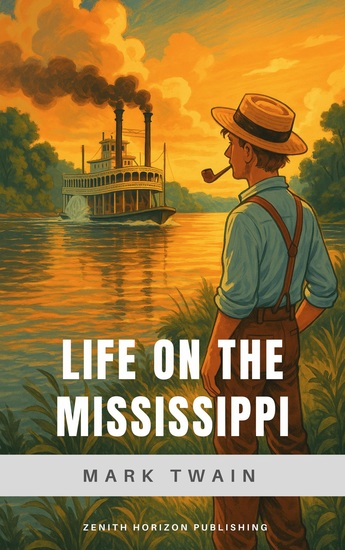
Life on the Mississippi - Mark Twain's Illustrated Memoir of Riverboats Adventure and American History - cover

Life on the Mississippi - Mark Twain's Illustrated Memoir of Riverboats Adventure and American History

Mark Twain, Zenith Horizon Publishing

Verlag: Zenith Horizon Publishing

  • 0
  • 0
  • 0

Beschreibung

Before he became a literary icon, Mark Twain was a steamboat pilot—and this is the journey that shaped him.

Life on the Mississippi is Twain's vivid memoir of life along America's greatest river. Blending travelogue, history, personal reflection, and storytelling, Twain brings to life the gritty, romantic, and dangerous world of 19th-century riverboats and frontier towns.

From his boyhood dreams to the bustling trade routes of the post–Civil War South, Twain's wit and observation make this not just a historical account—but a living portrait of an evolving America.

🛶 This edition includes:

The full, unabridged text

Vintage-style illustrations and a period map

Kindle-optimized formatting for smooth navigation

📚 Perfect for fans of American history, memoirs, and classic literature.

Step aboard and relive a journey that helped shape the voice of American storytelling.
Get your illustrated edition now.
Verfügbar seit: 16.06.2025.
Drucklänge: 502 Seiten.

Weitere Bücher, die Sie mögen werden

  • The Job - cover

    The Job

    Sinclair Lewis

    • 0
    • 0
    • 0
    The Job is an early work by American novelist Sinclair Lewis.
    It is considered an early declaration of the rights of working women. The focus is on the main character, Una Golden, and her desire to establish herself in a legitimate occupation while balancing the eventual need for marriage. The story takes place in the early 1900-1920s and takes Una from a small Pennsylvania town to New York. Forced to work due to family illness, Una shows a talent for the traditional male bastion of commercial real estate and, while valued by her company, she struggles to achieve the same status of her male coworkers. On a parallel track, her quest for traditional romance and love is important but her unique role as a working woman, doing a man's job, makes it tough to find an appropriate suitor.
    Zum Buch
  • As Good as a Lord - cover

    As Good as a Lord

    P. O. Dixon

    • 0
    • 0
    • 0
    Elizabeth had intended to tell no one about Mr. Darcy's proposal. At length, she confided in her dearest sister, Jane. It was meant to be their secret, but secrets have a way of getting found out. 
    What happens when Mrs. Bennet learns that her headstrong daughter has refused the hand of a second respectable man in less than six months? Darcy is determined to put his disastrous proposal to Miss Elizabeth Bennet behind him by filling the empty space in his life that can only be occupied by a wife. A chance meeting with Elizabeth at Pemberley gives him pause. Elizabeth may be the only woman in his heart, but she is not the only woman in his life. Will Darcy adhere to his original plan to find another, or will he follow his heart?
    Zum Buch
  • The Bishop of Hell - An abusive man runs off with a married woman and tragedy ensues - cover

    The Bishop of Hell - An abusive...

    Marjorie Bowen

    • 0
    • 0
    • 0
    Margaret Gabrielle Vere Campbell was born on 1st November 1885 on Hayling Island in Hampshire.  
     
    Her childhood was fraught with problems, her alcoholic father left early in her life and was later found dead on a London Street. Life thereafter was poverty with an uncaring mother. 
     
    However, her talents took her to the Slade School of Fine Art and later to study in Paris.  
     
    Her first fiction, written at a mere 16, was a violent medieval historical novel, ‘The Viper of Milan’. Initially rejected by several publishers it went on to become a best-seller  
     
    After this her prolific writings were the main financial support for the family.  Her literary output numbered over 150 volumes, mainly under the pseudonym of Marjorie Bowen but she also used the names Joseph Shearing, George R Preedy, John Winch, Robert Paye and Margaret Campbell.  Within this output she assigned the pseudonyms to the various genres she worked across, from Historical fiction to supernatural short stories.  
     
    Perhaps her best known work is the 1909 book ‘Black Magic’, a Gothic horror novel about a medieval witch. 
     
    Several of her works were also adapted into films.   
     
    She was married twice.  The first to Zefferino Emilio Constanza (they had two children), who died of tuberculosis, and then to Arthur L Long (and another two children) 
     
    Marjorie Bowen died on 23rd December 1952 at St Charles Hospital in North Kensington, London after suffering serious concussion from a fall in her bedroom.  She was 67.
    Zum Buch
  • The Moon And Sixpence - cover

    The Moon And Sixpence

    Somerset Maugham

    • 0
    • 0
    • 0
    "The Moon and Sixpence" is a captivating novel by W. Somerset Maugham, published in 1919. Loosely inspired by the life of the renowned French artist Paul Gauguin, the story delves into the life of Charles Strickland, a middle-aged Englishman leading a seemingly ordinary life as a stockbroker in London. However, Strickland's life takes a drastic turn when he abruptly abandons his family and career to pursue his burning passion for art in the bohemian world of early 20th-century Paris. 
     
    As Strickland immerses himself in the world of painting, he undergoes a profound transformation, shedding his societal constraints and embracing an unconventional and often controversial lifestyle. His single-minded devotion to his art takes him to far-flung places, including the South Pacific, where he seeks inspiration amidst primitive cultures. Through Strickland's relentless pursuit of artistic expression, Maugham explores themes of artistic genius, the clash between societal norms and individual desires, and the sacrifices an artist may make in the name of their craft. 
     
    "The Moon and Sixpence" is a thought-provoking exploration of the tension between conformity and the pursuit of one's true calling. Maugham's narrative skillfully captures Strickland's enigmatic character and the turbulent emotions that drive him. The novel challenges readers to contemplate the price of artistic freedom and the complexities of the human spirit in the face of unconventional choices, making it a timeless work that continues to resonate with those who seek to understand the nature of artistic genius and the sacrifices it may entail.
    Zum Buch
  • Freckles - From their pens to your ears genius in every story - cover

    Freckles - From their pens to...

    William Pett Ridge

    • 0
    • 0
    • 0
    William Pett Ridge was born at Chartham, near Canterbury, Kent, on 22nd April 1859. 
    His family’s resources were certainly limited. His father was a railway porter, and the young Pett Ridge, after schooling in Marden, Kent became a clerk in a railway clearing-house. The hours were long and arduous, but self-improvement was Pett Ridge’s goal.  After working from nine until seven o’clock he would attend evening classes at Birkbeck Literary and Scientific Institute and then to follow his passion; the ambition to write.  He was heavily influenced by Dickens and several critics thought he had the capability to be his successor. 
    From 1891 many of his humourous sketches were published in the St James's Gazette, the Idler, Windsor Magazine and other literary periodicals of the day. 
    Pett Ridge published his first novel in 1895, A Clever Wife. By the advent of his fifth novel, Mord Em'ly, a mere three years later in 1898, his success was obvious.  His writing was written from the perspective of those born with no privilege and relied on his great talent to find humour and sympathy in his portrayal of working class life. 
    Today Pett Ridge and other East End novelists including Arthur Nevinson, Arthur Morrison and Edwin Pugh are being grouped together as the Cockney Novelists.   
    In 1924, Pugh set out his recollections of Pett Ridge from the 1890s: “I see him most clearly, as he was in those days, through a blue haze of tobacco smoke. We used sometimes to travel together from Waterloo to Worcester Park on our way to spend a Saturday afternoon and evening with H. G. Wells. Pett Ridge does not know it, but it was through watching him fill his pipe, as he sat opposite me in a stuffy little railway compartment, that I completed my own education as a smoker... Pett Ridge had a small, dark, rather spiky moustache in those days, and thick, dark, sleek hair which is perhaps not quite so thick or dark, though hardly less sleek nowadays than it was then”. 
    With his success, on the back of his prolific output and commercial success, Pett Ridge gave generously of both time and money to charity. In 1907 he founded the Babies Home at Hoxton.  This was one of several organisations that he supported that had the welfare of children as their mission.  
    His circle considered Pett Ridge to be one of life's natural bachelors. In 1909 they were rather surprised therefore when he married Olga Hentschel.  
    As the 1920’s arrived Pett Ridge added to his popularity with the movies. Four of his books were adapted into films.  
    Pett Ridge now found the peak of his fame had passed. Although he still managed to produce a book a year he was falling out of fashion and favour with the reading public and his popularity declined rapidly.  His canon runs to over sixty novels and short-story collections as well as many pieces for magazines and periodicals. 
    William Pett Ridge died, on 29th September 1930, at his home, Ampthill, Willow Grove, Chislehurst, at the age of 71. 
    He was cremated at West Norwood on 2nd October 1930.
    Zum Buch
  • Antigone - Full Cast Drama - cover

    Antigone - Full Cast Drama

    Sophocles

    • 0
    • 0
    • 0
    "Antigone" is a Greek tragedy written by Sophocles in the 5th century BCE. The play is part of a trilogy, but only "Antigone," the third installment, has survived. The narrative revolves around Antigone, the daughter of Oedipus, who defies the king's decree and buries her brother Polynices, in defiance of the law. The king, Creon, orders that Polynices' body should remain unburied as punishment for his rebellion against the city. 
     
    Antigone's act of burial is not only an expression of familial loyalty but also an assertion of divine laws over human laws. She believes in the moral duty to honor her brother, even in death and is willing to face the consequences. Creon, however, sees her actions as an affront to his authority and issues a decree that anyone attempting to bury Polynices will be put to death. 
     
    As the plot unfolds, the clash between divine and human laws intensifies. Antigone is caught and brought before Creon, where she staunchly defends her actions. Creon remains resolute in his decision to punish her, regardless of her familial ties. The play explores themes of morality, duty, and the consequences of pride and authoritarian rule. 
     
    Tragedy unfolds as Antigone is sentenced to be entombed alive. The narrative weaves the fates of various characters, including Antigone, Haemon (Creon's son and Antigone's fiancé), and Eurydice (Creon's wife). The play culminates in a series of tragic events, leading to Creon's realization of his own tragic flaw and the devastating consequences of his decisions.
    Zum Buch