




ÉCOUTER EXTRAIT

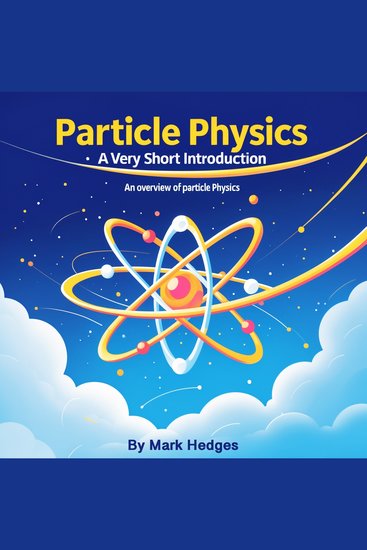
Particle Physics - A Very Short Introduction: An Overview of Particle Physics
Mark Hedges
Narrateur Aria Montgomery
Maison d'édition: Daphne Haydens LLC
Synopsis
Particle physics is the branch of physics that explores the fundamental particles that constitute matter and the forces that govern their interactions. At its core, particle physics aims to understand the building blocks of the universe, which are invisible to the naked eye but form the essence of everything around us. This field of study delves into the smallest scale of nature, where particles like quarks, leptons, and bosons interact in ways that determine the structure and behavior of all matter.
The development of particle physics began with the early studies of atoms, but as scientific knowledge advanced, it became clear that atoms themselves were not indivisible. The discovery of the electron in the late 19th century marked the beginning of this journey. Subsequent advancements led to the identification of other subatomic particles, such as protons and neutrons, which make up the atomic nucleus. These findings, however, were only the beginning, and as technology advanced, especially with the creation of particle accelerators, scientists began probing even deeper into the atomic structure.
A pivotal moment in particle physics came with the formulation of the Standard Model, a comprehensive theory that describes the electromagnetic, weak, and strong forces and classifies all known elementary particles. According to the Standard Model, all matter is made up of fundamental particles, and their interactions are mediated by force-carrier particles called bosons. This model successfully explains the behavior of particles in a wide range of experiments, and it has been verified by numerous experiments, such as those conducted at large particle accelerators like the Large Hadron Collider (LHC). The discovery of the Higgs boson at CERN in 2012 provided strong experimental confirmation of the Standard Model and earned the physicists involved the Nobel Prize.
Durée: environ 2 heures (01:49:53)
Date de publication: 15/03/2025; Unabridged; Copyright Year: — Copyright Statment: —




