Rejoignez-nous pour un voyage dans le monde des livres!
Ajouter ce livre à l'électronique
Grey
Ecrivez un nouveau commentaire Default profile 50px
Grey
Abonnez-vous pour lire le livre complet ou lisez les premières pages gratuitement!
All characters reduced
Political Comics Role - cover

Political Comics Role

Mark Chambers

Traducteur A AI

Maison d'édition: Publifye

  • 0
  • 0
  • 0

Synopsis

Political Comics Role explores the impactful intersection of comics, art, and politics, revealing how sequential art has served as a potent tool for political satire, social critique, and activism throughout history. The book examines how comics dissect power structures and amplify marginalized voices, influencing political events. One intriguing fact explored is how comics can transcend linguistic barriers, engaging audiences on emotional and intellectual levels, making them effective for political expression and mobilization. The book further reveals that comics challenge traditional notions of political discourse, spotlighting the importance of visual literacy in today's political landscapes.

 
The book progresses through three central themes, starting with the evolution of political satire in comics, then analyzing their use as tools for social critique, and finally, examining their influence on political discourse and activism.

 
By drawing from a diverse range of sources, including analyses of specific comic books and strips, interviews, and historical documents, the book showcases key moments where comics played a significant role. It is valuable to those interested in political science, art history, and media studies, as it demonstrates how the visual language of comics can express complex political ideas in an accessible and engaging way.
Disponible depuis: 10/03/2025.
Longueur d'impression: 64 pages.


D'autres livres qui pourraient vous intéresser

  • How we save the world - The Fight to Rewrite Our Future Begins Now - cover

    How we save the world - The...

    Jack Jay

    • 0
    • 0
    • 0
    How We Save The World by Jack Jay is a manifesto for those eager to reshape humanity’s future. Blending philosophy with actionable wisdom, Jay explores pressing global issues like inequality, environmental damage, and AI ethics. 
    Chapter 1: Introduces a new meta-narrative, emphasizing the need for a better global story. 
    Chapter 2: Explores the rapid evolution of technology. 
    Chapter 3: Discusses how information shapes reality through the butterfly effect. 
    Chapter 4: Outlines pragmatic philosophies for creating effective global movements. 
    Chapter 5: Introduces the concept of the “Prodemic” — viral methods anyone can use to upgrade humanity. 
    Chapter 6/7: Focus on hacking dopamine systems to avoid burnout and redefine laziness. 
    Chapter 8: Advocates for simplicity in self-improvement and avoiding over-optimization. 
    Chapter 9: Addresses the AI alignment problem, offering a solution for humanity to collectively manage the risks of AI. 
    Chapter 10: Redefines consumerism and philanthropy through designer goods purchased via tax-deductible donations. 
    Chapter 11: Introduces “storyhacking” to help individuals start global movements. 
    Chapter 12: Emphasizes long-term thinking in a future dominated by AI. 
    Chapter 13: Presents the concept of "spear ritual wisdom" as a catalyst for positive global change. 
    Chapter 14-16: Dive deeper into leading and sustaining such a movement. 
    Chapter 17: Discusses real-world operations for achieving tipping points in society. 
    Chapter 18: Focuses on the strategy behind global leadership and spear rituals. 
    Chapter 19: Recaps the book’s worldview, offering new solutions and missions for a brighter future. 
    The book combines deep reflections with practical approaches for individuals and movements to spark change, encouraging people to take action in reshaping the world.
    Voir livre
  • Samoan Crisis The: The History of the Military Standoff Between the United States Germany and Great Britain over the Samoan Islands - cover

    Samoan Crisis The: The History...

    Editors Charles River

    • 0
    • 0
    • 0
    Samoa is a group of about 20 islands in the South Pacific Ocean, totaling slightly over 1,100 square miles, about a fifth the size of Hawai’i. The ancestors of the Samoans arrived there many centuries ago. Archaeological artifacts suggest Polynesians arrived perhaps three thousand years before the present, or perhaps even earlier (O’Connor, 2017). 
    Samoans remained part of an isolated Pacific Ocean region for a very long time, with trade and social links with the people of the Fiji and Tonga islands. That inter-island world was not “discovered” by European explorers until 1722, when a Dutch ship, captained by Joseph Roggeveen, visited. The next European view of the Samoan islands was in 1778 by a French expedition, commanded by Louis-Antoine de Bougainville. A later French expedition under La Perouse found the islands far from congenial; a fight erupted and the French lost 12 men (O’Connor, 2017). 
    The pace of contact with the outside world quickened by the end of the 1700s. Explorers visited, naval expeditions checked out Samoa and other islands, a few European beachcombers arrived, and so did missionaries. Samoa, like many other Pacific Island groups, attracted outside interest for several reasons. Missionaries found souls to save. Whaling ships found places to resupply themselves with food, water, sometimes crew, and for rest and recreation. As navies converted to steam, islands became useful as coaling stations, and as the Industrial Revolution spread, islands offered raw materials and goods for potential profit. The Pacific Islands also became pawns in what is best described as a global imperial competition.
    Voir livre
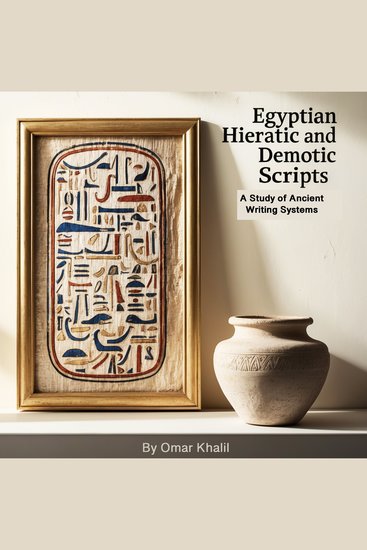
  • Egyptian Hieratic and Demotic Scripts - A Study of Ancient Writing Systems - cover

    Egyptian Hieratic and Demotic...

    Omar Khalil

    • 0
    • 0
    • 0
    The writing systems of ancient Egypt are among the most fascinating and intricate aspects of the civilization’s rich cultural heritage. These scripts not only served as practical tools for administration and communication but also held immense symbolic and ritual significance. The evolution of Egyptian scripts reflects the social, political, and religious transformations that took place throughout the millennia of Egyptian history. 
    Egyptian writing developed as a means of recording religious texts, administrative documents, literary works, and personal correspondence. Among the earliest and most iconic forms of writing is the hieroglyphic script, characterized by its detailed pictorial symbols. While hieroglyphs are often associated with monumental inscriptions and sacred texts, they were not the only writing system employed by the ancient Egyptians. As the civilization advanced, the need for more practical and expedient writing methods became apparent, giving rise to the development of cursive scripts. 
    Hieratic script emerged as a more fluid and practical adaptation of hieroglyphs, primarily used for religious texts, administrative records, and personal documents. Unlike the elaborate and artistic nature of hieroglyphs, hieratic writing was simplified, making it faster to write and more suited for daily use. Its cursive nature allowed scribes to quickly document information on papyrus, ostraca, and other media. Despite its practicality, hieratic remained closely tied to its hieroglyphic origins, preserving many of the same signs and structures.
    Voir livre
  • Wisdom Quotations Of The Masters - cover

    Wisdom Quotations Of The Masters

    Sripad Jaganantha Das

    • 0
    • 0
    • 0
    “Be the change that you wish to see in the world.” Gandhi 
     
    "The quieter you become, the more you can hear.” Ram Das 
     
    “Whoever works for God, his work will be done by itself.” Neem Karoli Baba 
     
    “By the practice of meditation, you will find that you are carrying within your heart a portable paradise.” Yogananda 
     
    "Women are, all of them, the veritable images of Shakti." Ramakrishna 
     
    “Religion means to know God and to love Him.” A. C. Bhaktivedanta Swami 
      
     Serious study of the principles of the transformative yogic ideal is as popular and imperative as it has ever been. Millions are looking to understand the deeper nature of life and their place in an ever-complex and difficult universe that seems to move so quickly as to leave the individual alone questioning one's very existence. 
     
    Wisdom is a very different audiobook. Six long months in the making this program highlights the seminal wisdom of ten of the greatest spiritual minds yoga philosophy has ever produced. With informative insightful biographies followed by a collection of life-changing thoughts and ideas from each. Here is an unexpected treasury of some of the finest spiritual thoughts ever collected. The list of those represented reads like a who of advanced spiritual thinking from the 20th and 21st century. Here are the greatest gurus, teachers, mystics, and yogis of the last 200 years who have their roots in the ancient Vedic scriptures (minimally at least 5,000 years old). Put together in a concise end easy and accessible way here's one-stop shopping for all your important spiritual questions, inquiries, and aspirations. This modern spiritual textbook is a loving gentle and meaningful guide to everyone interested in being the very best version of themselves that they could possibly be.
    Voir livre
  • A Rare Recording of Bill Wilson - cover

    A Rare Recording of Bill Wilson

    Bill Wilson

    • 0
    • 0
    • 0
    Bill Wilson (1895 – 1971), also known as Bill W., was the co-founder of Alcoholics Anonymous (AA), a group dedicated to helping alcoholics break their habit. AA has over two million members belonging to 100k groups of alcoholics helping other alcoholics achieve and maintain sobriety. In 1999 Time listed him as "Bill W.: The Healer" in the Time 100: The Most Important People of the Century. In this recording, Wilson gives a public lecture on the history of AA and his experience in 1934 when he was visited by old drinking companion Ebby Thacher, who had been sober for several weeks under the guidance of the evangelical Christian Oxford Group.
    Voir livre
  • Autoportrait - cover

    Autoportrait

    Jesse Ball

    • 0
    • 0
    • 0
    Jesse Ball has produced fourteen acclaimed works of deeply empathetic absurdism in poetry and fiction. Now, he offers listeners his first memoir, one that showcases his "humane curiosity" (James Wood) and invites the listener into a raw and personal account of love, grief, and memory. Inspired by the memoir Édouard Levé put to paper shortly before his death, Autoportrait is an extraordinarily frank and intimate work from one of America's most brilliant young authors. 


    The subtle power of Ball's voice conjures the richness of everyday life. In each chapter, half-remembered moments are woven together with the joys and triumphs—and the mistakes and humiliations, too—that somehow tell us who we are, why we are here. Held at the same height as tragic accounts of illness or death are moments of startling beauty, banality, or humor: "I wake in the morning, I sit, I walk long distances. If there is somewhere to swim, I may swim. If I have a bicycle, I will ride it, especially to meet someone. There is no more preparing for me to do, other than preparing for death, and I do that by laughing. Not laughing at death, of course. Laughing at myself." 


    An extraordinary memoir that reminds us what is possible, Autoportrait will leave you feeling utterly invigorated, inspired, and a little afraid.
    Voir livre