Begleiten Sie uns auf eine literarische Weltreise!
Buch zum Bücherregal hinzufügen
Grey
Einen neuen Kommentar schreiben Default profile 50px
Grey
Jetzt das ganze Buch im Abo oder die ersten Seiten gratis lesen!
All characters reduced
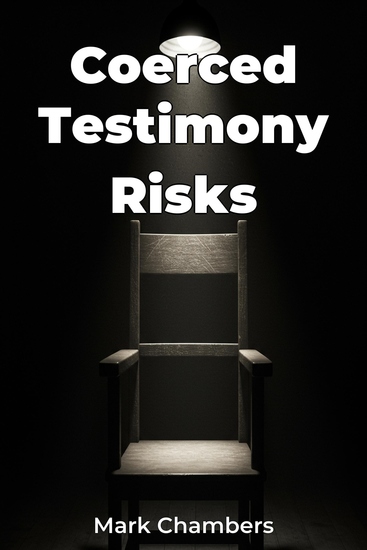
Coerced Testimony Risks - cover

Coerced Testimony Risks

Mark Chambers

Übersetzer A AI

Verlag: Publifye

  • 0
  • 0
  • 0

Beschreibung

Coerced Testimony Risks explores the troubling issue of forced confessions and witness statements within the American criminal justice system. It examines how psychological coercion during police interrogation can lead to false confessions, undermining due process and potentially resulting in wrongful convictions. The book reveals that even seemingly voluntary confessions can be unreliable due to sophisticated interrogation techniques and power imbalances.

 
The book delves into the legal precedents, like Miranda v. Arizona, that shape safeguards against self-incrimination, while also highlighting how "third degree" interrogation methods have evolved into modern psychological manipulation. By analyzing real-world case studies and trial transcripts, the book identifies patterns and warning signs of coerced testimony. It also discusses how implicit biases within the system can exacerbate the risk of obtaining coerced statements, despite existing legal protections.

 
Ultimately, Coerced Testimony Risks argues for a more comprehensive understanding of the psychological and legal factors that contribute to coercion. It progresses by first defining coercion and its forms, then analyzing case studies and psychological tactics, and finally, assessing legal standards. The book offers policy recommendations aimed at mitigating the risk of coerced testimony and ensuring fairer trials, making it a valuable resource for legal professionals, criminal justice reformers, and anyone concerned about the integrity of the justice system.
Verfügbar seit: 05.04.2025.
Drucklänge: 79 Seiten.

Weitere Bücher, die Sie mögen werden

  • The World As Will and Idea - cover

    The World As Will and Idea

    Arthur Schopenhauer

    • 0
    • 0
    • 0
    ", The World as Will and Idea" is a major work in Western philosophy, first published in 1818, in which Schopenhauer presents his unique philosophy of the world as being fundamentally driven by an irrational, insatiable will that underlies all phenomena. He argues that this will is the source of all human suffering and that the only way to attain true happiness and liberation from this suffering is to transcend one's individual will and identify with the universal will that animates all things. 
    Schopenhauer's ideas have been influential in many areas of philosophy and intellectual history, particularly in the fields of existentialism and psychology. "The World as Will and Idea" is considered a classic of Western philosophy and is widely studied and debated by scholars and students of philosophy.
    Zum Buch
  • Forget Me Not - Loving God's Aging Children - cover

    Forget Me Not - Loving God's...

    Elisabeth Elliot

    • 0
    • 0
    • 0
    What do we do when those we love are no longer able to care for themselves? How are we to face the brokenness and suffering of those to whom we once looked for strength? Elisabeth Elliot wrestled with these difficult questions while watching the steady erosion of her mother's memory - an erosion that seemed to devour every strong and noble attribute that made her mother who she was. This book contains insights Elisabeth gained as she struggled to find perspective.
    Zum Buch
  • Hungarian History - Hungary In World War 1 & 2 The Golden Age Of Football The Worst Inflation Ever Recorded And The Collapse Of Communism - cover

    Hungarian History - Hungary In...

    HISTORY FOREVER

    • 0
    • 0
    • 0
    ★ Did you know that Hungary once was considered one of the greatest powers in Central Europe? ★ 
    ★ Or better, did you know that Hungarians invented the Vitamin C, Safety Match and Colour Television? ★ 
    ★ GET THIS BOOK NOW AND DISCOVER WHAT IT TAKES TO BE A HUNGARIAN! ★In this book you will discover;Austria-Hungary in World War 1The Hungarian Romanian War - 1919The Hungarian Soviet RepublicThe Treaty of Trianon - 1920Hungary Joining the Axis PowersHungary Attacking the USSR - 1941The German Invasion of Hungary - 1944Hungary before the Revolution of 1956The Hungarian Revolution of 1956The Golden Age of Hungarian footballHistory of Hungarian Oil in World War 2Worst Inflation In World HistoryThe Collapse of Communism in Hungary 
    ★ GET THIS BOOK NOW AND DISCOVER WHAT IT TAKES TO BE A HUNGARIAN! ★
    Zum Buch
  • Critique of Interventionism - cover

    Critique of Interventionism

    Ludwig Von Mises

    • 0
    • 0
    • 0
    In "Critique of Interventionism," Ludwig von Mises delves into the economic consequences and philosophical underpinnings of government intervention in the market. Mises argues that interventionism, which involves state interference in economic affairs while maintaining private ownership, inevitably leads to unintended consequences, distortions, and economic inefficiencies. The book is a critical analysis of interventionist policies, examining their impact on individual freedom, economic coordination, and the overall functioning of a market economy.
    Zum Buch
  • Village Labourer 1760-1832 The: A Study in the Government of England before the Reform Bill - cover

    Village Labourer 1760-1832 The:...

    James L Hammond, Barbara...

    • 0
    • 0
    • 0
    Many histories have been written of the governing class that ruled England with such absolute power during the last century of the old régime. Those histories have shown how that class conducted war, how it governed its colonies, how it behaved to the continental Powers, how it managed the first critical chapters of our relations with India, how it treated Ireland, how it developed the Parliamentary system, how it saved Europe from Napoleon. One history has only been sketched in outline: it is the history of the way in which this class governed England. The writers of this book have here attempted to describe the life of the poor during this period. It is their object to show what was in fact happening to the working classes under a government in which they had no share. They found, on searching through the material for such a study, that the subject was too large for a single book; they have accordingly confined themselves in this volume to the treatment of the village poor, leaving the town worker for separate treatment. It is necessary to mention this, for it helps to explain certain omissions that may strike the reader.The growth and direction of economic opinion, for example, are an important part of any examination of this question, but the writers have been obliged to reserve the consideration of that subject for their later volume, to which it seems more appropriate. The writers have also found it necessary to leave entirely on one side for the present the movement for Parliamentary Reform which was alive throughout this period, and very active, of course, during its later stages.Two subjects are discussed fully in this volume, they believe, for the first time. One is the actual method and procedure of Parliamentary Enclosure; the other the labourers’ rising of 1830. Nowhere can the student find a full analysis of the procedure and stages by which the old village age was destroyed. The rising of 1830 is covered as well.
    Zum Buch
  • How to Make Money - An Ancient Guide to Wealth Management (series: Ancient Wisdom for Modern Readers) - cover

    How to Make Money - An Ancient...

    PLINY

    • 0
    • 0
    • 0
    Ancient Romans liked money. But how did they make a living and sometimes even become rich? The Roman economy was dominated by agriculture, but it was surprisingly modern in many ways: the Romans had companies with CEOs, shareholders, and detailed contracts regulated by meticulous laws; systems of banking and taxation; and a wide range of occupations, from merchant and doctor to architect and teacher. The Romans also enjoyed a relatively open society, where some could start from the bottom, work, invest, and grow rich. How to Make Money gathers a wide variety of ancient writings that show how Romans thought about, made, invested, spent, lost, and gave away money. 


    The Roman elite idealized farming and service to the state but treated many other occupations with suspicion or contempt, from money lending to wage labor. But whatever their attitudes, pecunia made the Roman world go round. In the Satyricon, Trimalchio brags about his wealth. Seneca accumulated a fortune—but taught that money can't buy happiness. Eumachia inherited a brick factory from her father, married well, and turned to philanthropy after she was widowed. How to Make Money also takes up some of the most troubling aspects of the Roman economy, slavery and prostitution, which the elite deemed unrespectable but often profited from.
    Zum Buch