Unisciti a noi in un viaggio nel mondo dei libri!
Aggiungi questo libro allo scaffale
Grey
Scrivi un nuovo commento Default profile 50px
Grey
Iscriviti per leggere l'intero libro o leggi le prime pagine gratuitamente!
All characters reduced
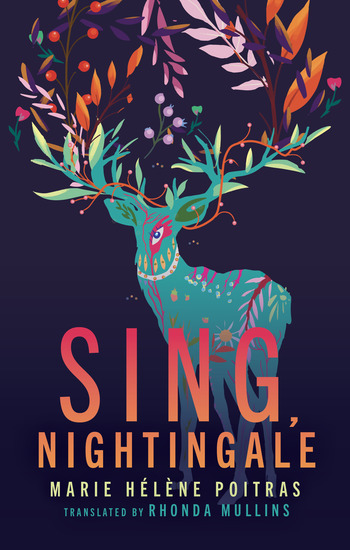
Sing Nightingale - cover

Sing Nightingale

Marie Hélène Poitras

Traduttore Rhonda Mullins

Casa editrice: Coach House Books

  • 0
  • 0
  • 0

Sinossi

CBC BOOKS - CANADIAN FICTION TO READ IN THE FIRST HALF OF 2023 
Peter Greenaway meets Angela Carter: a Gothic tale of secrets and revenge
   
When the curtain rises on Malmaison, it reveals a once-enchanting estate, quietly falling into darkness and ruin, and at the heart of it, a father, one of a long line of fathers who have flourished at the expense of those around them. The silence seems peaceful, but lurking under it is a deep malevolence, scores of ugly and violent secrets kept by cast-off mistresses and abandoned daughters.
   
Ever-greedy, the father brings in Aliénor, a woman who promises to make the lands give even more of themselves; the plants will flourish, the animals will multiply, each feast will be more sumptuous than the last. The father thinks the stage is set to satisfy his every desire, but Aliénor will bring a new script, one in which the hunters are hunted and a new reign will begin.
Disponibile da: 24/02/2023.
Lunghezza di stampa: 176 pagine.

Altri libri che potrebbero interessarti

  • No Place Like Murder - True Crime in the Midwest - cover

    No Place Like Murder - True...

    Janis Thornton

    • 0
    • 1
    • 0
    “This engrossing collection of historical Midwest murders reads like a thriller. True crime at its best. I couldn’t put it down.” —Susan Furlong, author of the Bone Gap Travellers novels 
     
    A modern retelling of 20 sensational true crimes, No Place Like Murder reveals the inside details behind nefarious acts that shocked the Midwest between 1869 and 1950. The stories chronicle the misdeeds, examining the perpetrators’ mindsets, motives, lives, apprehensions, and trials, as well as what became of them long after. 
     
    True crime author Janis Thornton profiles notorious murderers such as Frankie Miller, who was fed up when her fiancé stood her up for another woman. As fans of the song “Frankie and Johnny” already know, Frankie met her former lover at the door with a shotgun. 
     
    Thornton’s tales reveal the darker side of life in the Midwest, including the account of Isabelle Messmer, a plucky young woman who dreamed of escaping her quiet farm-town life. After she nearly took down two tough Pittsburgh policemen in 1933, she was dubbed “Gun Girl” and went on to make headlines from coast to coast. In 1942, however, after a murder conviction in Texas, she vowed to do her time and go straight. Full of intrigue and revelations, No Place Like Murder also features such folks as Chirka and Rasico, the first two Hoosier men to die in the electric chair after they brutally murdered their wives in 1913. The two didn’t meet until their fateful last night. 
     
    An enthralling and chilling collection, No Place Like Murder is sure to thrill true crime lovers. 
     
    “Thornton wittily describes heretofore unheralded true crime stories from Indiana’s small towns.” —Keven McQueen, author of Horror in the Heartland
    Mostra libro
  • Awakening to Your True Self - cover

    Awakening to Your True Self

    Zensho W. Kopp

    • 0
    • 0
    • 0
    In clear words, Zen Master Zensho W. Kopp shows us in an inspiring way how we can see through the deceptive nature of our concepts so that we rise up above our self-made limitations. Through this we transcend our identification with the unreal and reach the absolute reality of our true self. We experience a liberating transformation to a deeper and all-embracing universal consciousness and thus to freedom of the mind.
    Mostra libro
  • The Folklore of Rome - Myth Magic Dying and the Making of The Empire - cover

    The Folklore of Rome - Myth...

    Davis Truman

    • 0
    • 0
    • 0
    Step beyond the ruins and into the pulse of ancient Rome—not the Rome of marble triumphs and imperial decrees, but of whispered spells, ghostly omens, and mythic memory. The Folklore of Rome: Myth, Magic, Dying, and the Making of the Empire is an immersive exploration of how stories, superstitions, and sacred rites shaped the world’s most enduring civilization from its legendary beginnings to its imperial zenith. 
    In these pages, history meets enchantment. Chapter by chapter, the book reveals how Roman identity was bound to its folklore: the way Livy’s histories blurred myth and moral lesson, how domestic charms and street-corner incantations governed daily life, and how rituals of dying transformed death into a civic and spiritual act. From household gods to battlefield omens, from public festivals to private fears, Rome’s imagination was alive with unseen forces—powers that both inspired and restrained its people. 
    With vivid scholarship and a storyteller’s touch, The Folklore of Rome uncovers the Empire’s hidden heartbeat: the dreams, doubts, and supernatural beliefs that gave meaning to conquest and glory. More than a study of myths and rituals, it is a rediscovery of Rome as a living myth itself—a civilization forever poised between the mortal and the divine.
    Mostra libro
  • Ottoman Edges - cover

    Ottoman Edges

    Anonimo

    • 0
    • 0
    • 0
    This book offers a vivid, ground-level narrative of how the Ottoman Empire navigated two turbulent centuries of war, diplomacy, and reinvention. From the Treaty of Zsitvatorok to the French invasion of Egypt, this book follows shifting frontiers in the Balkans, the Caucasus, and the Arab provinces; the rise of provincial notables; the transformation of the Janissaries; the monetized pressures of silver and global trade; the aesthetics and politics of the Tulip Period; and the Empire’s steadily sharpening view of Europe. It explores how Russia and Austria surged, how forts and bridges became social institutions, how markets whispered the first warnings of defeat and recovery, and how knowledge—maps, manuals, and newspapers—turned into instruments of power. Bringing cities, soldiers, scholars, and merchants to life, the book reframes “decline” as an intense school of adaptation that culminated in the shock of 1798 Egypt—an ending that seeded the next Ottoman century of reforms.
    Mostra libro
  • Clouds - The Comic Portrait of Socrates – Aristophanes’ Satirical Play on Sophistry Education and Athenian Society - cover

    Clouds - The Comic Portrait of...

    Aristophanes, Tim Zengerink

    • 0
    • 0
    • 0
    What if the greatest threat to society wasn’t ignorance—but cleverness without conscience? 
    Clouds by Aristophanes is a scathing comedic masterpiece that lampoons Socratic philosophy and the Athenian obsession with rhetorical trickery. This modern translation revives the wit, rhythm, and political punch of Aristophanes’ classic play, in which a debt-ridden father seeks to cheat his way to freedom by mastering the art of deceit—under the tutelage of a ridiculous, cloud-dwelling Socrates. 
    What you’ll discover inside: 
    •	A satirical comedy skewering philosophy, education, and generational conflict 
    •	A wildly irreverent portrait of Socrates and his absurd “Thinkery” 
    •	A sharp critique of sophistry, relativism, and rhetorical manipulation 
    •	A lively and accessible modern translation of Aristophanes’ classic 
    Join the riotous drama where logic tangles, thunder rumbles, and the line between wisdom and foolishness vanishes in the clouds.
    Mostra libro
  • Anatolia and the Bronze Age: The History of the Earliest Kingdoms and Cities that Dominated the Region - cover

    Anatolia and the Bronze Age: The...

    Editors Charles River

    • 0
    • 0
    • 0
    While the Bronze Age is recognized as one of history’s most important phases, it’s been hard for historians to precisely date. The idea of the Bronze Age comes from a three-age system developed in the 19th century through which archaeologists and historians believe cultures evolve. These three ages are the Stone Age, the Bronze Age, and the Iron Age, and the concept of the system stems from the simultaneous development of museums in Europe during that time. In the Royal Museum of Nordic Antiquities in Denmark, Christian Jürgensen Thomsen, the director of the museum, began classifying objects of stone, bronze, or iron to better categorize and exhibit them. Each archaeological artifact was thus sorted according to their materials and further organized by shape and style. Through such methodology, working alongside archaeological reports, he was able to show how certain objects changed over time. 
    	During the Late Bronze Age, from about 1500-1200 BCE, the Near East was a time and place where great kingdoms and empires vied for land and influence, playing high stakes diplomatic games, trading, and occasionally going to war with each other in the process. The Egyptians, Hittites, Babylonians, Assyrians, and several smaller Canaanite kingdoms were all part of this system, which was one of the first true “global” systems in world history and also one of the most materially prosperous eras in antiquity. The major kingdoms are well-known to most people, but among them were powerful neighbors, many of whom have been mostly overlooked.  
    The transition from the Bronze to the Iron Age during the late 13th and early 12th centuries BCE arguably changed the structure and course of world history more fundamentally than any period before or since, and at the center of this period of turmoil was a group of people known today as the Sea Peoples, the English translation of the name given to them by the Egyptians.
    Mostra libro