Rejoignez-nous pour un voyage dans le monde des livres!
Ajouter ce livre à l'électronique
Grey
Ecrivez un nouveau commentaire Default profile 50px
Grey
Abonnez-vous pour lire le livre complet ou lisez les premières pages gratuitement!
All characters reduced
A Sin of Omission - cover

A Sin of Omission

Marguerite Poland

Maison d'édition: Envelope Books

  • 0
  • 0
  • 0

Synopsis

A powerful novel about innocent faith and an abuse of trust 
 
Torn from his parents as a child, Stephen Mzamane is picked by the Anglican church to train at the Missionary College in Canterbury and then sent back to southern Africa’s Cape Colony to be a preacher. 
 
He is a brilliant success, but troubles stalk him: his unresolved relationship with his family and people, the condescension of church leaders towards their own native pastors in the 1870s, and That Woman—seen once in a photograph and never forgotten. And now he has to find his mother and take her a message that will break her heart. 
 
In this raw and compelling story, Marguerite Poland employs her massive experience as a writer and African linguist to recreate the polarised, duplicitous world of Victorian colonialism and its betrayal of the very people that it claimed to be enlightening.
Disponible depuis: 18/10/2024.
Longueur d'impression: 420 pages.
D'autres livres qui pourraient vous intéresser

  • A Saga of the Seas - From their pens to your ears genius in every story - cover

    A Saga of the Seas - From their...

    Kenneth Grahame

    • 0
    • 0
    • 0
    Kenneth Grahame was born on 8th March 1859 in Edinburgh. 
    At age 5 his mother succumbed to puerperal fever.  His father, who had a drinking problem, now sent his 4 children to live with their grandmother at her large house in Cookham, Berkshire. Here the children lived in large open grounds next to the river.  These early experiences would in later years, be retold in his writing through a myriad of characters. 
    Grahame loved being a pupil at St Edward's School, Oxford and wanted to enroll at the university there but his guardian demurred on account of the cost. 
    Instead, a banking career was chosen for him, starting in 1879 at the Bank of England, where he rose steadily to the rank of its Secretary until retiring, with a pension, in 1908 due to ill health. 
    Alongside his commercial career Grahame had written and published various stories and essays in several periodicals. Some were anthologized as ‘Pagan Papers’ in 1893, and two years later ‘The Golden Age’ and later still ‘Dream Days’ and its masterpiece ‘The Reluctant Dragon’ became part of many home libraries.  His ability to view life through the lens of a young and curious child was superb, enabling the reader to easily identify with the character.   
    Grahame married Elspeth Thomson in 1899 and they had one child; Alastair, born semi-blind and plagued by health problems.  In a heart-rending tragedy he would later take his own life whilst attending Oxford University in 1920.   
    In 1908 Grahame reworked many of the bedtime stories he had fashioned for his son into the enduring favourite; ‘The Wind in the Willows’, describing the heart-warming adventures of Mr Toad and his friends.   
    Kenneth Grahame died in Pangbourne, Berkshire, on 6th July 1932.
    Voir livre
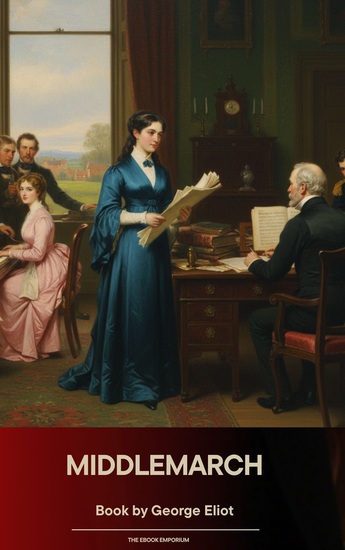
  • Middlemarch - cover

    Middlemarch

    George Eliot

    • 0
    • 0
    • 0
    "The growing good of the world is partly dependent on unhistoric acts."
    
    Set in a fictional Midlands town during the social upheaval of the 1832 Reform Act, Middlemarch is a sprawling, deeply moving tapestry of human life. It follows the parallel lives of Dorothea Brooke, an idealistic woman seeking a "grand life" of purpose, and Tertius Lydgate, a brilliant young doctor determined to revolutionize medicine. Both find their lofty ambitions shackled by the realities of unhappy marriages and the suffocating weight of social gossip. George Eliot's "Study of Provincial Life" is a brilliant exploration of how our smallest choices and hidden sacrifices shape the world around us.
    
    The Masterpiece of Realism: Eliot doesn't rely on melodrama or easy villains. Instead, she offers an unprecedented level of psychological depth, showing how even "mediocre" people struggle with their consciences. Through characters like the dry scholar Edward Casaubon and the charismatic but troubled Will Ladislaw, she examines the gap between our private dreams and our public failures.
    
    A Mirror of History: While deeply personal, the novel is also a brilliant historical document. It captures a moment of massive transition—the arrival of the railroads, the rise of modern science, and the birth of political reform. Eliot argues that history isn't just made by "Great Men," but by the "hidden lives" of ordinary people striving to be better.
    
    Discover the novel that Virginia Woolf called "one of the few English novels written for grown-up people." Purchase "Middlemarch" today.
    Voir livre
  • David Copperfield - The Classic Tale - cover

    David Copperfield - The Classic...

    Charles Dickens

    • 0
    • 0
    • 0
    First published in 1850, David Copperfield begins with avid the tragedy of David's brother dying when David is just a boy. After this episode, he is sent by his step-father to work in London for a wine merchant. When conditions worsen he decides to run away and embarks on a journey by foot from London to Dover. On his arrival, he finds his eccentric aunt, Betsey Trotwood who becomes his new guardian. Being witness to the formation of David's character is quite fascinating. David begins as a strong child whose only aspiration is a better life. On the way to his adulthood, David sees how people enter and leave his life. Romanticism takes its place in David’s life as he gets married to Dora Spenlow who is not long for this world. Will David ever find stability and happiness? And what of his wife? Dickens proves to be a master in creating an autobiographical work that is a captivating page-turner.
    Voir livre
  • The Death of Justina - cover

    The Death of Justina

    John Cheever

    • 0
    • 0
    • 0
    Read by Meryl Streep 
    Here is one of twelve magnificent stories, originally part of The John Cheever Audio Collection, in which John Cheever celebrates—with unequaled grace and tenderness—the deepest feelings we have. 
    As Cheever writes in his preface, ""These stories seem at times to be stories of a long-lost world when the city of New York was still filled with a river light, when you heard the Benny Goodman quartets from a radio in the corner stationery store, and when almost everybody wore a hat.""
    Voir livre
  • The Great Wall of China - cover

    The Great Wall of China

    Franz Kafka

    • 0
    • 0
    • 0
    "The Great Wall of China" is a short story by Franz Kafka. While written in 1917, it was not published until 1930, seven years after his death. Its first publication occurred in Der Morgen, a German literary magazine. A year later, Max Brod included it in Beim Bau der Chinesischen Mauer, the first posthumous collection of short stories by Franz Kafka.Contained within the story is a parable that was separately published as "A Message from the Emperor" ("Eine kaiserliche Botschaft") in 1919 in the collection Ein Landarzt (A Country Doctor). Some sub-themes of the story include why the wall was built piecemeal (in small sections in many different places), the relationship of the Chinese with the past and the present and the emperor's imperceptible presence. The story is told in the first person by an older man from a southern province.The first English translation, by Willa and Edwin Muir, was published by Martin Secker in London in 1933. It appeared in The Great Wall of China. Stories and Reflections (New York City: Schocken Books, 1946).
    Voir livre
  • Happy Family The - Story Time Episode 69 (Unabridged) - cover

    Happy Family The - Story Time...

    Hans Christian Andersen

    • 0
    • 0
    • 0
    The Happy Family (1848): The largest green leaf in this country is certainly the burdock-leaf. If you hold it in front of you, it is large enough for an apron; and if you hold it over your head, it is almost as good as an umbrella, it is so wonderfully large. A burdock never grows alone; where it grows, there are many more, and it is a splendid sight; and all this splendor is good for snails. The great white snails, which grand people in olden times used to have made into fricassees; and when they had eaten them, they would say, "O, what a delicious dish!" for these people really thought them good; and these snails lived on burdock-leaves, and for them the burdock was planted...
    Voir livre