Join us on a literary world trip!
Add this book to bookshelf
Grey
Write a new comment Default profile 50px
Grey
Subscribe to read the full book or read the first pages for free!
All characters reduced
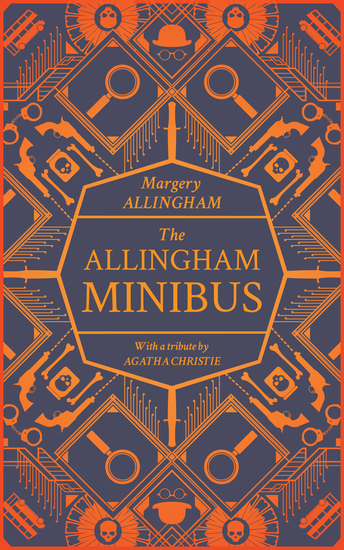
The Allingham Minibus - cover

The Allingham Minibus

Margery Allingham

Publisher: Open Road Media Mystery & Thriller

  • 0
  • 0
  • 0

Summary

A collection of eighteen classic Golden Age short stories from “the best of mystery writers”—with a tribute by Agatha Christie (The New Yorker).   Acclaimed by critics and her peers, Margery Allingham was one of the finest writers of her day, crafting fiction that challenged readers’ crime-solving skills and kept them on the edge of their seats. Foul play, mystery, and the macabre set the stage for unforgettable characters who struggled with the complexities of life and their own morality.   In these pages, you’ll find eighteen stories that showcase Margery Allingham’s wit, sharp characterization, and clever plotting. From her famous detective’s swift dispatch of a case in “Mr. Campion’s Lucky Day,” to ghost-hunting in a terrorized village in “’Tis Not Hereafter,” to a debate about—and proof of—good and evil in “The Wink,” Margery Allingham shows why she “deserves to be rediscovered” (P. D. James, New York Times–bestselling author).  Praise for Margery Allingham   “[Allingham was a] rare and precious talent.” —The Washington Post   “Don’t start reading these books unless you are confident that you can handle addiction.” —The Independent   “One of the finest Golden-Age crime novelists.” —The Sunday Telegraph  
Available since: 05/30/2023.
Print length: 258 pages.

Other books that might interest you

  • Coffee Tea or Murder? - A Murder She Wrote Mystery - cover

    Coffee Tea or Murder? - A Murder...

    Jessica Fletcher, Donald Bain

    • 0
    • 0
    • 0
    In this installment of the USA Today bestselling series, Jessica Fletcher, Cabot Cove's crime-solving novelist, is on a new airline's maiden flight when murder occurs en route. 
    When Cabot Cove's own Wayne Silverton wants to debut his new airline, he invites Jessica Fletcher and other locals on the inaugural flight from Boston to London. Jessica is thrilled for the opportunity to visit a dear friend, Scotland Yard inspector George Sutherland. But the reunion hits turbulence when George is called to the airport to investigate the apparent murder of Wayne Silverton. Jessica and George decide to put their finely honed sleuthing skills together and investigate. But there is a full passenger list of suspects who have something to gain by Silverton's demise. Now Jessica will have to catch a killer before she can catch a flight home.
    Show book
  • Murder in Cairo - cover

    Murder in Cairo

    Martha Bond

    • 0
    • 0
    • 0
    Beware of the Pharaoh's Curse! 


    Young sleuth, Lottie Sprigg, accompanies her employer to Cairo—a city flushed with excitement after the discovery of Tutankhamun's tomb. But a shadow looms after the untimely death of Lord Carnarvon—could the Pharaoh's Curse be real? 


    Fears are confirmed when a wealthy hotel guest is poisoned. While some blame the long-dead pharaoh, Lottie's suspicions fall on her fellow guests. They're all up to no good, but can she work out why? 


    Another murder leaves the Cairo police baffled. Lottie's gathered some clues and thinks she's on the right track. But before she can act, her beloved dog, Rosie, is in danger . . .
    Show book
  • The Conflict - cover

    The Conflict

    Mike Ryan

    • 0
    • 0
    • 0
    The war with Ames only intensifies for Brett Jacobs in this explosive edition of The Eliminator Series. 
    With Wilson Ames now his number one focus because of what he did to his friend, Eddie Franks, Jacobs is willing to do anything to get his revenge. And that includes teaming up with people he normally wouldn’t. 
    But Ames will not go down without a fight. He will attempt to do what Rich Mallette couldn’t. He will try to finish The Eliminator and he will do it in any way possible. That includes using someone who appears to be getting closer to Jacobs’ affections. 
    It will all culminate in an action-packed and explosive finale as Jacobs tries to prevent history from repeating itself.
    Show book
  • Not Alive Not Dead - cover

    Not Alive Not Dead

    John Donoghue

    • 0
    • 0
    • 0
    With secrets and corruption hidden behind locked doors, this historical thriller is perfect for fans of Conclave 
     
    Buenos Aires, 1976. A military junta has taken power and rules Argentina with an iron fist. People are going missing. There are whispers of secret detention centres, of torture and murder behind locked doors. 
     
    Pablo Morales, a young priest, doesn't believe the rumours, until he hears a series of confessions that force him to confront the truth of the government's crimes - as well as the complicity of the Catholic Church. 
     
    Torn between his faith, his ambition and his conscience, Pablo knows he must investigate. 
     
    But the deeper he explores this dangerous world rife with corruption and violence, the harder it will be to ever escape it . . .
    Show book
  • Bury the Wren - cover

    Bury the Wren

    Carlene O'Connor

    • 0
    • 0
    • 0
    Amidst the stark, lonely beauty of southwest Ireland’s windswept coast, veterinarian Dimpna Wilde wrangles with dark traditions, village folklore, and a killer’s motives during the annual Wren Day celebration in this deeply atmospheric and suspenseful County Kerry novel for readers of Dervla McTiernan, Lin Anderson, and Louise Penny. 
    Dingle is a town steeped in folklore, where old traditions like Wren Day linger like mist on the Kerry mountains. On the day after Christmas, St. Stephen’s Day, the wren boys—local lads from competing neighborhoods—paint their faces and dress in straw garb to march through town. In times past, the tiny body of a wren would be displayed during the parade. According to legend, the little bird deserved to die for betraying St. Stephen’s hiding place to his enemies. 
    These days, Wren Day is a kinder affair, with different groups vying to raise money for charity. But this year’s celebration gets off to an ominous start when Dimpna finds a dead wren on her doorstep. Things take a darker turn when one of the wren boys is found strangled, thick fisherman rope still around his neck. Then Dimpna goes to return her friend Paul Byrne’s dog to his house and discovers Paul dead—with a wren’s body beside him. 
    Is someone sending a message that Paul was a traitor, or this an effort to cast suspicion on the wren boys? And how are the deaths connected? While Detective Sergeant Cormac O’Brien, visiting from Dublin, begins to investigate, Dimpna immerses herself in tangled motives that harken back to past tragedies, and a case that has become deeply personal. For it’s not only traditions that persist here, grudges and secrets do too . . .
    Show book
  • Sybil or the Two Nations - cover

    Sybil or the Two Nations

    Benjamin Disraeli

    • 0
    • 0
    • 0
    Sybil is one of the most prominent political novels of the mid-nineteenth century, taking as its subject the "condition of England" question. That phrase was first used by Thomas Carlyle in an essay of 1839 on Chartism, a working-class protest movement that plays a prominent role in this novel. The two nations are the rich and the poor, and the increasing gulf between them, and their condition also inspired such writers as Charles Dickens and Mrs. Gaskell, among others (one of whom, Friederich Engels, was the disciple of Karl Marx, and in his The Condition of the Working Class in England in 1844 described the appalling effects of the industrial revolution a year before Sybil appeared).Disraeli, of course, was far from being a Marxist though, like Engels, his sympathies are with the poor, exemplified in this book particularly by the Chartists, who were active between roughly 1839 and 1848. In his view, the villains are the aristocratic Whigs and Whig-Liberals, who, ever since the despoliation of the monasteries by Henry VIII in the sixteenth century, had made sure that the moneys which had been used for the alleviation of social distress and poverty, now flowed into their own pockets, leaving the poor with little recourse to help. His solution, which he sought to put into effect when he later became Prime Minister, was to push for measures of what he called "Tory democracy," or a kind of "compassionate conservatism," though quite different from the sort recently seen in the United States.Whatever one thinks of his politics, Disraeli tells a good story, in this case about the love of the aristocratic Charles Egremont for the lovely Chartist Sybil Gerard. In 2003, the Guardian ranked Sybil as No. 15 on its list of Hundred Greatest novels, and some consider it the best political novel of the nineteenth century. There is also general agreement that Disraeli (Lord Beaconsfield, as he became) and Winston Churchill are probably the only two prime ministers who can be seen as successes in the world of literature as well as that of politics. (Summary by Nicholas Clifford)
    Show book