Rejoignez-nous pour un voyage dans le monde des livres!
Ajouter ce livre à l'électronique
Grey
Ecrivez un nouveau commentaire Default profile 50px
Grey
Abonnez-vous pour lire le livre complet ou lisez les premières pages gratuitement!
All characters reduced
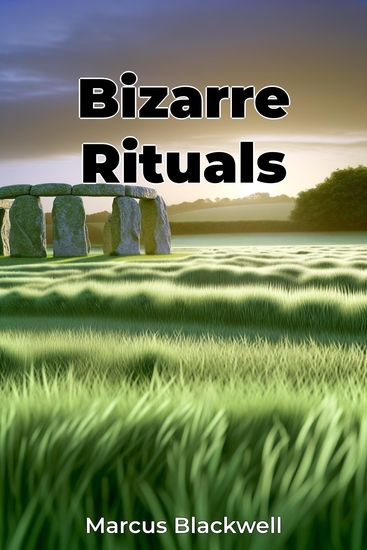
Bizarre Rituals - cover

Bizarre Rituals

Marcus Blackwell

Traducteur A AI

Maison d'édition: Publifye

  • 0
  • 0
  • 0

Synopsis

"Bizarre Rituals" delves into the world of cultural rituals, exploring traditions across various societies and historical periods. It argues that seemingly strange practices serve vital social and psychological functions. These rites often reinforce social bonds, transmit cultural values, and manage anxieties. For instance, funerary rites help communities cope with mortality, while rites of passage mark significant life transitions such as adulthood or marriage. The book examines rituals related to life and death, rites of passage, and practices designed to ensure prosperity. It draws from ethnographic studies, historical records, and anthropological research to provide detailed descriptions and historical context. By analyzing these rituals, the book offers insights into social behavior, belief systems, and cultural diversity. It emphasizes understanding rituals within their original cultural context, avoiding ethnocentric biases, and acknowledging ongoing debates about ritual symbolism and power dynamics. The book progresses chapter by chapter, investigating specific categories of rituals and culminating in a synthesis of their universal functions and impact on human societies. This approach allows readers to grasp the significance of bizarre rituals and their place in world history and social science. It is an informative exploration of the social science behind how diverse cultures function.
Disponible depuis: 12/02/2025.
Longueur d'impression: 64 pages.

D'autres livres qui pourraient vous intéresser

  • The Irish Troubles - Conflict and Peace in Northern Ireland - cover

    The Irish Troubles - Conflict...

    Nova Ashford

    • 0
    • 0
    • 0
    The deep divisions that came to define the Troubles in Northern Ireland have their roots in centuries of conflict, conquest, and colonization. The split between the largely Catholic Irish population and the Protestant settlers brought by British rule laid the groundwork for enduring hostility. This divide was not merely religious but deeply political and cultural, with Catholic nationalists largely advocating for a united Ireland, while Protestant unionists were loyal to the British crown and sought to remain part of the United Kingdom. These opposing identities hardened over time, especially in the north, where British colonization during the 16th and 17th centuries planted a Protestant presence in predominantly Catholic lands, most notably in the province of Ulster. 
    The 1921 partition of Ireland formalized the division, creating Northern Ireland as a separate political entity within the United Kingdom. While the south eventually became the Republic of Ireland, the north remained under British control with a Protestant-majority government. This arrangement was viewed by many Catholics as both illegitimate and oppressive, fostering a sense of exclusion and marginalization. Protestants, in turn, felt under siege by the threat of Irish republicanism and feared losing their political and cultural dominance. The new state was marked from the beginning by systemic discrimination against the Catholic minority in areas such as housing, employment, and political representation. 
    Tensions simmered for decades, occasionally flaring into violence, but it was in the 1960s that the situation began to unravel. Inspired by civil rights movements elsewhere, Northern Irish Catholics began organizing protests demanding equal treatment and an end to institutionalized bias. The state’s heavy-handed response to these demonstrations, combined with Protestant fears of losing control, only intensified the divide.
    Voir livre
  • The Persian Continuum - cover

    The Persian Continuum

    Santiago Machain

    • 0
    • 0
    • 0
    The Persian Continuum traces how the Achaemenid Empire’s administrative genius, religious pragmatism, and infrastructural vision shaped a vast world stretching from the Aegean to the Indus—and how Alexander’s lightning conquests disrupted but did not erase that order. Through a sequence of richly drawn chapters, the book follows the Persian high tide under Xerxes, the long wars and negotiations with Greek city-states, and the empire’s resilient governance from Egypt to Bactria. It then charts Macedon’s rise under Philip II, Alexander’s campaigns and statecraft, and the striking continuity of Persian institutions under Hellenistic rulers. 
    Beyond conquest, the narrative explores what came after: Seleucid experiments in Greek cityhood layered over Iranian provincial rule, Parthian aristocratic federalism built on cavalry and caravan routes, and Sasanian resurgence with law, priesthood, and fortified frontiers. The final chapters bring the story into the present, revealing how Achaemenid ideas—satrapies and couriers, plural law and shared rituals, standardized coinage and road networks—continue to inform modern governance, diplomacy, and identity. Blending military history with economic systems, religious life, and everyday experience, the book illuminates how empires rise and endure, and how their vocabularies of order survive long after the names on the coins have changed.
    Voir livre
  • How Would You Like Your Mammoth? - 12000 Years of Culinary History in 50 Bite-Size Essays - cover

    How Would You Like Your Mammoth?...

    Uta Seeburg, Max Miller

    • 0
    • 0
    • 0
    Did you know that Egyptians mummified beef ribs for their dearly departed to enjoy in the afterlife? That Roman gladiators were relegated to a vegan diet of grains and beans? That the fast-food hamburger was a result of a postwar, high-efficiency work ethic? This is not a cookbook; instead, How Would You Like Your Mammoth? is a chronological journey through the culinary history of humankind, with fifty short, snackable essays packed to the brim with juicy tidbits and cultural insights. With author Uta Seeburg as your guide, you'll learn not only which dishes are linked to key cultural moments, but also how each represents the social hierarchy and values of the civilization that invented it. 
     
    Discover how and why: the Columbian exchange gave Indian curry its spicy kick; roasted swan became the centerpiece of choice in spectacle-loving 1650s high society; a Portuguese princess helped popularize tea in England; the first dish ever to be prepared live on television was an omelet; and much more. 
     
    Foodies and history buffs alike will savor every amusing yet educational historical snapshot, from one of the oldest recorded recipes (lamb stew with barley and onions) to out-of-this-world food fit for astronauts (dehydrated chicken soup just like mom used to make).
    Voir livre
  • The Relevance of Buddhism in the Modern World - cover

    The Relevance of Buddhism in the...

    Princess Poon Pismai Diskul

    • 0
    • 0
    • 0
    This is an audiobook of Bodhi Leaves No. 43 by Princess Poon Pismai Diskul, The Relevance of Buddhism in the Modern World narrated by Gregory M. Dams. The print edition can be found in the Pariyatti Edition of Collected Bodhi Leaves Vol. 2. The eBook of Bodhi Leaves No. 43 can be downloaded from the BPS website.
     
    Excerpt:
     
    Throughout history, the practice, adherence and belief in religion has been a virtually universal aspect of human society. And as a rule, the increase in complexity and sophistication of a given culture has borne with it an accompanying increase in the level of ethical and philosophical development of that society’s religious thought.
     
    Today, however, the world witnesses a level of civilization and social complexity far surpassing that of any previous era. Yet out of the great thoughts and discoveries of our time, no new major religion has evolved. Whatever new religious concepts may have appeared, they have failed to reach the masses of humanity in the form of altering basic beliefs and practices. Most of the new reforms that modern institutions sometimes announce with pride are actually negative in character; that is, the termination of outmoded practices and the relinquishment or reinterpretation of embarrassing dogmas. ...
    Voir livre
  • How Antigravity Built the Pyramids - The Mysterious Technology of Ancient Superstructures - cover

    How Antigravity Built the...

    Nick Redfern

    • 0
    • 0
    • 0
    Discover the Lost Secrets of the Ancients and the Time When Stones Floated High over Egypt   Throughout history, folklore, and mystery, tales have circulated of massive stones being moved through the air effortlessly by sound. Bizarre? Well, yes, it is. That doesn't take away the fact that sound was, and still remains, the key to the construction of the pyramids of Egypt, Stonehenge, the stone figures of Easter Island, and the massive stones at Baalbek, Lebanon. Were they the work of ancient humans or of equally ancient extraterrestrials?How Antigravity Built the Pyramids delves into specific stories and theories:• A 9th-century story of a mysterious papyrus with the power to move large stones at the Giza Necropolis • The Mayan story of the construction of the Pyramid of the Magician said to be overseen by a small humanoid who could whistle large stones into place • Native American stories of ancient priests being able to make stones light to move easily    Author Nick Redfern argues it was not literally music and whistling that somehow raised large stones, but both have one thing in common: sound. Acoustics. Almost certainly, acoustic levitation was at the heart of these incredible feats. The truth of the science behind acoustic levitation was lost and forgotten for ages with little more left than fanciful tales of music, whistles, a curious papyrus, and strange metal rods that could achieve incredible feats in the air. Today, we are finally starting to get a grasp on this incredible technology, a technology that may have been the work of ancient humans, aliens from faraway worlds—or, perhaps, a combination of the two.
    Voir livre
  • Russian History Through the Ages - Empire Enlightenment and the Road to Revolution - cover

    Russian History Through the Ages...

    History Retold

    • 0
    • 0
    • 0
    Dive into the enthralling world of Russia's past with the second book of our captivating series about Russian history. This mesmerizing book takes you on a journey through a pivotal era in Russian history, where empires expanded, new ideas flourished, and the seeds of revolution were sown. 
    Witness the grandeur and might of the Russian Empire as it reached new heights under visionary rulers like Catherine the Great and Peter the Great. Explore the impact of the Enlightenment on Russia's intellectual and cultural landscape, as the nation embraced new ideas and engaged with the wider world. 
    Experience the mounting social unrest and revolutionary fervor that would ultimately pave the way for the momentous events of the 20th century. Delve into the lives of influential figures like Alexander II and the Decembrists, whose actions and ideas would shape the course of Russian history. 
    "Russian History Through the Ages: Empire, Enlightenment, and the Road to Revolution 1700-1906" masterfully combines vivid storytelling with expert analysis, providing readers with a comprehensive and engaging account of this critical period in Russia's development. This accessible and informative book is perfect for history enthusiasts and newcomers alike. 
    Don't miss the opportunity to immerse yourself in the captivating tales of Russia's past. Order your copy Today! And dive into Russia’s thrilling past. 
    Voir livre