Rejoignez-nous pour un voyage dans le monde des livres!
Ajouter ce livre à l'électronique
Grey
Ecrivez un nouveau commentaire Default profile 50px
Grey
Abonnez-vous pour lire le livre complet ou lisez les premières pages gratuitement!
All characters reduced
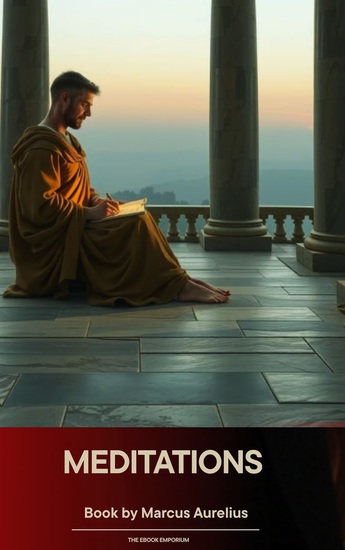
Meditations - cover

Meditations

Marcus Aurelius

Maison d'édition: The Ebook Emporium

  • 0
  • 0
  • 0

Synopsis

"Written in the heat of battle and the halls of power—the ultimate guide to mastering your mind."

Meditations is a collection of twelve books containing the private thoughts of the most powerful man in the ancient world. Writing to himself as a form of spiritual exercise, Marcus Aurelius explores how to remain virtuous in a world of vice, how to find tranquility in the face of death, and how to perform one's duty without complaint. He argues that while we cannot control external events, we have absolute power over our own thoughts and reactions. This isn't just a book of philosophy; it is a practical blueprint for living a life of purpose, integrity, and calm.

The Core Principles of Stoicism: Through pithy aphorisms and deep introspection, Aurelius focuses on the concept of the Amor Fati (love of fate) and the Dichotomy of Control. He reminds himself—and the reader—that everything is change, and that the only thing that truly matters is the quality of one's character.

A Leader's Inner Battle: Unlike other philosophical texts, Meditations is deeply personal. It captures an emperor reminding himself to be patient with "tiresome people," to avoid the temptations of fame, and to stay grounded in the present moment. It remains a favorite of world leaders, athletes, and entrepreneurs for its brutal honesty and practical application.

Why It Matters Today: In an age of constant distraction and anxiety, Marcus Aurelius's words are more relevant than ever. He teaches us that "the happiness of your life depends upon the quality of your thoughts" and provides the tools to build an "inner citadel" that no external force can break.

Master your mind and conquer your world. Purchase "Meditations" today.
Disponible depuis: 15/01/2026.
Longueur d'impression: 154 pages.

D'autres livres qui pourraient vous intéresser

  • The Korean Conflict - From Causes to Consequences - Exploring the Events of the Korean War - cover

    The Korean Conflict - From...

    History Retold

    • 0
    • 0
    • 0
    Are you looking for a guide to the history of the Korean War? 
    This short book provides a clear and accessible overview of the causes, events, and consequences of the Korean War. 
    The book is packed with detailed descriptions of key battles, insightful analysis of major political decisions, and eye-opening accounts of life on both sides during wartime.  
    You'll learn about:  
    • The origins of the conflict in Korea's divided government  
    • The role played by regional powers like China and Japan  
    • How America's Cold War policies impacted the fighting  
    • The devastating humanitarian costs suffered by civilians on both sides  
    • And much more! 
      
    This book is sure to help you gain a better understanding of this crucial period in modern history. 
     Don't miss out on your chance to understand one of history’s most important conflicts – buy the book today!
    Voir livre
  • Esther's Army - The Christian Women Who Power the American Right - cover

    Esther's Army - The Christian...

    Katie Gaddini

    • 0
    • 0
    • 0
    How and why right-wing Christian women have risen to the forefront of American politics. 
     
    For decades, conservative Christian women have been dismissed as naive and brainwashed, victims of political coercion by the men in their lives. Yet that narrative doesn’t explain how they have also become some of the most influential political organizers of our time: the backbone of the modern conservative movement whose strategic efforts over the past six decades have culminated in the 2024 election of Donald Trump. 
    To understand this unique and growing political force, sociologist Katie Gaddini conducted over ten years of ethnographic research, interviewing key players in the field and joining them across the country as they organized, rallied, and celebrated. As a former evangelical, Gaddini speaks the language of the Christian Right fluently, and in Esther’s Army, she profiles six distinct archetypes: college idealists, (anti)feminist powerhouses, Black conservatives, MAHA social media influencers, white suburbanites, and “Mama Bears” marching on state capitols to ban books and gender initiatives. 
    Observing Christian women’s activism from grassroots networks to conservative universities to public politics and jobs at the White House—as they borrow feminist rhetoric to “lean in” to their executive skills while rejecting liberal feminism—Gaddini reveals how these women have turned being underestimated into a strategic force. The result is a sweeping portrait of the women shaping the political future of the United States.
    Voir livre
  • Chechnya and Dagestan: The History of the Chechen Republic and the Ongoing Conflict with Russia - cover

    Chechnya and Dagestan: The...

    Charles River Editors

    • 0
    • 0
    • 0
    Today, Chechnya is a republic with some degree of autonomy in the contemporary Russian Federation. Its population is just over a million people, and it stretches over an area of 17,000 square kilometers. The majority of Chechnya’s population is comprised of Sunni Muslims, meaning religion has played a key role in the territory’s development. In southwestern Russia, landlocked within 100 kilometers of the Caspian Sea, Chechnya is north of the Caucasian mountains, bordering other North Caucasus provinces such as North Ossetia, and Dagestan, and Georgia. 
    Russia itself is a well-established Slavic, Orthodox Christian country, though its majority Muslim provinces were not obvious to outsiders until the post-Soviet conflicts of the 1990s. The history of the Chechen people in the region is, nevertheless, long-established, and Chechnya has become synonymous with conflict, civil war, and discontent. While many people are aware of that, few understand how things reached that point. The area is complex and fascinating, representing one of the world’s true fault lines in terms of religion, empire, and geography. 
    Wedged in the North Caucasus mountain range and bordering the Caspian Sea, Dagestan is a true meeting point of cultures, religions and geopolitical rivalries. A crossroad between east and west, Dagestan has been vitally important at different times for various powers in Asia, Europe, and the Middle East, and even between different religious and ethnic groups. In spite of all that, and in large measure because of it, Dagestan’s society is a composite of these rivalries over the centuries. 
    Voir livre
  • German Literary History for Beginners an Exciting and Entertaining Journey Through German Literature From the Middle Ages to the Present Day - cover

    German Literary History for...

    Christian Möhlenkamp

    • 0
    • 0
    • 0
    This book is intended for readers who are looking for an introduction to the confusing diversity of German literature. The chronological order chosen is best suited for this purpose because, in contrast to topic- or genre-oriented ordering procedures, it shows a genesis and traces the genealogy of German literature. The fact that Goethe's novel Wilhelm Meisters Lehrjahre would most likely have looked completely different without Hans Jakob Christoffel von Grimmelshausen's Simplicissimus can be shown most easily and effectively in the context of a chronologically presented journey through time. And this is only one of many examples, especially in the field of poetry quite a few more could be found.
    
    "He who knows how to read holds the key to great deeds, to undreamed-of possibilities," Aldous Huxley once said. This book is intended to open up some of these possibilities for you.
    Voir livre
  • The Environmental Unconscious - Ecological Poetics from Spenser to Milton - cover

    The Environmental Unconscious -...

    Steven Swarbrick

    • 0
    • 0
    • 0
    Why has psychoanalysis long been kept at the margins of environmental criticism despite the theories of eco-Marxism, queer ecology, and eco-deconstruction available today? What is unique, possibly even traumatic, about eco-psychoanalysis? The Environmental Unconscious addresses these questions as it provides an innovative and theoretical account of environmental loss focused on the counterintuitive forms of enjoyment that early modern poetry and psychoanalysis jointly theorize. 


    Steven Swarbrick urges literary critics and environmental scholars to rethink notions of entanglement, animacy, and consciousness raising. Through close readings of Edmund Spenser, Walter Ralegh, Andrew Marvell, and John Milton, he reveals a world of matter that is not merely hyperconnected, as in the new materialism, but porous and off-kilter. And yet the loss these poets reveal is central to the enjoyment their works offer—and that nature offers. 


    The Environmental Unconscious offers a provocative challenge to ecocriticism that a new theory of disconnection is desperately needed. Tracing the propulsive force of the environmental unconscious from the early modern period to Freudian and post-Freudian theories of desire, Swarbrick not only puts nature on the couch in this book but also renews the psychoanalytic toolkit in light of environmental collapse.
    Voir livre
  • Tlaloc: The History of the Aztec God of Rain and Giver of Life - cover

    Tlaloc: The History of the Aztec...

    Charles River Editors

    • 0
    • 0
    • 0
    One of the reasons for the prevalence of Tlaloc in the Valley of Mexico is that in the semi-arid climate, water was a powerful daily symbol. Although there were no naturally occurring water connections to the sea, the high altitude of the mountains and volcanoes that surrounded it caught the rain water well and formed five important lakes: Xochimilco, Xaltocan, Zumpango, Chalco and Texcoco. As the largest, Texcoco was where the Aztecs eventually built their capital city Tenochtitlan. Since this was not a desert culture, their god Tlaloc was not just a reflection of an opposite extreme they desired; instead, he was a complex god that reflected the duality of water as both a boon and a force for destruction. From his home in Tlalocan, Tlaloc was able to send good and bad waters to the people of the Valley of Mexico and beyond. He was the lord of the chthonic powers of Mexico even as far south as the Maya, who called him Chaac and connected him with warfare and agriculture much the same way the Aztec did. 
    What is known today is that Tlaloc was the god who granted good harvests and caused famines. The Aztec tell the story of Tlaloc blessing their rise to regional dominance by sending a famine to the Toltec, and his duality of good waters vs. bad waters was a product of the largely two-season system in Mexico. This was also one reason for his role in warfare since the Aztec focused on agriculture during his “wet” season and marched off to conquest if they had received his blessings. He was an earth deity, connected with aquatic animals and underground streams, and therefore also a god connected with fertility. This is reflected through his association with his wife, Xochiquetzal, the goddess of flowers, pleasure, young female sexuality and pregnancy, in the earlier myths. 
    All in all, Tlaloc is one of the most important and least well-known gods from an outsider’s perspective. 
    Voir livre