Join us on a literary world trip!
Add this book to bookshelf
Grey
Write a new comment Default profile 50px
Grey
Subscribe to read the full book or read the first pages for free!
All characters reduced
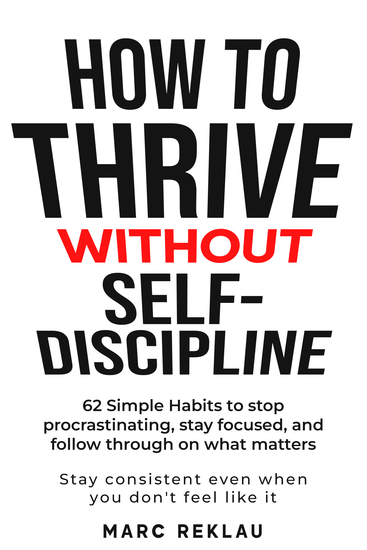
How to Thrive Without Self-Discipline - 62 Simple Habits to stop procrastinating stay focused and follow through on what matters - cover

How to Thrive Without Self-Discipline - 62 Simple Habits to stop procrastinating stay focused and follow through on what matters

Marc Reklau

Publisher: Publishdrive

  • 0
  • 0
  • 0

Summary

Do you find yourself stuck in an endless cycle of starting strong but never following through? What if the path to success wasn't about having more discipline, but about making it unnecessary?
 
Marc Reklau knows firsthand the frustration of feeling like you're not disciplined enough to achieve your goals. After hitting rock bottom and losing his job in 2013, he discovered something revolutionary: true success isn't about forcing yourself to do things you hate, but about creating systems that make good choices automatic. Through personal experience and extensive research, he developed a groundbreaking approach that has helped thousands break free from the myth of willpower-based achievement. His method isn't about suffering through tasks - it's about designing your life so that success becomes the path of least resistance.
 
'How to Thrive Without Self-Discipline' offers a revolutionary approach to achievement that works even if you think you're the most undisciplined person in the world. These 62 habits will transform your approach to success, making it feel natural and effortless.
 
Take control of your future - buy your copy and start thriving today!
Available since: 08/26/2025.
Print length: 184 pages.

Other books that might interest you

  • Traces of Enayat - cover

    Traces of Enayat

    Iman Mersal

    • 0
    • 0
    • 0
    "A subtle and universal exploration of identity." —Aida Alami, the New York Times 


    Cairo, 1963: four years before her lone novel is finally published, the writer Enayat al-Zayyat takes her own life at age twenty-seven. For the next three decades, it's as if Enayat never existed at all. 


    Years later, when celebrated Egyptian poet Iman Mersal stumbles upon Enayat's long-forgotten Love and Silence in a Cairo book stall, she embarks on a journey of reflection and rediscovery that leads her ever closer to the world and work of Enayat al-Zayyat. 


    In this luminous biographical detective story, Mersal retraces Enayat's life and afterlife though interviews with family members and friend, even tracking down the apartments, schools, and sanatoriums where Enayat spent her days. As Mersal maps two simultaneous psychogeographies—from the glamor of golden-age Egyptian cinema to the Cairo of Mersal's own past—a remarkable portrait emerges of two women striving to live on their own terms. With Traces of Enayat, Iman Mersal embraces the reciprocal relationship between a text and its reader, between past and present, between author and subject.
    Show book
  • Bloody Tuesday - The Untold Story of the Struggle for Civil Rights in Tuscaloosa - cover

    Bloody Tuesday - The Untold...

    John M. Giggie

    • 0
    • 0
    • 0
    The dramatic story of one of the most violent episodes of the civil rights movement and its role in the ongoing reckoning with racial injustice in the United States. 


    On Tuesday, June 9, 1964, police attacked more than 600 Black men, women, and children inside First African Baptist Church (Tuscaloosa, Alabama), where Reverend Martin Luther King had launched the Tuscaloosa campaign for integration three months earlier. As the group gathered to march, they faced over seventy law enforcement officers and hundreds more deputized white citizens and Klansmen eager to end their protests for good. Police smashed the historic church's stained-glass windows with water hoses and fired rounds of tear gas inside. As demonstrators streamed from the church, many choking and soaked, they beat them with nightsticks, cattle prods, and axe handles, arrested nearly a hundred, and sent over thirty to the hospital. Here this event is recounted through the eyes of locals—a charismatic Black preacher trained by Rev. King, an aging police chief, the Imperial Wizard of the Ku Klux Klan, and Black women who were the backbone of the protests. 


    In Bloody Tuesday, John Giggie powerfully recovers one of the last great untold stories of the civil rights movement and its role in the reckoning with America's ongoing struggle for racial justice.
    Show book
  • Quietly powerful - How your quiet nature is your hidden leadership strength - cover

    Quietly powerful - How your...

    Megumi Miki

    • 0
    • 0
    • 0
    In the uncertain, changing, global and interconnected world, the 'alpha' or 'hero' leadership style alone is outdated and inadequate. Quieter professionals, who are often overlooked or taken advantage of without recognition, have immense value to contribute to organisations. In this book, Megumi Miki shares her own experience and those of many other quiet professionals who have achieved great success in the business environment. 
    Megumi believes that a shift in our beliefs about leadership will allow talented quiet professionals to view their quiet nature as a strength and to succeed in their own way, rather than seeing it as a disadvantage. She aims to empower quieter professionals and those outside majority groups to fulfil their potential. 
    Quietly Powerful challenges quiet professionals to reframe the story they tell themselves about their leadership potential - and encourages organisations to expand their ideas about what good leadership looks, sounds and feels like.
    Show book
  • 30: A Year of Poems - cover

    30: A Year of Poems

    Richard Kish

    • 0
    • 0
    • 0
    “How do you measure a year?” 
    Turning 30 is a milestone age in anybody’s life, so why not chart the span of a year by writing a poem a day? Capturing the highs and lows of life and love, this poetry collection houses poems from the deeply personal to the truly random. It’s a picture of one man’s year through a poetic lens.
    Show book
  • Venetian Empire - The Grand History of the Venetians - cover

    Venetian Empire - The Grand...

    Kelly Mass

    • 0
    • 0
    • 0
    When we think of Venice, we think of masks, canals, murals and frescoes, and little “gondoliers” with picturesque boats. Venice, indeed, has an impressive artistic history. But did you know that Venice was also, for a while, a considerably-sized empire? 
    Although no enduring historic records associate with the creation of Venice, the Republic of Venice's history is typically said to start at 12 a.m. on Friday, March 25th, AD 421, when authorities from Padua established the city to develop a trading center in that area of northern Italy. 
    The creation of the Venetian republic is said to have accompanied the starting of the church of St. James at the exact same time. Still, the church (which is believed to be that of Saint Giacomo di Rialto) dates no earlier than the l lth century, and no after the mid-twelfth century. 
    According to legend, the area's first residents were Hun and Germanic refugees escaping succeeding waves of Hun and Germanic intrusions from the mid-second to mid-fifth centuries, who originated from near Roman cities like Padua, Aquileia, Treviso, Altino, and Concordia (contemporary Concordia Sagittaria), and the undefended countryside. 
    Let’s dive deeper into the history of the Venetian Empire. Let’s find out what made them so unique and successful at what they did.
    Show book
  • The New Leviathans - Thoughts After Liberalism - cover

    The New Leviathans - Thoughts...

    John Gray

    • 0
    • 0
    • 0
    Ever since its publication in 1651, Thomas Hobbes's Leviathan has unsettled and challenged how we understand the world. Condemned and vilified by each new generation, his cold political vision continues to see through any number of human political and ethical vanities. 


    In his wonderfully stimulating book The New Leviathans, John Gray allows us to understand the world of the 2020s with all its contradictions, moral horrors, and disappointments. The collapse of the USSR ushered in an era of near apoplectic triumphalism in the West: a genuine belief that a rational, liberal, well-managed future now awaited humankind and that tyranny, nationalism, and unreason lay in the past. Since then, so many terrible events have occurred and so many poisonous ideas have flourished, and yet our liberal certainties treat them as aberrations that will somehow dissolve. Hobbes would not be so confident. 


    Filled with fascinating and challenging observations, The New Leviathans is a powerful meditation on historical and current folly. As a species we always seem to be struggling to face the reality of base and delusive human instincts. Might a more self-aware, realistic, and disabused ethics help us?
    Show book