Rejoignez-nous pour un voyage dans le monde des livres!
Ajouter ce livre à l'électronique
Grey
Ecrivez un nouveau commentaire Default profile 50px
Grey
Abonnez-vous pour lire le livre complet ou lisez les premières pages gratuitement!
All characters reduced
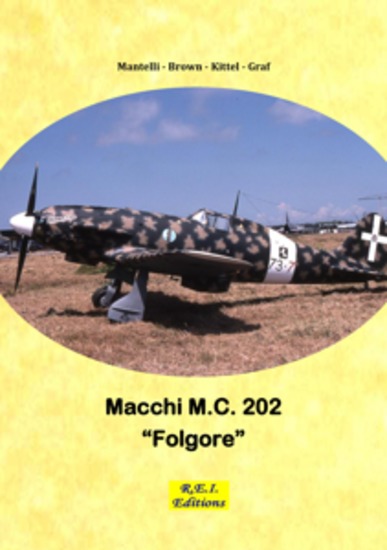
Macchi MC 202 "Folgore" - cover

Macchi MC 202 "Folgore"

Mantelli - Brown - Kittel - Graf

Maison d'édition: R.E.I. Editions

  • 0
  • 0
  • 0

Synopsis

The Macchi M.C. 202 Folgore was the best Italian fighter aircraft fielded by the Regia Aeronautica in a significant number of units during the Second World War. 
The aircraft demonstrated that Italy was certainly capable of designing and building high-class aircraft.
The Macchi M.C.202 Folgore was a single-engine, single-seater, low-wing aircraft designed by the Italian Aeronautica Macchi and also produced by Breda of Sesto S. Giovanni and S.A.I. Ambrosini of Passignano in 1941-1943.
Used in the Second World War by the Regia Aeronautica, it retained from its predecessor, the M.C. 200 Saetta, the wings and the tail but the fuselage, very elegant and aerodynamic, was completely new and, above all, it was equipped with the most powerful German Daimler-Benz DB601A engine, used for the Messerschmitt Bf 109E and F, later built under license by Alfa Romeo as RA 1000 RC41-1 at the new factory in Pomigliano d'Arco, at the time being completed.
Between May 1941 and September 1943, the date of the Italian surrender, approximately 1,150 examples of this aircraft were manufactured, divided into fifteen series, each of which introduced changes and improvements compared to the previous series.
The Macchi M.C. was directly derived from the "Folgore" 205 “Veltro”, which differed from the 202 only in adopting the more powerful 1,475 hp Daimler-Benz DB 605 engine, a larger diameter propeller and two tubular oil radiators under the nose.


Disponible depuis: 29/12/2024.

D'autres livres qui pourraient vous intéresser

  • Ancient Egypt and the Pyramids - World Knowledge for Children - cover

    Ancient Egypt and the Pyramids -...

    KidsChoice

    • 0
    • 0
    • 0
    KidsChoice: World knowledge for Children is an engaging audiobook series that takes young listeners on a fascinating journey to explore and understand the world around them. Aimed at curious children aged 7 to 99, this series dives into a variety of topics in science, society, and culture, making complex ideas accessible and exciting.  Each episode brings a unique theme to life—whether exploring the mysteries of space, uncovering the secrets of the human body, or discovering the diversity of cultures and traditions worldwide. With lively narration, interesting facts, and interactive elements, the series guides young listeners on an adventure full of discovery, encouraging them to ask questions and expand their understanding in a fun way.  In the scientific world of KidsChoice, children learn about the wonders of nature and the universe. Concepts like the solar system, animal behavior, the human body, and Earth's various ecosystems are explained in a way that is easy for kids to grasp and find fascinating. Exciting analogies and vivid examples help spark curiosity, turning learning into an adventure.  Societal topics also have a special place in the series. KidsChoice introduces young listeners to the basics of community, compassion, and making a positive impact. Children learn what it means to be a good citizen and how they can make small, meaningful contributions to their communities.  Additionally, KidsChoice opens a window to the vibrant world of global cultures. Through a virtual journey around the globe, children discover how people in other countries live, the customs and traditions they follow, the languages they speak, and the foods they enjoy. This fosters understanding and respect for diverse ways of life, celebrating the richness of human experience as a beautiful, valuable part of the world.  With its vivid language and captivating soundscapes, "KidsChoice: World knowledge for Children" turns learning into an exciting experience, sparking a lifelong curiosity and a deeper understanding of the world around them.
    Voir livre
  • Women of Ancient Greece - Philosophers Leaders and Goddesses - cover

    Women of Ancient Greece -...

    Layla Gupta

    • 0
    • 0
    • 0
    The ancient Greeks created a rich tapestry of gods and goddesses that embodied the complexities of the human experience, and among them, the divine feminine figures stood out as powerful symbols of strength, wisdom, love, and conflict. The goddesses of ancient Greece were not merely passive figures but rather active forces that shaped both the natural world and the lives of mortals. Their stories reveal a deep understanding of the roles and expectations of women, as well as the power dynamics that governed ancient Greek society. 
    Among the most prominent of these divine figures was Athena, the goddess of wisdom, warfare, and craft. Athena was a paradoxical figure, blending intelligence with martial prowess. As the patron goddess of Athens, she embodied the city's values of logic, strategy, and civic duty. Her virginity, a defining characteristic, symbolized purity and independence, and her role as a warrior was unique in that it was based on strategic thinking rather than physical aggression. Athena's guidance was sought not just in matters of war but also in philosophy and the arts, making her one of the most revered figures in the pantheon. 
    In stark contrast to Athena's intellectual and strategic prowess, Aphrodite, the goddess of love, beauty, and desire, represented the compelling and often uncontrollable forces of attraction. Aphrodite's influence was not confined to the physical realm; she also governed the emotional and relational dynamics of gods and mortals alike. Her beauty and charm were legendary, capable of inciting both creation and destruction. Through her, the Greeks understood love not just as a harmonious union but also as a force that could disrupt order, as seen in the myth of her involvement in the Trojan War. Aphrodite’s power was as much about seduction as it was about the more fragile human emotions, teaching that love could be both transcendent and tumultuous.
    Voir livre
  • Secret Powers and Why We Shouldn't Use Them - cover

    Secret Powers and Why We...

    Manly P. Hall

    • 0
    • 0
    • 0
    Secret Powers and Why We Shouldn't Use Them by Manly P. Hall is a thought-provoking exploration of the hidden abilities within human consciousness and the moral, ethical, and spiritual implications of their misuse. Drawing from esoteric traditions, philosophy, and psychology, Hall delves into the nature of these powers, such as clairvoyance, telepathy, and other psychic phenomena, emphasizing their potential to disrupt personal and universal harmony if wielded irresponsibly. Through a balanced perspective, he advocates for self-discipline, ethical development, and a commitment to spiritual growth as prerequisites for engaging with these latent abilities. The work serves as both a cautionary tale and an invitation to introspection, encouraging readers to align with universal principles of integrity and wisdom before attempting to unlock their hidden potential.
    Voir livre
  • Ancient Indus Valley Civilization’s Biggest Cities The: The History and Legacy of Mohenjo-daro Harappa and Kalibangan - cover

    Ancient Indus Valley...

    Editors Charles River

    • 0
    • 0
    • 0
    When one thinks of the world’s first cities, Sumer, Memphis, and Babylon are some of the first to come to mind, but if the focus then shifts to India, then Harappa and Mohenjo-daro will likely come up. These cities owe their existence to India’s oldest civilization, known as the Indus Valley Civilization or the Harappan Civilization, which was contemporary with ancient Mesopotamia and ancient Egypt and had extensive contacts with the former, making it one of the most important early civilizations in the world. Spread out along the rivers of the Indus River Valley, hundreds of settlements began forming around 3300 BCE, eventually coalescing into a society that had all of the hallmarks of a true civilization, including writing, well-developed cities, a complex social structure, and long-distance trade. 
    Mohenjo-daro was the largest city of the Indus Valley Civilization, one of the most advanced civilizations to have ever existed, and the best-known and most ancient prehistoric urban site on the Indian subcontinent. It was a metropolis of great cultural, economic, and political importance that dates from the beginning of the 3rd millennium BCE. Although it primarily flourished between approximately 2500 and 1500 BCE, the city had longer lasting influences on the urbanization of the Indian subcontinent for centuries after its abandonment. It is believed to have been one of two capital cities of the Indus Civilization, its twin being Harappa located further north in Punjab, Pakistan. 
    Kalibangan was unknown to the modern world until archaeologists began uncovering its secrets in excavations during the 1960s. Although it followed some of the patterns of larger Indus cities such as Mohenjo-daro and Harappa, it was also a unique city in many ways. Kalibangan was located on a different river from the other major Indus Valley Civilization cities, and its river suffered a fate that led to the end of the city.
    Voir livre
  • Healing Your Inner Child - Transformative CBT Methods to Overcome Abandonment Trauma Heal From Childhood Emotional Neglect and Find Inner Peace - cover

    Healing Your Inner Child -...

    Daniel Hill

    • 0
    • 0
    • 0
    Do you often feel like a part of you is still trapped in the past, unable to move forward?  
    Are you haunted by feelings of abandonment or emotional neglect from your childhood?  
    Does this lingering pain impact your relationships, self-esteem, or everyday happiness?  
    You might be wondering why it's so hard to shake off these feelings, despite your best efforts. I know how deeply these wounds can run and how they can cast a shadow over your life. But I also know that it's possible to heal and find peace. You're not alone in this journey. 
    Does any of these situations sound familiar? 
    - You feel a persistent sense of loss or emptiness, as if something crucial is missing from your life. 
    - Childhood memories of being ignored, unloved, or unsupported frequently resurface, affecting your current state of mind. 
    - There's a constant battle with low self-esteem and feelings of unworthiness. 
    - You find yourself repeating unhealthy patterns in your personal and professional life. 
    - Intimacy feels challenging or frightening due to past emotional neglect. 
    Here's a little sneak preview of what you’ll get: 
    - Three Ways That You Were Made to Feel Unsafe as a Child 
    - What Happens When the Inner Child Is Wounded? 
    - The Unsafe Messages That Kids Are Exposed To 
    - How to Develop a Relationship With Your Inner Child in Two Easy Steps 
    - 5 Easy Steps to Heal Trauma 
    - Reparenting's Four Pillars and How to Get Started 
    - Cognitive Behavioral Therapy to Address Trauma and Fear of Abandonment 
    - How to Overcome Childhood Emotional Neglect 
    - The Three Elements of Emotion 
    - Trauma Bonding: How to Heal from ItYour path to healing and inner peace is just a click away. Don't let the shadows of the past dictate your future. 
    Voir livre
  • Why War? - cover

    Why War?

    Richard Overy

    • 0
    • 0
    • 0
    Why has war been such a consistent presence throughout the human past? A leading historian explains, drawing on rich examples and keen insight. 


    Richard Overy is not the first scholar to take up the title question. In 1931, at the request of the League of Nations, Albert Einstein asked Sigmund Freud to collaborate on a short work examining whether there was "a way of delivering mankind from the menace of war." Published the next year as a pamphlet entitled Why War?, it conveyed Freud's conclusion that the "death drive" made any deliverance impossible—the psychological impulse to destruction was universal in the animal kingdom. The global wars of the later 1930s and 1940s seemed ample evidence of the dismal conclusion. 


    A preeminent historian of those wars, Overy brings vast knowledge to the title question and years of experience unraveling the knotted motivations of war. His approach is to separate the major drivers and motivations, and consider the ways each has contributed to organized conflict. They range from the impulses embedded in human biology and psychology, to the incentives to conflict developed through cultural evolution, to competition for resources. The discussions show remarkable range, delving deep into the Neolithic past, through the twentieth-century world wars, and up to the current conflict in Ukraine.
    Voir livre