Begleiten Sie uns auf eine literarische Weltreise!
Buch zum Bücherregal hinzufügen
Grey
Einen neuen Kommentar schreiben Default profile 50px
Grey
Jetzt das ganze Buch im Abo oder die ersten Seiten gratis lesen!
All characters reduced
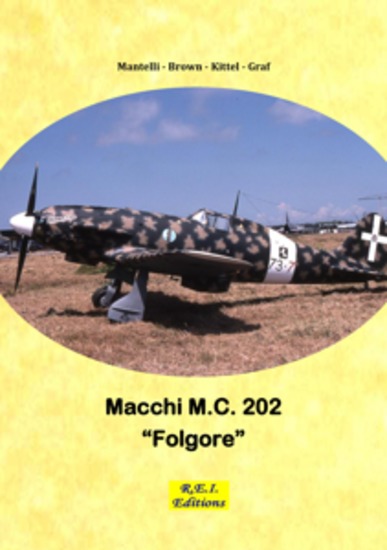
Macchi MC 202 "Folgore" - cover

Macchi MC 202 "Folgore"

Mantelli - Brown - Kittel - Graf

Verlag: R.E.I. Editions

  • 0
  • 0
  • 0

Beschreibung

The Macchi M.C. 202 Folgore was the best Italian fighter aircraft fielded by the Regia Aeronautica in a significant number of units during the Second World War. 
The aircraft demonstrated that Italy was certainly capable of designing and building high-class aircraft.
The Macchi M.C.202 Folgore was a single-engine, single-seater, low-wing aircraft designed by the Italian Aeronautica Macchi and also produced by Breda of Sesto S. Giovanni and S.A.I. Ambrosini of Passignano in 1941-1943.
Used in the Second World War by the Regia Aeronautica, it retained from its predecessor, the M.C. 200 Saetta, the wings and the tail but the fuselage, very elegant and aerodynamic, was completely new and, above all, it was equipped with the most powerful German Daimler-Benz DB601A engine, used for the Messerschmitt Bf 109E and F, later built under license by Alfa Romeo as RA 1000 RC41-1 at the new factory in Pomigliano d'Arco, at the time being completed.
Between May 1941 and September 1943, the date of the Italian surrender, approximately 1,150 examples of this aircraft were manufactured, divided into fifteen series, each of which introduced changes and improvements compared to the previous series.
The Macchi M.C. was directly derived from the "Folgore" 205 “Veltro”, which differed from the 202 only in adopting the more powerful 1,475 hp Daimler-Benz DB 605 engine, a larger diameter propeller and two tubular oil radiators under the nose.


Verfügbar seit: 29.12.2024.

Weitere Bücher, die Sie mögen werden

  • Democracy in Action - Collective Problem Solving in Citizens' Governance Spaces - cover

    Democracy in Action - Collective...

    Carolyn M. Hendriks, Albert W. Dzur

    • 0
    • 0
    • 0
    Government and market failures spur many citizens to practical action today. Around the globe people form renewable energy cooperatives, provide support for marginalized populations, and deliver alternative justice and care services. What motivates citizens to begin such practical problem-solving? How do they engage others? What knowledge do they generate? How do they interact with state and market actors? What risks and opportunities do they hold for contemporary democracy? 


    To answer these questions, Dzur and Hendriks develop the concept of citizens' governance space to delineate these efforts from contentious social movements, formal civic associations, and local community organizations. Drawing on cases from around the globe, the authors examine how citizens do functional policy work, develop and disrupt knowledge, and selectively partner with governments and corporations. They reveal complexities and risks posed by citizens' governance spaces while also showing how they offer a distinct form of democratic participation centered on practical efforts and outcomes. 


    Democracy in Action provides a new lens for recognizing and understanding the more practical ways that citizens contribute to governance and democracy.
    Zum Buch
  • The Swedish Famine of 1867-1869 - A Nordic Tragedy - cover

    The Swedish Famine of 1867-1869...

    Sarah Willards

    • 0
    • 0
    • 0
    In the years leading up to the Swedish Famine of 1867–1869, the Kingdom of Sweden stood at a crossroads between tradition and transformation. The mid-19th century was a period of great change, with emerging industrialization in urban areas clashing with the deep-rooted agrarian lifestyle that still defined the countryside. A vast majority of Swedes lived in rural regions, relying heavily on subsistence farming and small-scale agriculture. This dependence on crop yields, particularly barley, rye, and potatoes, made the rural population extremely vulnerable to climatic changes and poor harvests. 
    Despite some gradual modernization efforts, Sweden’s agricultural systems remained underdeveloped and highly sensitive to weather conditions. Farming techniques were largely traditional, and the infrastructure for food storage and distribution was limited. There was little to cushion communities in the event of failed crops. In a nation where most people lived off what they could grow or trade locally, a single bad season could spell hardship. Several parts of the country had endured minor food shortages in prior decades, but none on the scale that would soon descend upon the nation. 
    Adding to this vulnerability were the unusual weather patterns beginning to emerge in the mid-1860s. Winters grew colder and longer, and summers were often too short or too wet for successful harvesting. These anomalies were not yet fully understood at the time, and meteorological science was in its infancy. Farmers, used to working in rhythm with the natural seasons, found themselves unprepared for the climatic disruptions that lay ahead. The winter of 1867 would prove to be particularly devastating, marking the beginning of a three-year catastrophe.
    Zum Buch
  • End of the Julio-Claudian Dynasty in Rome The: The History of Nero’s Reign and the Year of the Four Emperors - cover

    End of the Julio-Claudian...

    Editors Charles River

    • 0
    • 0
    • 0
    Throughout the annals of history, there have been few figures as reviled as Lucius Domitius Ahenobarbus, better known as Nero Claudius Caesar Drusus Germanicus, or more simply, Nero. Even today, he remains one of the Roman Empire’s most famous – or notorious – figures, a villain whose impact on popular culture is so vast that his name crops up consistently to this day in literature, film, TV and mediums as unlikely as video games and anime. 
    Nero ranks among the very worst of the Caesars, alongside the likes of mad Caligula, slothful Commodus, and paranoid Domitian, a figure so hated that, in many ancient Christian traditions, he is literally, without hyperbole, considered the Antichrist; according to a notable Biblical scholar, the coming of the Beast and the number 666 in the Book of Revelation are references to Nero. He was the man who, famously, “fiddled while Rome burned”, an inveterate lecher, a murderous tyrant who showed little compunction in murdering his mother and who liked to use Christian martyrs as a source of illumination at night – by burning them alive. His economic policies, according to many historians, virtually bankrupted Rome.  
    Having left no heir, Nero’s death plunged the empire into confusion and chaos, bringing to an end the Julio-Claudian lineage while at the same time offering no clear rule of succession. This presented the opportunity for influential individuals in the empire, and in particular provincial governors who also commanded large military garrisons, to express and further their own ambitions to power. The result was a period of instability and civil war as several pretenders to the throne, among them the emperors Galba, Otho and Vitellius, gained and lost power, until finally the emperor Vespasian seized and retained the imperial principate. Vespasian subsequently imposed order and discipline on a chaotic empire and went on to establish the Flavian Dynasty.
    Zum Buch
  • History of Finland: A Captivating Guide to Finnish History - cover

    History of Finland: A...

    Captivating History

    • 0
    • 0
    • 0
    Finnish culture is centuries old, yet Finland itself has only been an independent nation for just over one hundred years.  
    Finland’s history is an interesting subject filled with misconceptions. Would you be surprised to learn that the Finns, for the most part, were not Vikings? Or that Finland is not part of Scandinavia? The Finns are not even related to their closest neighbors: Sweden, Norway, and Denmark. 
    This book pulls back the curtain so you can get a better look at Finland’s history. Its history is exciting, even without the Vikings, and its proximity to Russia is something that is still talked about in the news today. 
    In 2022, moves were made for the nation to join the North Atlantic Treaty Organization (NATO) in response to the Russian invasion of Ukraine. Finland has entered a new phase of its history. But wouldn’t you like to learn about its past? 
    In this book, you’ll learn the following:The ancient Finnish did not worship the famous Norse gods like Thor and Odin.The national poem of Finland, the Kalevala, explores the ancient Finnish creation myth and the gods and heroes of Finland’s distant past.The history of Finland and Sweden are intertwined; Finland was part of Sweden for five hundred years!Finland was also part of the Russian Empire from 1809 to 1917.The Finns fought a heroic struggle against the Russians in 1939/40, which inspired the world and inspires Finns today.The Finn who commanded Finland’s armies during that struggle, Marshal Mannerheim, was of Swedish/German descent and did not speak Finnish particularly well. Yet, in 2004, he was voted the “greatest Finn of all time.”Finnish is one of the most unique languages in the world.And much, much more! 
    So, what are you waiting for? Click the “add to cart” button to begin learning about Finland today!
    Zum Buch
  • ABC - The Beginning Of The End - cover

    ABC - The Beginning Of The End

    Aaron LaLux

    • 0
    • 0
    • 0
    The poems written in this book were composed in over 20 different countries & different cities including Australia, Bali, Brooklyn, Budapest, Colombia, Cyprus, Greece, India, Israel, Istanbul, Los Angeles, Madagascar, Miami, New Zealand, Oklahoma, Portugal, Romania, Sydney, Tbilisi, Thailand, & The Hamptons & Ukraine. 
    I left a piece of my heart in each one of these places that I visited along with leaving a piece of my heart, with every one of those amazing souls that I met & connected with along the way, a lot of who I still know to this day. Those out there know who you are so I don’t need to name names. 
    I’ve been traveling the world for several decades, but I notice this most recent trip felt the most strange & I can’t just blame COVID for this post COVID feeling. See something has just fundamentally changed the whole global vibe is a bit off & I don’t just mean the obvious stuff.  
    Sure there’s the political chaos with right & left becoming increasingly polarized which is absolutely heartbreaking because if we put our differences aside we’d see we have more similarities than differences what I'm really talking about a fundamental change in the individual.  
    We're spending way more time with machines than we are spending with each other & a lot of the time we spend interacting with each other is done through machines instead of directly with each other. 
    It’s as if we are recognizing each other’s existences less & less. 
    On top of this a majority of people including myself seem tired “out of it” directionless & disassociated. Maybe I’m trippin’ but I can’t be imagining all these things, it can’t just be me.  
    So yeah, a lot more to say, but I’m just going to stop here & let the poems contained in this book do the explaining, 
    Zum Buch
  • May Contain Lies - How Stories Statistics and Studies Exploit Our Biases And What We Can Do About It - cover

    May Contain Lies - How Stories...

    Alex Edmans

    • 0
    • 0
    • 0
    Our lives are minefields of misinformation. It ripples through our social media feeds, our daily headlines, and the pronouncements of politicians, executives, and authors. Stories, statistics, and studies are everywhere, allowing people to find evidence to support whatever position they want. Many of these sources are flawed, yet by playing on our emotions and preying on our biases, they can gain widespread acceptance, warp our views, and distort our decisions. 


    In this eye-opening book, renowned economist Alex Edmans teaches us how to separate fact from fiction. Using colorful examples—from a wellness guru's tragic but fabricated backstory to the blunders that led to the Deepwater Horizon disaster to the diet that ensnared millions yet hastened its founder's death—Edmans highlights the biases that cause us to mistake statements for facts, facts for data, data for evidence, and evidence for proof. 


    Armed with the knowledge of what to guard against, he then provides a practical guide to combat this tide of misinformation. Going beyond simply checking the facts and explaining individual statistics, Edmans explores the relationships between statistics—the science of cause and effect—ultimately training us to think smarter, sharper, and more critically.
    Zum Buch