
Rejoignez-nous pour un voyage dans le monde des livres!
Ajouter ce livre à l'électronique
Grey
Ecrivez un nouveau commentaire Default profile 50px
Grey
Abonnez-vous pour lire le livre complet ou lisez les premières pages gratuitement!
All characters reduced
Cloud Computing A Beginners Guide to Expertise - cover

Cloud Computing A Beginners Guide to Expertise

Manish Soni

Maison d'édition: Poorav Publications

  • 0
  • 0
  • 0

Synopsis

This book, Cloud Computing: A Beginner’s Guide to Expertise, is designed to demystify cloud computing and provide a comprehensive introduction to this transformative technology. Whether you are a student, a professional looking to upskill, or simply someone curious about the cloud, this guide will take you from the basics to a deeper understanding of cloud architecture, services, and deployment models.We begin with an overview of the fundamental concepts, including the definition of cloud computing, its history, and the key players in the industry. As we progress, you will learn about different cloud service models—Infrastructure as a Service (IaaS), Platform as a Service (PaaS), and Software as a Service (SaaS)—and how they can be leveraged to meet various business needs.Practical examples and real-world case studies are included to help you see how cloud computing is applied in different industries. You will also find hands-on exercises to practice your skills and deepen your understanding. By the end of this book, you will not only have a solid grasp of cloud computing fundamentals but also be equipped with the knowledge to explore more advanced topics and certifications.
Disponible depuis: 13/11/2024.
Longueur d'impression: 146 pages.

D'autres livres qui pourraient vous intéresser

  • Fire Eaters - The People and Aircraft Combatting Wildfires Over the Last Century - cover

    Fire Eaters - The People and...

    Peter Pigott

    • 0
    • 0
    • 0
    Throughout history, when threatened by wildfires our only defense was to pray for rain and run—until aircraft changed the way we fight fires. Beginning with the Canadian "H-Boats" in 1924, aircraft have become indispensable in detecting and extinguishing wildfires. Fire Eaters tells the incredible stories of the Ontario Provincial Air Service, the first government aerial fire suppression organization in history; one of its pilots, Carl Crossley, who invented the water scoop-up and drop-off system; and the Canadair CL-215, the first purpose-built water bomber. 


    Today, helicopters with "Bambi Buckets" and snorkels can dump water while hovering directly over the flames, and Air Tractors and Dash 8-400AT air tankers not only perform a crucial role in saving communities but also protect our ecosystem. Satellites—unmanned aircraft able to fly for sixteen hours, even overnight when manned aircraft do not—and artificial intelligence already play a decisive role in fire management. 


    But it is the men and women of the aerial fire service who have really changed the way we fight fire around the world. Their bravery and dedication mean that response times are fast, fires can be contained sooner, and people have the chance to save rather than lose everything.
    Voir livre
  • The Autopilot Loop - The Neuroscience of What You Do - cover

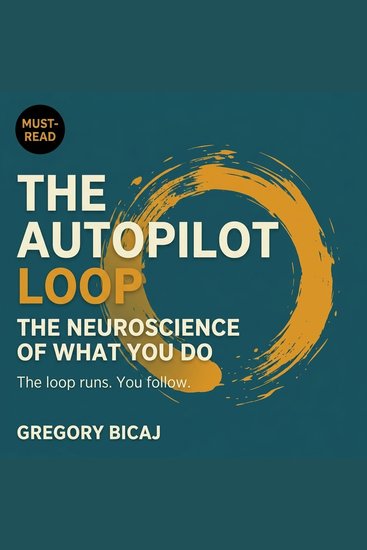
    The Autopilot Loop - The...

    Gregory Bicaj

    • 0
    • 0
    • 0
    You set the alarm early, plan the salad, and promise yourself you'll put the phone down before midnight. By evening, nothing has gone according to plan. You weren't lazy. You weren't weak. You were, quite simply, on autopilot.
    In The Autopilot Loop, neuroscientist and clinical psychologist Gregory Bicaj draws on two decades of laboratory research and frontline clinical practice to explain the hidden architecture governing human behavior. The answer lies not in character or willpower, but in the brain's ancient habit machinery — a system built for efficiency, operating largely outside conscious awareness, and running roughly 40 percent of your daily life without you.
    Bicaj introduces readers to the neurological loop at the heart of all habitual behavior: the cue that triggers action, the craving that propels it, the routine that executes it, and the reward that locks it in. From Ann Graybiel's landmark maze experiments to Wolfram Schultz's dopamine research, from the Vietnam heroin studies to Michael Phelps's Olympic preparation, the science is clear — habits are not personality. They are compressed behavioral scripts encoded in the basal ganglia, running on contextual triggers, and stubbornly indifferent to your best intentions.
    But this book is not a counsel of helplessness. It is a practical manual for working with your brain rather than against it. Bicaj shows why suppression fails and substitution succeeds, why environmental design outperforms willpower, why crises and life transitions open rare windows of behavioral plasticity, and how a single keystone habit can cascade change across an entire life. He also examines how these mechanisms operate beyond individuals — in organizations, social movements, and the digital platforms specifically engineered to capture and hold your attention.
    Across seventeen chapters that move from cellular neuroscience to corporate boardrooms to the Montgomery bus boycott, The Autopilot Loop offers a unified account of why humans repeat what they repeat — and a research-grounded, clinically tested framework for choosing something different. The result is not a promise of instant reinvention, but something more honest and more durable: a way of gradually shifting the odds, one redesigned loop at a time.
    For readers of Jonathan Haidt and Gabor Maté, and for anyone who has ever wondered why knowing better so rarely means doing better.
    Voir livre
  • Ideas & Opinions - cover

    Ideas & Opinions

    Albert Einstein

    • 0
    • 0
    • 0
    Unravel the enigmatic depths of Albert Einstein's mind in "Ideas and Opinions." This captivating collection, compiled by the master himself, unveils his diverse perspectives on science, philosophy, social issues, and even religion. Delve into the workings of relativity, ponder his nuanced views on faith, and journey with him as he advocates for peace, justice, and societal transformation. Each essay, speech, and letter resonates with the clarity and depth of a true genius, offering timeless insights that transcend his scientific legacy. This isn't just a book, it's a direct conversation with history's most brilliant mind, challenging and inspiring readers across generations.
    Voir livre
  • Meditation On Leadership Development - cover

    Meditation On Leadership...

    Max Topoff

    • 0
    • 0
    • 0
    Our today’s program is aimed to enhance your leader skills. Leadership is a natural part of your life. Your every action from the very childhood was related to opportunity to develop and strengthen it. And, by the way, leadership is not only the ability to take command over the people and lead them along. Leadership is ability to say in a good hour the things to be said and, on the contrary, to remain silent when you want to answer so much. Leadership is a help to your fellow ones. Leadership is about getting up early feeling like all the world is at your feet and you can be worthy contribution into development of this world. Leadership is a mentality which helps you to make right decisions and take actions which benefit you and the people around you. And even if you didn’t have much occasions to prove yourself as a leader, believe me when I’m saying that your nature has been striving and strives to it from your very first breath in this world. And to exercise this right given to you from birth, I’ll lead you through the depths of your subconscious mind to the very source of your nature as a leader. And now, the adventure on your way to grasp the leadership has begun.
    Voir livre
  • Our Western spring - Where is political divide leading us ? - cover

    Our Western spring - Where is...

    Nir Shvalb

    • 0
    • 0
    • 0
    "Progress is not just electronics and robots; it’s also adaptation and correction of social structures in light of these technological advances," Shvalb asserts, warning that "the old democracy won't survive if we don’t adjust it to the new era." 
    After reviewing the social phenomena leading societies to dangerous places, he points out, "History teaches us that civilizations tend to fade, and when they do, it can happen very suddenly." He then explores the influence of social networks on public discourse, noting that "fake news spreads six times faster than truthful news." As a scientist in the field of hard sciences, he examines the dangers of advancing technology, particularly the role of AI in societal unrest. Shvalb questions, "Can technological mega-giants know us intimately enough to control our choices?" 
    Life as we knew it no longer exists. The benefits technology has given us come with a heavy price. In a world where social interactions are shaped by powerful platforms guiding the way we think, behave, buy, and choose, there is a real risk to our societies that we must consider. The last part of the book is dedicated to practical solutions and suggestions. Yet, despite its serious themes, "Our Western Spring: Where is Political Divide Leading Us?" is engaging and fun to read. If you're curious about who suffered from scrotal ascites, what is considered the worst film of all time, or why China's government hates Winnie-the-Pooh, this book is for you. This blend of intriguing trivia and insightful analysis makes the book both thought-provoking and enjoyable, offering readers a captivating journey through the complexities of modern society.
    Voir livre
  • FAIK - A Practical Guide to Living in a World of Deepfakes Disinformation and AI-Generated Deceptions - cover

    FAIK - A Practical Guide to...

    Perry Carpenter

    • 0
    • 0
    • 0
    In an era where artificial intelligence can create content indistinguishable from reality, how do we separate truth from fiction? In FAIK: A Practical Guide to Living in a World of Deepfakes, Disinformation, and AI-Generated Deceptions, cybersecurity and deception expert Perry Carpenter unveils the hidden dangers of generative artificial intelligence, showing you how to use these technologies safely while protecting yourself and others from cyber scams and threats. 


    This isn't just another book about technology—it's your survival guide to the digital jungle. Carpenter takes you on an insightful journey through the "Exploitation Zone," where rapid technological advancements outpace our ability to adapt, creating fertile ground for deception. Explore the mechanics behind deepfakes, disinformation, and other cognitive security threats. Discover how cybercriminals can leverage even the most trusted AI systems to create and spread synthetic media and use it for malicious purposes. At its core, FAIK is an empowering exposé in which Carpenter effectively weaves together engaging narratives and practical insights, all aimed to equip you with the knowledge to recognize and counter advanced tactics with practical media literacy skills and a deep understanding of social engineering.
    Voir livre