¡Acompáñanos a viajar por el mundo de los libros!
Añadir este libro a la estantería
Grey
Escribe un nuevo comentario Default profile 50px
Grey
Suscríbete para leer el libro completo o lee las primeras páginas gratis.
All characters reduced
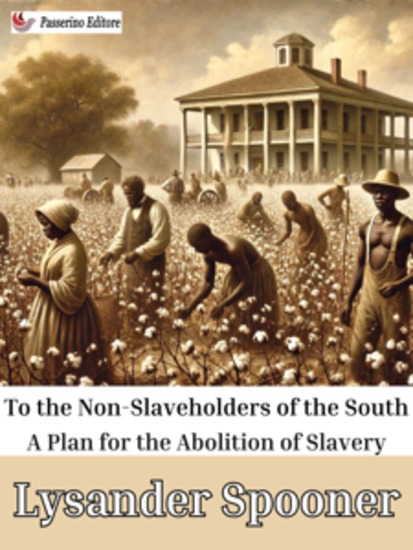
To the Non-Slaveholders of the South - A Plan for the Abolition of Slavery - cover

To the Non-Slaveholders of the South - A Plan for the Abolition of Slavery

Lysander Spooner

Editorial: Passerino

  • 0
  • 0
  • 0

Sinopsis

A Plan for the Abolition of Slavery and To the Non-Slaveholders of the South were two significant anti-slavery pamphlets written by Lysander Spooner. Published in 1858, these works argued passionately against slavery, but with a unique perspective that aimed to reach a specific audience: non-slaveholding white Southerners.

Lysander Spooner (January 19, 1808 — May 14, 1887) was an American abolitionist, entrepreneur, lawyer, essayist, natural rights legal theorist, pamphletist, political philosopher, and writer often associated with the Boston anarchist tradition.
Disponible desde: 06/11/2024.

Otros libros que te pueden interesar

  • Too Good to Fact Check - Flying the Skies with Stars Scotch and Scandal (Mostly Mine) - cover

    Too Good to Fact Check - Flying...

    Jeremy Murphy, Sophia Paulmier

    • 0
    • 0
    • 0
    A peek into the world of celebrity and how the journalists who cover them live even more outrageous lives. 


    What happens when magazine editors behave worse than the celebrities they feature? Shock, comedy, and farce, expertly chronicled in Jeremy Murphy's Too Good to Fact Check, a firsthand account of his ten years traveling with stars as the editor of a glossy magazine. In between taking Julianna Marguiles to the Côte d'Azur, Neil Patrick Harris aboard the Orient Express, and LL Cool J to Paris among other locales, the author lived a wild, decadent life that rivaled anyone he was covering, and recounts the most outrageous moments in colorful, candid detail. 


    Celebrities! Bar fights! Hotel bans! Airplane arrest! Fires! Singing to Mary J Blige! 


    Too Good to Fact Check provides a fascinating look at the rarefied worlds of celebrity, fashion, magazines, and glamour through the eyes of someone who may have been blacked out. 


    Sarcastic, dishy, self-deprecating, surprising, and fun, Too Good to Fact Check is the fall's guiltiest pleasure.
    Ver libro
  • Squalus Disaster The: The History of the Dramatic Rescue Operation on a Sunken Submarine - cover

    Squalus Disaster The: The...

    Charles River Editors

    • 0
    • 0
    • 0
    Given that there’s such little margin for error in a submersible, many submarine losses remain sources of intrigue and mystery, but in American history, few rival the tragedy and drama aboard the Squalus in 1939. On May 23 of that year, the Squalus, one of the U.S. Navy’s newest submarines, was undertaking the latest in a series of test dives off the coast of New Hampshire. She had been commissioned less than three months before and represented the cutting-edge of new submarine technology. Provided with eight torpedo tubes and a three-inch deck gun, Squalus had a range of over 11,000 miles and was capable of running at over 20 knots on the surface. This was a formidable warship, and the test dives undertaken in May were a routine part of preparing the submarine for service. 
    After successfully completing a series of dives over the previous days, on the 23rd, the Squalus undertook practice for one of the most challenging maneuvers, a rapid dive performed while the sub was running at full speed on the surface. This was a vital procedure if the submarine was attacked unexpectedly by an aircraft or surface ship - it had to be able to dive quickly in any circumstances. This practice ensured that the crew, and the submarine, were fully prepared.  
    Tragically, during this test dive, the unthinkable happened: the rear section of Squalus flooded, and the submarine, without power, began to sink to the bottom of the Atlantic Ocean. 26 men in the rear compartments died in the flooding, but 33 men in the forward compartments were still alive as Squalus came to rest on the ocean floor almost 250 feet below the surface.  
    The situation seemed hopeless to everyone but one naval officer, Lieutenant Commander Charles B. "Swede" Momsen. 
    Ver libro
  • The Whale Hunters - cover

    The Whale Hunters

    Sebastian Junger

    • 0
    • 0
    • 0
    This piece, which appeared in Outside magazine in 1995 and was originally recorded for "Rough Water: Stories of Survival From The Sea," is about an old man, a Bequian harpooner, who uses a wooden sailboat to hunt humpback whales. The piece is an elegy of sorts--an unsentimental lament for something lost.
    Ver libro
  • Space Trek - cover

    Space Trek

    Raphael Terra

    • 0
    • 0
    • 0
    This audiobook has been recorded using Text to speech (TTS). 
     
    For decades we have all grown up watching science fiction movies and TV shows. And we have all dreamed of going where no man has gone before. That time is here and now. We are on the very edge of a new era in humanity. Within the next few years mankind will be not only journeying to other planets, we will be inhabiting them. Our ultra-high technology robots are even now walking upon the surface of Mars, sending back information and preparing the ground for our coming. 
     
    This is not science fiction. This is science fact. And just as before in the history of humanity, the process is being led by several unique, intelligent and talented individuals such as Elon Musk. 
     
    Rocket ships take off vertically and return to Earth vertically. Humans are shuttled to the International Space Station as if they're travelling from New York to Los Angeles. Supersonic space craft fly mankind around the globe virtually in space, just to make things faster. 
     
    But what does the future hold for us? We cannot maintain peace on Earth. How can we do so in space? NASA, SpaceX and Virgin are not the only ones with eyes upon the stars. Russia and especially China, also have desires in that direction. 
     
    The race for space is on and all bets are off.
    Ver libro
  • West Virginia and the Civil War - Mountaineers Are Always Free - cover

    West Virginia and the Civil War...

    Mark A. Snell

    • 0
    • 0
    • 0
    The only state born as a result of the Civil War, West Virginia was the most divided state in the nation. About forty thousand of its residents served in the combatant forces about twenty thousand on each side. 


    The Mountain State also saw its fair share of battles, skirmishes, raids, and guerrilla warfare, with places like Harpers Ferry, Philippi, and Rich Mountain becoming household names in 1861. When the Commonwealth of Virginia seceded from the Union on April 17, 1861, leaders primarily from the northwestern region of the state began the political process that eventually led to the creation of West Virginia on June 20, 1863. Renowned Civil War historian Mark A. Snell has written the first thorough history of these West Virginians and their civil war in more than fifty years.
    Ver libro
  • Dispossessing the Wilderness - Indian Removal and the Making of the National Parks - cover

    Dispossessing the Wilderness -...

    Mark David Spence

    • 0
    • 0
    • 0
    National parks like Yellowstone, Yosemite, and Glacier preserve some of this country's most cherished wilderness landscapes. While visions of pristine, uninhabited nature led to the creation of these parks, they also inspired policies of Indian removal. By contrasting the native histories of these places with the links between Indian policy developments and preservationist efforts, this work examines the complex origins of the national parks and the troubling consequences of the American wilderness ideal. The first study to place national park history within the context of the early reservation era, it details the ways that national parks developed into one of the most important arenas of contention between native peoples and non-Indians in the twentieth century.
    Ver libro