Rejoignez-nous pour un voyage dans le monde des livres!
Ajouter ce livre à l'électronique
Grey
Ecrivez un nouveau commentaire Default profile 50px
Grey
Abonnez-vous pour lire le livre complet ou lisez les premières pages gratuitement!
All characters reduced
History of Magic and Experimental Science (Vol 1&2) - Study on Alchemy & Pseudoscience During the First Thirteen Centuries of Our Era - cover

History of Magic and Experimental Science (Vol 1&2) - Study on Alchemy & Pseudoscience During the First Thirteen Centuries of Our Era

Lynn Thorndike

Maison d'édition: DigiCat

  • 0
  • 0
  • 0

Synopsis

Lynn Thorndike's monumental work, "History of Magic and Experimental Science (Vol. 1&2)," meticulously charts the intricate evolution of magical practices and experimental science from antiquity through the Renaissance. Thorndike employs a scholarly yet accessible narrative style, seamlessly blending detailed historical accounts with critical analysis of the philosophical underpinnings that shaped early scientific thought. The comprehensive two-volume set delves into the intersections of superstition, alchemy, and the burgeoning rationalism of the period, contextualizing magic not merely as folly but as a vital component of the intellectual landscape that eventually led to modern science. An esteemed historian of science, Lynn Thorndike was profoundly influenced by the intellectual currents of the early 20th century, which were marked by a growing interest in the scientific revolution and its origins. His extensive academic background and commitment to uncovering the complexities of medieval and early modern thought culminated in this exhaustive exploration. Thorndike's rigorous scholarship is evident in the breadth of his research, meticulously sourcing texts and traditions that illuminate the symbiotic relationship between magic and science. "History of Magic and Experimental Science" is an essential read for scholars, historians, and anyone interested in the roots of scientific inquiry. This work not only enriches our understanding of historical epistemologies but also invites readers to reevaluate the cultural significance of magic in shaping scientific paradigms, making it a pivotal study for those dedicated to exploring the interplay between superstition and rational thought.
Disponible depuis: 26/11/2023.
Longueur d'impression: 1824 pages.

D'autres livres qui pourraient vous intéresser

  • My March Through Hell - A Young Girl's Terrifying Journey to Survival - cover

    My March Through Hell - A Young...

    Halina Kleiner, Edwin Stepp

    • 0
    • 0
    • 0
    A young girl is suddenly all alone and on the run from the Nazis in her hometown in Poland. Having survived an aktion that was intended to completely rid Czestochowa of all the Jews, she and her father try to make their way back to their home during the late hours of the night. 


    Confronted by a policeman, Halina Goldberg unexplainably runs away from her father and begins her long journey of survival. When tired of fleeing, she volunteers to go into a work camp. That decision buys her some time because the Germans need labor for the war effort. Halina works in three different camps from the Fall of 1943 to January 1945. At first, the camps are bearable, even though the prisoners are worked hard and fed very little. But as the Germans begin to lose the war, the conditions turn deathly. The Jews become overrun with disease and their captors grow crueler and crueler. 


    As it becomes clear that the war is lost, the SS empty the camps and set over 2,000 women on a four-month long march that would cover over 800 kilometers during one of Europe's coldest winters on record. Halina was one of the only 300 who survived the Volary Death March and finally felt the need to record her hellish story of survival.
    Voir livre
  • Leadership for Sustainability - Saving the planet one school at a time - cover

    Leadership for Sustainability -...

    David Dixon

    • 0
    • 0
    • 0
    Mobilised by the rousing words and protests of Greta Thunberg, young people all over the globe are calling for more action to combat climate change and better protect their futures. Yet they cannot do this alone. They are reliant on people in positions of power to set the necessary changes in motion - and these people include their own school leaders operating within their own local communities.This book is a rallying cry for all schools to unleash their potential to deliver a brighter future for both their pupils and society at large.David Dixon draws on both his doctoral research and his 20 years' experience as a head teacher to set out how school leaders can embed eco-friendly practices in the day-to-day running of their schools that will also contribute to overall school improvement, including that recognised by inspectors.David weaves his guidance around the 'five Cs of sustainability' - captaincy, curriculum, campus, community and connections - to position sustainability as a natural vehicle for developing a type of fully integrated learning ecology and culture for the benefit of all.The book provides a detailed analysis of where we are now in terms of environmental impact, and lays out a road map to help schools move towards more effective eco-friendly provision. It shares practical examples of sustainability in schools and how these contribute to school improvement in the wider, more conventional sense too. Furthermore, each chapter concludes with a series of suggested strategies to encourage further thought and discussions among school stakeholders.Suitable for school leaders, teachers and teacher trainers - in both primary and secondary settings - and for any professionals who work in schools on environmental education or improvement projects.
    Voir livre
  • Inner Revolution Poetry 2 - Time for Surrender - cover

    Inner Revolution Poetry 2 - Time...

    Jan Wolter

    • 0
    • 0
    • 0
    This book has been compiled during pilgrimages in India and around the world capturing bhakti, the spiritual path of devotional service. 
    Herein one finds poems about the spiritual master, practicing bhakti, connecting to God and living a life of spiritual pursuit. 
    From the Foreword 
    The beauty of poetry is also practical. It is said in the Vedic scripture that to be a poet is one of the divine qualities possessed by devotees of the Lord. Like an ornament it enhances the character of a person, if he is using this poetry not for own sense gratification, but for glorification of the Supreme Person. That is the only work of a poet, namely to glorify the all-attractive person, literally Kṛṣṇa. 
    Words that do not glorify the All-attractive Person, Kṛṣṇa, are considered by saintly persons to be like places of pilgrimage for crows. Swan-like devotees who are actually residents of the kingdom of God do not derive any pleasure there. Thus, I follow in the footsteps of my spiritual teachers who were all expert poets and writers. 
    2016, as a believer and traveler I came to win back faith. Finding shelter with the wisdom texts of the Vedas, a doorway to self-realisation was opened. Self-realisation is nothing cheap, but the sole purpose of human existence. This human form of life is essentially meant for inquiring about the Absolute Truth. 
    When this mystical door opened, I had insight into spiritual truth, substantial, enlightened and blissful. In a state of meditation this spiritual drop touched my heart and I tried to get hold of it. Expressing my experiences in words of poetry helped to channel these spiritual visions and insights. 
    Hare Kṛṣṇa
    Voir livre
  • End of World War II The: The History of the Battles that Ended the Fighting in Europe and the Pacific - cover

    End of World War II The: The...

    Editors Charles River

    • 0
    • 0
    • 0
    After the successful amphibious invasion on D-Day in June 1944, the Allies began racing east toward Germany and liberating France along the way. The Allies had landed along a 50 mile stretch of French coast, and despite suffering 8,000 casualties on D-Day, over 100,000 still began the march across the western portion of the continent. By the end of August 1944, the German Army in France was shattered, with 200,000 killed or wounded and a further 200,000 captured. However, Adolf Hitler reacted to the news of invasion with glee, figuring it would give the Germans a chance to destroy the Allied armies that had water to their backs. As he put it, “The news couldn’t be better. We have them where we can destroy them.” While that sounds delusional in retrospect, it was Hitler’s belief that by splitting the Allied march across Europe in their drive toward Germany, he could cause the collapse of the enemy armies and cut off their supply lines.  
    Near the end of 1944, as Allied forces were pushing across the Pacific and edging ever closer to Japan, plans were drawn up to invade the Ryuku islands, the most prominent of them being Okinawa. Military planners anticipated that an amphibious campaign would last a week, but instead of facing 60,000 Japanese defenders as estimated, there were closer to 120,000 on the island at the beginning of the campaign in April 1945. The Battle of Okinawa was the largest amphibious operation in the Pacific theater, and it would last nearly 3 months and wind up being the fiercest in the Pacific theater during the war, with nearly 60,000 American casualties and over 100,000 Japanese soldiers killed. In addition, the battle resulted in an estimated 40,000-150,000 Japanese civilian casualties.
    Voir livre
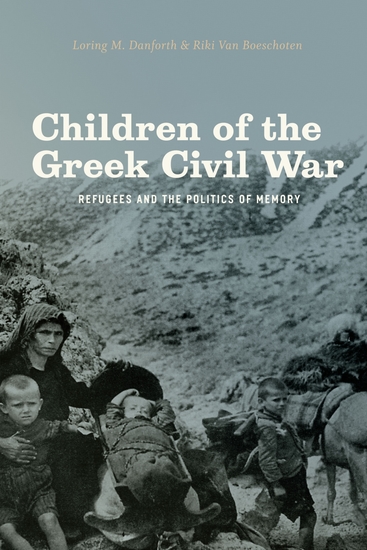
  • Children of the Greek Civil War - Refugees and the Politics of Memory - cover

    Children of the Greek Civil War...

    Loring M. Danforth, Riki Van...

    • 0
    • 0
    • 0
    At the height of the Greek Civil War in 1948, thirty-eight thousand children were evacuated from their homes in the mountains of northern Greece. The Greek Communist Party relocated half of them to orphanages in Eastern Europe, while their adversaries in the national government placed the rest in children’s homes elsewhere in Greece. A point of contention during the Cold War, this controversial episode continues to fuel tensions between Greeks and Macedonians and within Greek society itself. Loring M. Danforth and Riki Van Boeschoten present here for the first time a comprehensive study of the two evacuation programs and the lives of the children they forever transformed. Marshalling archival records, oral histories, and ethnographic fieldwork, the authors analyze the evacuation process, the political conflict surrounding it, the children’s upbringing, and their fates as adults cut off from their parents and their homeland. They also give voice to seven refugee children who poignantly recount their childhood experiences and heroic efforts to construct new lives in diaspora communities throughout the world. A much-needed corrective to previous historical accounts, Children of the Greek Civil War is also a searching examination of the enduring effects of displacement on the lives of refugee children.
    Voir livre
  • The Hanseatic League - Medieval Trade Network - cover

    The Hanseatic League - Medieval...

    Harris Ropes

    • 0
    • 0
    • 0
    The Hanseatic League, often simply referred to as the Hansa, emerged during the late Middle Ages as a powerful and influential commercial and defensive confederation of merchant guilds and market towns in northern Europe. Its origins can be traced back to the 12th century, a time when trade across Europe was expanding, and the need for security, consistency, and cooperation among merchants became more apparent. In this period of growing urbanization and shifting political structures, the groundwork was laid for what would become one of the most successful trade networks of the medieval world. 
    Before the League formally took shape, various Germanic merchants had already been engaged in trade across the North and Baltic Seas. These early trade routes connected regions like modern-day Germany, the Netherlands, Scandinavia, and the Baltic states. Merchant groups began forming guilds—organized associations that provided mutual protection, standardized trade practices, and a collective voice in foreign cities. These early guilds were critical in shaping the cooperative ethos that would later define the Hanseatic League. 
    The political and economic environment of medieval Europe also contributed to the League's formation. The decline of centralized imperial authority, particularly in the Holy Roman Empire, left towns and cities to manage their own economic affairs. This autonomy encouraged local leaders and merchants to seek regional alliances to protect trade interests and ensure the safe passage of goods and people. At the same time, the Crusades had opened new routes and markets, boosting the importance of northern European trade centers.
    Voir livre