Join us on a literary world trip!
Add this book to bookshelf
Grey
Write a new comment Default profile 50px
Grey
Subscribe to read the full book or read the first pages for free!
All characters reduced
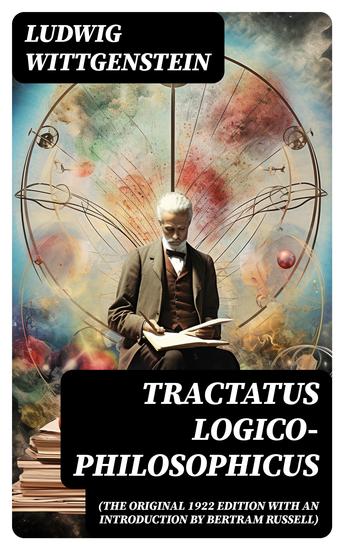
Tractatus Logico-Philosophicus (The original 1922 edition with an introduction by Bertram Russell) - cover

Tractatus Logico-Philosophicus (The original 1922 edition with an introduction by Bertram Russell)

Ludwig Wittgenstein

Publisher: DigiCat

  • 0
  • 0
  • 0

Summary

In the seminal work 'Tractatus Logico-Philosophicus,' first published in 1922, Ludwig Wittgenstein presents a groundbreaking exploration of the relationship between language, reality, and thought. The text unfolds through a series of propositions, meticulously structured to elucidate the limits of language and its role in depicting the world. Wittgenstein's distinctive style combines precision with a poetic resonance, thus firmly situating his work within the analytic tradition of philosophy. He posits that many philosophical problems arise from misunderstandings of language, leading to a profound inquiry into the nature of meaningful statements and the underpinnings of logical representation. Ludwig Wittgenstein, a philosopher and logician, experienced a diverse background, influenced by his Austrian upbringing and studies under prominent thinkers. His compelling visions on the philosophy of language and logic were profoundly shaped by his early life in a wealthy family and his experiences during World War I. The 'Tractatus' emerged from his desire to resolve the complexities surrounding philosophical discourse, reflecting both personal and intellectual struggles that resonate deeply within his philosophy. This book is essential for anyone engaged in philosophical discussion or interested in the foundations of modern logical thought. Wittgenstein's radical ideas invite readers to reconsider the structure of language and its implications for understanding meaning. Delve into this pivotal text to gain insights that continue to inform and challenge contemporary philosophical inquiry.
Available since: 12/29/2023.
Print length: 91 pages.


Other books that might interest you

  • HBR's 10 Must Reads on AI (with bonus article "How to Win with Machine Learning" by Ajay Agrawal Joshua Gans and Avi Goldfarb) - cover

    HBR's 10 Must Reads on AI (with...

    Harvard Business Review

    • 0
    • 0
    • 0
    The next generation of AI is here—use it to lead your business forward. 


    If you read (or listen to) nothing else on artificial intelligence and machine learning, listen to these ten articles. We've combed through hundreds of Harvard Business Review articles and selected the most important ones to help you understand the future direction of AI, bring your AI initiatives to scale, and use AI to transform your organization. This book will inspire you to: create a new AI strategy, learn to work with intelligent robots, get more from your marketing AI, be ready for ethical and regulatory challenges, understand how generative AI is game changing, and stop tinkering with AI and go all in. 


    This collection of articles includes "Competing in the Age of AI," by Marco Iansiti and Karim R. Lakhani; "How to Win with Machine Learning," by Ajay Agrawal, Joshua Gans, and Avi Goldfarb; "Developing a Digital Mindset," by Tsedal Neeley and Paul Leonardi; "Learning to Work with Intelligent Machines," by Matt Beane; "Getting AI to Scale," by Tim Fountaine, Brian McCarthy, and Tamim Saleh; "Why You Aren't Getting More from Your Marketing AI," by Eva Ascarza, Michael Ross, and Bruce G. S. Hardie; "The Pitfalls of Pricing Algorithms," by Marco Bertini and Oded Koenigsberg; "A Smarter Strategy for Using Robots," by Ben Armstrong and Julie Shah; and more.
    Show book
  • Learn French - Level 3: Lower Beginner French - Volume 2: Lessons 1-25 - cover

    Learn French - Level 3: Lower...

    Innovative Language Learning, ...

    • 0
    • 0
    • 0
    Welcome to Lower Beginner French, Volume 2


    You're on your way to France! Master the basics of French conversation!


    Start speaking French in minutes, and learn key vocabulary, phrases, and grammar in just minutes more with Lower Beginner French. Our native French hosts break down all the sentences, grammar and more in a simple, easily understandable way! 


    Here are a few topics covered in this audiobook: 
     
    • Talk About Numbers and Time
     
    • Saying "No"
     
    • Asking and Giving Directions
     
    • Talk About the Past
     
    • French Cultural Tips and More!


    This isn't stale textbook material - it's fun, effective, and practical! You learn beginner French conversation that you can use immediately!


    What you get in Lower Beginner French:
     
    • 190+ pages of French learning material 
     
    • 25 French lessons: dialog transcripts with translation, vocabulary, sample sentences and a grammar section
     
    • 25 Audio Lesson Tracks 
     
    • 25 Audio Review Tracks (practice new words and phrases)
     
    • 25 Audio Dialog Tracks (read along while you listen 


    Interactive. Effective. And FUN!


    Discover or rediscover how fun learning a language can be with the future of language learning.


    Buy this now and start speaking French instantly!


    Download the PDF and read along
    Show book
  • Theodor Fontane: A short biography - 5 Minutes: Short on time – long on info! - cover

    Theodor Fontane: A short...

    5 Minutes, 5 Minute Biographies,...

    • 0
    • 0
    • 0
    Theodor Fontane, German poet and novelist: Life and work in a short biography! Everything you need to know, brief and concise. Infotainment, education and entertainment at its best!
    Show book
  • Popular Works Volume 2 - The Characteristics of the Present Age The Doctrine of Religion and Other Works - cover

    Popular Works Volume 2 - The...

    Johann Gottleib Fitche

    • 0
    • 0
    • 0
    Though born to a poor but pious family of ribbon weavers in in Saxony in 1762, Johann Gottlieb’s exceptional intelligence was apparent from an early age. Remarkably, from this humble background, he earned himself a respected place in the pantheon of late 18th and early 19th century German philosophers. That fact that he is placed between Kant and Hegel, yet still retains a significant and individual presence, says much about his work and personality. He became known, especially, for initiating the concept of ‘German idealism’ (linked with Romanticism and the revolutionary politics which emerged after the Enlightenment). In the 20th and 21st century, his importance and contribution to Western philosophy has been increasingly acknowledged.  
     
    There are two substantial lecture series and one essay stemming from his time in Berlin in Popular Works Volume 2: much of Fichte’s important work appeared initially in lectures. 
     
     The Characteristics of the Present Age, (1806) consists of 17 lectures in which Fichte presents his ‘speculative philosophy of history’. The series opens with ‘The Idea of Universal History’ in which he ‘divides earthly life into 5 Principal Epochs.’ Against this overview of history and culture, (including the state, civil and political freedom, science and religion) he develops his thesis with particular reference to his ‘present age’ – the time of Voltaire, Rousseau on the one hand and Lessing, Kant and Goethe on the other.  
     
    In The Way Towards The Blessed Life or The Doctrine Of Religion (1806) (11 lectures) Fichte considers the relationship between established religion and his particular view on ‘transcendental’ philosophy. His opening statement is ‘Life is Love; and hence Life and Blessedness are in themselves one and the same.’  He continues by examine metaphysics, ontology, mysticism, actual and apparent life, Christianity, and his Doctrine of Being.  
     
    The final work in this anthology is Outlines of the Doctrine of Knowledge (1810). It is a concise exposition of Fichte’s Wissenschaftslehre’ but in its strictly scientific form. It had an unusual provenance in that it was printed by Fichte at the conclusion of lectures as a form of a memorandum with 14 short sections. It opens with the question: ‘How this Knowledge can come into being, and what it is in its inward and essential Nature?’
    Show book
  • Epic Feats: Conquer the World with Courage and Grit - "Achieve greatness with Epic Feats! Dive into inspiring audio lessons crafted for your bold adventures!" - cover

    Epic Feats: Conquer the World...

    Gideon Marwood

    • 0
    • 0
    • 0
    Epic Feats: Conquer the World with Courage and Grit  
    ⭐⭐ Simplified Guide & Explanations Included ⭐⭐ 
    Are you ready to advance your career and solidify your expertise by successfully transforming challenges into triumphs through grit and resilience? 
    Looking for an all-encompassing guide that equips you with everything you need to navigate your path to success? 
    Your search ends here! 
    This guide is your ultimate companion for enhancing your understanding, applying your skills, and engaging in practical exercises. With it, you’re set for success. 
    Updated for the latest Exam Structure for 2024-2025. 
    Key features of this comprehensive guide: 
    - In-depth insights into transforming challenges into triumphs through grit and resilience for the 2024-2025 certification. 
      - Thorough explanations of the principles behind overcoming obstacles. 
    - Effective strategies for preparation and effective problem-solving. 
    Our guide stands out due to its extensive coverage, which is vital for your success. Concepts are explored in detail; they are not simply skimmed over. 
    Please note that this guide operates independently and is not affiliated with any official entities. It is designed purely to serve your needs. 
    Crafted with a logical structure and straightforward language, our guide ensures seamless navigation between topics. Say goodbye to complicated jargon and embrace clear, precise, and technically accurate content. 
    So, why wait? Click the BUY NOW button to secure your guide and embark on your journey to success in transforming challenges into triumphs through grit and resilience!
    Show book
  • The Battle of Waterloo - Napoleon's Last Stand - cover

    The Battle of Waterloo -...

    Nova Ashford

    • 0
    • 0
    • 0
    In the early months of 1815, Europe found itself once again on the brink of war. Napoleon Bonaparte, exiled to the island of Elba after his abdication in 1814, had made a daring return to France. On March 1, he landed on the southern coast and began a dramatic march north to Paris. Along the way, regiments sent to arrest him instead joined his cause. By mid-March, he had reclaimed power in what would be known as the Hundred Days. This return sent shockwaves across the continent and disrupted the fragile peace established by the Congress of Vienna. 
    The leaders of the major European powers—Britain, Prussia, Austria, and Russia—swiftly moved to form the Seventh Coalition. Their shared goal was simple: defeat Napoleon once and for all. The coalition agreed to raise massive armies and converge on France from multiple directions. Among the key figures in this alliance were the Duke of Wellington, commanding Anglo-allied forces, and Field Marshal Gebhard Leberecht von Blücher, leading the Prussians. Napoleon, ever the strategist, understood the urgency of striking quickly before these forces could unite. 
    France, still weary from years of revolution and war, was divided in its support. While many rallied to Napoleon out of loyalty or fear, others viewed his return as a dangerous setback. Nonetheless, he managed to raise an army of around 124,000 men—smaller than the coalition forces, but composed largely of veterans loyal to him. Napoleon's plan hinged on speed: he would drive a wedge between Wellington and Blücher’s armies in Belgium, defeat them separately, and then force a negotiated peace.
    Show book