Rejoignez-nous pour un voyage dans le monde des livres!
Ajouter ce livre à l'électronique
Grey
Ecrivez un nouveau commentaire Default profile 50px
Grey
Abonnez-vous pour lire le livre complet ou lisez les premières pages gratuitement!
All characters reduced
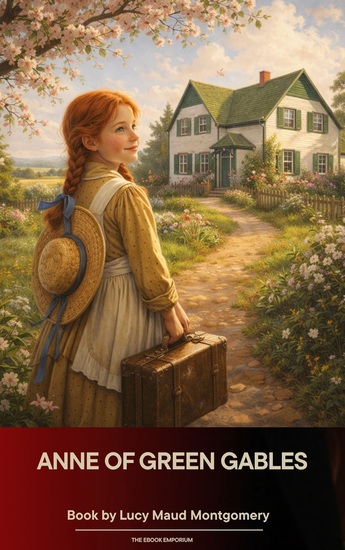
Anne of Green Gables - cover

Anne of Green Gables

Lucy Maud Montgomery

Maison d'édition: The Ebook Emporium

  • 0
  • 0
  • 0

Synopsis

What if imagination could turn an ordinary life into something extraordinary?

Anne of Green Gables is one of the most cherished novels in world literature. When spirited, talkative, and imaginative Anne Shirley arrives at Green Gables by mistake, her presence transforms the quiet lives of Marilla and Matthew Cuthbert—and the entire village of Avonlea.

With her vivid imagination, fiery temper, and boundless optimism, Anne grows from a misunderstood orphan into a young woman discovering friendship, belonging, and self-worth. Lucy Maud Montgomery's storytelling blends humor, warmth, and gentle wisdom, creating a world that feels comforting, hopeful, and deeply human.

This timeless novel celebrates individuality, kindness, resilience, and the beauty of everyday life.

Inside this eBook, you'll experience:

One of the most beloved coming-of-age stories ever written

A memorable heroine full of heart, humor, and imagination

Themes of family, friendship, and personal growth

A cornerstone of classic children's and young-adult literature

Read by generations and adapted for film, television, and stage, Anne of Green Gables remains a story that feels like home.

Step into Avonlea and rediscover the joy of imagination. Buy now and enjoy this timeless classic.
Disponible depuis: 28/01/2026.
Longueur d'impression: 346 pages.

D'autres livres qui pourraient vous intéresser

  • A Chameleon - From their pens to your ears genius in every story - cover

    A Chameleon - From their pens to...

    Anton Chekhov

    • 0
    • 0
    • 0
    Anton Pavlovich Chekhov was born on 29th January 1860 in Taganrog, on the south coast of Russia.  
    His family life was difficult; his father was strict and over-bearing but his mother was a passionate story-teller, a subject Chekhov warmed to. As he later said; ‘our talents we got from our father, but our soul from our mother’.  
    At school Chekhov was distinctly average. At 16 his father mis-managed his finances and was declared bankrupt. His family fled to Moscow. Chekhov remained and eked out a living by various means, including writing and selling short sketches to newspapers, to finish his schooling. That completed and with a scholarship to Moscow University obtained he rejoined his family. 
    He was able to help support them by selling satirical sketches and vignettes of Russian lifestyles and gradually obtained further commissions. In 1884, he qualified as a physician and, although it earned him little, he often treated the poor for free, he was fond of saying ‘Medicine is my lawful wife, and literature is my mistress.’ 
    His own health was now an issue as he began to cough up blood, a symptom of tuberculosis.  Despite this his writing success enabled him to move the family into more comfortable accommodation.  
    Chekhov wrote over 500 short stories which included many, many classics including ‘The Kiss’ and ‘The Lady with a Dog’.  His collection ‘At Dusk’ won him the coveted Pushkin Prize when was only 26.  
    He was also a major playwright beginning with the huge success of ‘Ivanov’ in 1887.   
    In 1892 Chekhov bought a country estate north of Moscow. Here his medical skills and money helped the peasants tackle outbreaks of cholera and bouts of famine. He also built three schools, a fire station and a clinic.  It left him with less time for writing but the interactions with real people gained him detailed knowledge about the peasantry and their living conditions for his stories.  
    His most famous work, ‘The Seagull’ was received disastrously at its premiere in St Petersburg. It was later restaged in Moscow to highlight its psychological aspects and was a huge success. It led to ‘Uncle Vanya’, ‘The Three Sisters’ and ‘The Cherry Orchard’.  
    Chekhov suffered a major lung hemorrhage in 1897 while visiting Moscow. A formal diagnosis confirmed tuberculosis and the doctors ordered changes to his lifestyle.  
    Despite a dread of weddings the elusive literary bachelor quietly married the actress Olga Knipper, whom he had met at rehearsals for ‘The Seagull’, on 25th May 1901. 
    By May 1904 with his tuberculosis worsening and death imminent he set off for the German town of Badenweiler writing cheerful, witty letters to his family and assuring them his health was improving.  
    On 15th July 1904 Anton Chekhov died at Badenweiler.  He was 44.
    Voir livre
  • The Enchanted April - cover

    The Enchanted April

    Elizabeth von Arnim

    • 0
    • 0
    • 0
    When four women leave their drab lives behind to go on holiday in Italy, their lives are changed forever by the Mediterranean. Mrs. Arbuthnot and Mrs. Wilkins, while part of the same ladies' club, have never spoken. Lady Caroline Dester and the elderly Mrs. Fisher join their holiday so as to mitigate expenses. As these women come together and learn more about themselves than they ever thought possible, they reveal their true personalities and the backdrops of their lives that tend to hinder them. Inspired by the author's own month-long trip to the Italian Riviera, this novel is noted as her most widely-read work.
    Voir livre
  • Filmer (Unabridged) - cover

    Filmer (Unabridged)

    H. G. Wells

    • 0
    • 0
    • 0
    Herbert George Wells (21 September 1866 - 13 August 1946) was an English writer. Prolific in many genres, he wrote dozens of novels, short stories, and works of social commentary, history, satire, biography and autobiography. His work also included two books on recreational war games. Wells is now best remembered for his science fiction novels and is often called the "father of science fiction", along with Jules Verne and the publisher Hugo Gernsback.
    FILMER: In truth the mastery of flying was the work of thousands of men-this man a suggestion and that an experiment, until at last only one vigorous intellectual effort was needed to finish the work.
    Voir livre
  • Bobok - From their pens to your ears genius in every story - cover

    Bobok - From their pens to your...

    Fyodor Dostoyevsky

    • 0
    • 0
    • 0
    Fyodor Mikhailovich Dostoyevsky was born in Moscow on 11th November, 1821 to distinguished multi-ethnic parents from a Lithuanian background.  
    His childhood years were at the family home in hospital grounds which also contained an orphanage, an insane asylum and a cemetery for criminals.  The young Fyodor often disobeyed his father by talking to the ill in the hospital gardens.   
    His health was compromised at age 9 when he experienced his first epileptic fit. By the time he was a teenager both parents had died and he was now enrolled in a military academy where he graduated and eventually became a Lieutenant in 1842.  He left military service the next year. 
    In 1846 he published his first novel ‘Poor Cow’ to great literary acclaim.  His next was unable to emulate that success but his short stories helped provide an income.  Life as an author was definitely difficult. As he began his next work he was arrested and incarcerated for treason and participation in the political and literary Petrashevsky Circle. Although the case was weak and unjustified he was sentenced to 4 years of hard labour followed by 5 years of military service in a Siberian regiment.  
    Despite the undoubted hardships and setbacks in his life, and whether they helped or hindered his writing, his talents produced many exceptional works of literature including ‘Crime and Punishment’, ‘The Idiot’ and ‘The Brothers Karamazov’.   
    Dostoevsky’s ability to get under the skin of his characters and show the inner workings of their mind was hugely influential and ahead of its time.  Interwoven with this was the influence of the broader social, spiritual and political forces at work in a person's psyche.   
    Fyodor Dostoevsky struggled financially and remained in poor health for much of his adult life.  He died from a lung haemorrhage on 9th February, 1881.
    Voir livre
  • Helping Others (Unabridged) - cover

    Helping Others (Unabridged)

    Booker T. Washington

    • 0
    • 0
    • 0
    Booker Taliaferro Washington (April 5, 1856 - November 14, 1915) was an American educator, author, orator, and adviser to several presidents of the United States. Between 1890 and 1915, Washington was the dominant leader in the African American community and of the contemporary black elite. Washington was from the last generation of black American leaders born into slavery and became the leading voice of the former slaves and their descendants. They were newly oppressed in the South by disenfranchisement and the Jim Crow discriminatory laws enacted in the post-Reconstruction Southern states in the late 19th and early 20th centuries.
    HELPING OTHERS: There are a few essential things in an institution of this kind that I think it is well for you to keep ever before you. This institution does not exist for your education alone; it does not exist for your comfort and happiness altogether, although those things are important, and we keep them in mind; it exists that we may give you intelligence, skill of hand, and strength of mind and heart; and we help you in these ways that you, in turn, may help others.
    Voir livre
  • The House Of The Arrow - cover

    The House Of The Arrow

    A. E. W. Mason

    • 0
    • 0
    • 0
    A young English girl is accused in Dijon of murdering her French aunt. Hanaud to the rescue! Inspector Hanaud is a member of the French Sûreté. He is said to have been the model for Agatha Christie’s Hercule Poirot, as well as the opposite of Conan Doyle’s Sherlock Holmes. In 1910, Mason undertook to create a fictional detective as different as possible from Sherlock Holmes, who had recently been resuscitated after his supposed death by Arthur Conan Doyle in 1903. Inspector Gabriel Hanaud was stout, not gaunt like Holmes; a professional policeman, not a gentleman amateur; from the French Sûreté, not Victorian England; and relying on psychological insights rather than physical evidence. His "Watson" is a retired London banker named Mr. Julius Ricardo, though he appears only briefly in this novel.
    Voir livre