Begleiten Sie uns auf eine literarische Weltreise!
Buch zum Bücherregal hinzufügen
Grey
Einen neuen Kommentar schreiben Default profile 50px
Grey
Jetzt das ganze Buch im Abo oder die ersten Seiten gratis lesen!
All characters reduced
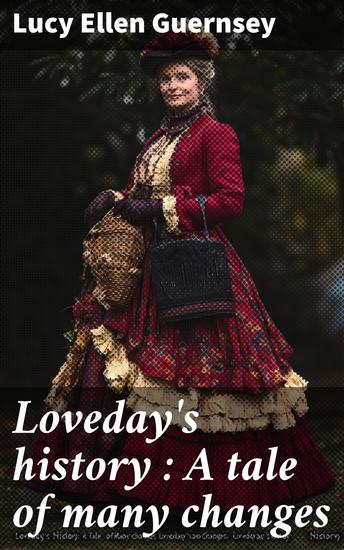
Loveday's history : A tale of many changes - cover

Loveday's history : A tale of many changes

Lucy Ellen Guernsey

Verlag: Good Press

  • 0
  • 0
  • 0

Beschreibung

In "Loveday's History: A Tale of Many Changes," Lucy Ellen Guernsey crafts a captivating narrative that navigates the tumultuous waters of change within 19th-century England. Drawing upon her rich literary style, Guernsey intertwines personal stories with broader historical themes, creating a vivid tapestry that reflects the societal transformations of the era. The novel is replete with richly drawn characters whose lives are intricately connected to significant historical events, offering readers a profound meditation on the interplay between individual destinies and the sweeping forces of change. Guernsey employs a seamless blend of realism and lyrical prose, inviting readers to immerse themselves in the complexities of human experience amid an evolving landscape. Lucy Ellen Guernsey, a notable figure in American literature, was deeply influenced by her own varied experiences, including her upbringing in a changing world marked by social upheaval and moving geographical landscapes. Her firsthand exposure to the struggles and triumphs of those around her provided a fertile ground for her writing, particularly in creating nuanced characters that resonate with authenticity. Guernsey's keen insights into the human condition and her passionate commitment to social justice are reflected in the narrative, underscoring her desire to bring forth underrepresented voices of her time. "Loveday's History" is an essential read for anyone interested in the intersections of history and personal narrative. Guernsey's masterful storytelling not only entertains but also educates, prompting readers to reflect on their own histories while engaging with the broader saga of societal change. This novel offers a compelling exploration of resilience and identity, making it a remarkable addition to any literary collection.
Verfügbar seit: 02.03.2025.
Drucklänge: 140 Seiten.
Weitere Bücher, die Sie mögen werden

  • The Criminal From Lost Honour - cover

    The Criminal From Lost Honour

    Frederick Schiller

    • 0
    • 0
    • 0
    Johann Christoph Friedrich Schiller was born on 10th November 1759, in Marbach, Württemberg, the sole son of six children, into a very religious family. 
     
    During his childhood his father was away, engaged in the Seven Years War and contact was sporadic until with the War’s end in 1763. His father became a recruiting officer and the family moved to Lorch. 
     
    It was here that Schiller received his early education, the quality of which was poor, not helped by the child’s frequent truancy.  His parents sought a clerical career for him and a local priest was engaged to teach him Latin and Greek. As a boy, Schiller was excited by the idea of becoming a cleric and often wore black robes and pretended to preach. 
     
    In 1766, the family left Lorch. Schiller's father had not been paid for three years, and the family’s savings were depleted, so his father Kaspar, joined the garrison in Ludwigsburg for the Duke of Württemberg. 
     
    There the boy Schiller came to the attention of the Duke. He entered the elite military academy, the Karlsschule Stuttgart, in 1773, and eventually studied medicine, which led him to frequently attempt cures for his various illnesses. 
     
    At the academy, he wrote his first play, ‘The Robbers’, which dramatizes the conflict between two aristocratic brothers. The play's themes of social corruption and proto-revolutionary republican ideals astounded its original audience. Schiller became an overnight sensation.  
     
    In 1780, he obtained a post as regimental doctor in Stuttgart. In order to attend the first performance of ‘The Robbers’ in Mannheim, Schiller left his regiment without permission. As a result, he was arrested, sentenced to 14 days imprisonment, and forbidden from publishing any further works. 
     
    He fled Stuttgart in 1782, going via Frankfurt, Mannheim, Leipzig, and Dresden to Weimar. Along this journey he had an affair with an army officer's wife, Charlotte von Kalb. She was at the centre of an intellectual circle and known for her cleverness and instability.  
     
    Schiller settled in Weimar in 1787. Two years later he was appointed professor of History and Philosophy in Jena, where he wrote only historical works. 
     
    On 22nd February 1790, he married Charlotte von Lengefeld who bore him two sons and two daughters. 
     
    Schiller returned with his family to Weimar from Jena in 1799. There Johann Wolfgang von Goethe convinced him to return to playwriting and together they founded the Weimar Theater, which led to a renaissance of drama now referred to as Weimar Classicism. They also worked together on Xenien, a collection of short satirical poems in which they challenged opponents of their philosophical vision. 
     
    For his achievements, Schiller was ennobled in 1802 by the Duke of Saxe-Weimar, adding the nobiliary particle ‘von’ to his name.  
     
    Schiller died on 9th May 1805, at age 45, from tuberculosis, at Weimar. 


    Although primarily admired for his plays Schiller also wrote histories, poetry and some notable translations.   
     
    In his short story ‘The Criminal from Lost Honour’ the layers of a man’s life are examined as perhaps only Schiller and his literary genius can.
    Zum Buch
  • The Adventures Of Sherlock Holmes - cover

    The Adventures Of Sherlock Holmes

    Arthur Conan Doyle

    • 0
    • 0
    • 0
    "The Adventures of Sherlock Holmes" is a collection of short stories featuring the iconic detective Sherlock Holmes and his friend Dr. John Watson. First published in 1892, the book includes some of Sherlock Holmes's most famous cases, such as "A Scandal in Bohemia," "The Adventure of the Blue Carbuncle," and "The Adventure of the Speckled Band." These stories showcase Holmes's unparalleled powers of observation and deduction as he solves various mysteries, from thefts and kidnappings to more complex and unusual crimes.
    Zum Buch
  • Louisa May Alcott - Six of the Best - Their legacy in 6 classic stories - cover

    Louisa May Alcott - Six of the...

    Louisa May Alcott

    • 0
    • 0
    • 0
    Six has always been a number we group things around – Six of the best, six of one half a dozen of another, six feet under, six pack, six degrees of separation and a sixth sense are but a few of the ways we use this number. 
     
    Such is its popularity that we thought it is also a very good way of challenging and investigating an author’s work to give width, brevity, humour and depth across six of their very best. 
     
    In this series we gather together authors whose short stories both rivet the attention and inspire the imagination to visit their gems in a series of six, to roam across an author’s legacy in a few short hours and gain a greater understanding of their writing and, of course, to be lavishly entertained by their ideas, their narrative and their way with words. 
     
    These stories can be surprising and sometimes at a tangent to what we expected, but each is fully formed and a marvellous adventure into the world and words of a literary master. 
     
    1 - Six of the Best - Louisa May Alcott - An Introduction 
    2 - Louisa May Alcott - An Introduction 
    3 - On Picket Duty by Louisa May Alcott 
    4 - The Brothers by Louisa May Alcott 
    5 - Obtaining Supplies by Louisa May Alcott 
    6 - My Red Cap by Louisa May Alcott 
    7 - Psyche's Art by Louisa May Alcott 
    8 - Transcendental Wild Oats by Louisa May Alcott
    Zum Buch
  • Anna Karenina (Part 6) - cover

    Anna Karenina (Part 6)

    Leo Tolstoy

    • 0
    • 0
    • 0
    Part 6: Dolly, her children, and her mother, the Princess Shcherbatskaya, spend the summer with Kostya and Kitty. The couple's life is simple and unaffected, although Kostya is uneasy at the "invasion" of so many Shcherbatskys. He becomes extremely jealous when one of the visitors, Veslovsky, flirts openly with the pregnant Kitty. Kostya tries to overcome his jealousy, and briefly succeeds during a hunt with Veslovsky and Oblonsky, but eventually succumbs to his feelings and asks Veslovsky to leave. Veslovsky immediately goes to stay with Anna and Vronsky at their nearby estate.
    Anna Karenina is a novel by the Russian author Leo Tolstoy, first published in book form in 1878. Many writers consider Anna Karenina the greatest work of literature ever, and Tolstoy himself called it his first true novel. It was initially released in serial installments from 1873 to 1877 in the periodical The Russian Messenger.
    Zum Buch
  • The Job - cover

    The Job

    Sinclair Lewis

    • 0
    • 0
    • 0
    The Job is an early work by American novelist Sinclair Lewis.
    It is considered an early declaration of the rights of working women. The focus is on the main character, Una Golden, and her desire to establish herself in a legitimate occupation while balancing the eventual need for marriage. The story takes place in the early 1900-1920s and takes Una from a small Pennsylvania town to New York. Forced to work due to family illness, Una shows a talent for the traditional male bastion of commercial real estate and, while valued by her company, she struggles to achieve the same status of her male coworkers. On a parallel track, her quest for traditional romance and love is important but her unique role as a working woman, doing a man's job, makes it tough to find an appropriate suitor.
    Zum Buch
  • Anticipations (Unabridged) - cover

    Anticipations (Unabridged)

    H. G. Wells

    • 0
    • 0
    • 0
    Anticipations of the Reaction of Mechanical and Scientific Progress upon Human Life and Thought, generally known as Anticipations, was written by H.G. Wells at the age of 34. He later called the book, which became a bestseller, "the keystone to the main arch of my work." His most recent biographer, however, calls the volume "both the starting point and the lowest point in Wells's career as a social thinker." Taking the revolution in transport facilitated by the "mechanical revolution" as his point of departure, Wells told readers they were living through a reorganization of human society that would alter every dimension of life. An academic biographer has described the degree of accuracy of Wells's predictions as "certainly phenomenal.
    Zum Buch