Rejoignez-nous pour un voyage dans le monde des livres!
Ajouter ce livre à l'électronique
Grey
Ecrivez un nouveau commentaire Default profile 50px
Grey
Abonnez-vous pour lire le livre complet ou lisez les premières pages gratuitement!
All characters reduced
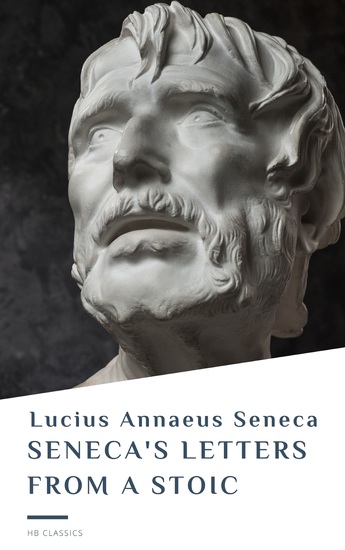
Seneca's Letters from a Stoic - cover

Seneca's Letters from a Stoic

Lucius Annaeus Seneca, HB Classics

Maison d'édition: HB Classics

  • 0
  • 0
  • 0

Synopsis

As chief advisor to the emperor Nero, Lucius Annaeus Seneca was most influential in ancient Rome as a power behind the throne. His lasting fame derives from his writings on Stoic ideology, in which philosophy is a practical form of self-improvement rather than a matter of argument or wordplay. Seneca's letters to a young friend advise action rather than reflection, addressing the issues that confront every generation: how to achieve a good life; how to avoid corruption and self-indulgence; and how to live without fear of death. 
Written in an intimate, conversational style, the letters reflect the traditional Stoic focus on living in accordance with nature and accepting the world on its own terms. The philosopher emphasizes the Roman values of courage, self-control, and rationality, yet he remains remarkably modern in his tolerant and cosmopolitan attitude. Rich in epigrammatic wit, Seneca's interpretation of Stoicism constitutes a timeless and inspiring declaration of the dignity of the individual mind.
Disponible depuis: 27/11/2022.
Longueur d'impression: 483 pages.
D'autres livres qui pourraient vous intéresser

  • Powerful Questioning - Strategies for improving learning and retention in the classroom - cover

    Powerful Questioning -...

    Michael Chiles

    • 0
    • 0
    • 0
    Foreword by John Hattie.
    Questioning is a staple feature of a teacher's toolkit across all phases of education. Classrooms are awash with explanation, modelling and feedback, but of all the pedagogical strategies at a teacher's disposal, questioning is one of the most important. It is the heartbeat of a classroom. While the art of asking a question seems relatively straightforward, to what extent do teachers consider the types of questions they're using? Are the questions they ask students actually helping to support learning? InPowerful Questioning,Michael Chiles delves into the complexity of asking questions and how best to use this pedagogical tool as a powerful springboard to support learning in the classroom.
    Teachers are described by many as 'professional question-askers' and the use of questioning in the teaching and learning process dates back to one of the most influential users and developers of questions, the Greek philosopher Socrates. Socrates believed that by asking questions we encourage reflection, and that their use is most effective when we create a continual loop of dialogue between the asker and the receiver, to allow movement from surface to deeper level thinking.Powerful Questioningtakes inspiration from this, providing original theory that relates back to the historical use of questioning in the classroom throughout.
    Offering a fresh perspective on how questioning can be engineered to support effective learning,Powerful Questioningexamines the reasons behind the questions we ask and reveals the power of asking the right questions, in the right way, at the right time. It details a set of core principles, recommendations and classroom-based practical examples that can be used to implement powerful questioning both in the classroom and wider school.
    Michael's aim is to help teachers become research-informed on the theories around the use of questioning in the classroom, whilst also providing a wide range of practical classroom-based strategies. Readers will take away specific examples from a broad range of case studies in which teachers at different phases of education (from Key Stages one to five) share how they use questioning to improve learning and retention.
    Essential reading for all teachers and school leaders.
    Voir livre
  • American Indian Symbolism - cover

    American Indian Symbolism

    Manly Palmer Hall

    • 0
    • 0
    • 0
    The North American Indian is by nature a symbolist, a mystic, and a philosopher. Like most: aboriginal peoples, his soul was en rapport with the cosmic agencies manifesting about him. Not only did his Manidos control creation from their exalted seats above the clouds, but they also descended into the world of men and mingled with their red children. The gray clouds hanging over the horizon were the smoke from the calumets of the gods, who could build fires of petrified wood and use a comet for a flame. The American Indian peopled the forests, rivers, and sky with myriads of superphysical and invisible beings. There are legends of entire tribes of Indians who lived in lake bottoms; of races who were never seen in the daytime but who, coming forth from their hidden caves, roamed the earth at night and waylaid unwary travelers; also of Bat Indians, with human bodies and batlike wings, who lived in gloomy forests and inaccessible cliffs and who slept hanging head downward from great branches and outcroppings of rock. The red man's philosophy of elemental creatures is apparently the outcome of his intimate contact with Nature, whose inexplicable wonders become the generating cause of such metaphysical speculations.
    Voir livre
  • Truthfulness - The Unvarnished Reality - cover

    Truthfulness - The Unvarnished...

    Esther Jameson

    • 0
    • 0
    • 0
    Truth is often regarded as a simple concept—something either is or it isn’t. Yet, when examined more closely, truth reveals itself to be one of the most profound and complex forces in human existence. It transcends the surface of facts and ventures into realms shaped by perception, experience, culture, and belief. Understanding the nature of truth requires more than a definition; it demands a deep exploration of how we relate to reality itself. 
    At its core, truth is commonly defined as that which aligns with fact or reality. However, facts can be interpreted differently depending on one’s background, intentions, and emotional state. Objective truth refers to things that remain constant regardless of personal opinions—scientific laws, historical events, and physical evidence fall into this category. Subjective truth, on the other hand, is shaped by personal perspective. It’s the kind of truth we feel rather than prove: our experiences, emotions, and beliefs about the world. Both forms are valid in their own domains, but problems often arise when subjective truth is presented as universally objective. 
    Culture also plays a significant role in shaping our understanding of truth. In some societies, truth is seen as communal—a shared agreement among people, traditions, or religious teachings. In others, truth is fiercely individual, something one must discover for oneself. This cultural lens can influence what people consider acceptable or unacceptable, right or wrong, honest or deceptive. What might be considered an innocent omission in one culture could be seen as a serious lie in another.
    Voir livre
  • Blacksound - Making Race and Popular Music in the United States - cover

    Blacksound - Making Race and...

    Matthew D. Morrison

    • 0
    • 0
    • 0
    A new concept for understanding the history of the American popular music industry. 


    Blacksound explores the sonic history of blackface minstrelsy and the racial foundations of American musical culture from the early 1800s through the turn of the twentieth century. With this namesake book, Matthew D. Morrison develops the concept of "Blacksound" to uncover how the popular music industry and popular entertainment in general in the United States arose out of slavery and blackface. 


    Blacksound as an idea is not the music or sounds produced by Black Americans but instead the material and fleeting remnants of their sounds and performances that have been co-opted and amalgamated into popular music. Morrison unpacks the relationship between performance, racial identity, and intellectual property to reveal how blackface minstrelsy scripts became absorbed into commercial entertainment through an unequal system of intellectual property and copyright laws. By introducing this foundational new concept in musicology, Blacksound highlights what is politically at stake—for creators and audiences alike—in revisiting the long history of American popular music.
    Voir livre
  • Tao Te Ching - cover

    Tao Te Ching

    Lao Tzu

    • 0
    • 0
    • 0
    The Tao Te Ching, Daodejing, Dao De Jing, or Daode jing, also simply referred to as the Laozi, is a Chinese classic text. According to tradition, it was written around 6th century BC by the sage Laozi, a record-keeper at the Zhou dynasty court, by whose name the text is known in China. The text's true authorship and date of composition or compilation are still debated, although the oldest excavated text dates back to the late 4th century BC.The Tao Te Ching, along with the Zhuangzi, is a fundamental text for both philosophical and religious Taoism, and strongly influenced other schools, such as Legalism, Confucianism, and Chinese Buddhism, which when first introduced into China was largely interpreted through the use of Daoist words and concepts. Many Chinese artists, including poets, painters, calligraphers, and even gardeners, have used the Daodejing as a source of inspiration. Its influence has also spread widely outside East Asia, and is among the most translated works in world literature.
    Voir livre
  • ACT for Treating Children - The Essential Guide to Acceptance and Commitment Therapy for Kids - cover

    ACT for Treating Children - The...

    PhD Tamar D. Black, Russ Harris

    • 0
    • 0
    • 0
    If you treat children struggling with mental health conditions such as depression or anxiety, you know that approaches designed for adults do not work with younger clients. ACT for Treating Children presents skills grounded in evidence-based acceptance and commitment therapy (ACT) to help children regulate emotions and cope with the inevitable ups and downs of life, and is suitable for clinicians with no prior knowledge of or training in ACT, as well as seasoned ACT clinicians. 


    Written by an experienced educational and developmental psychologist, this practical clinician's guide outlines a simplified version of the ACT Hexaflex—a key component of this treatment model—called the Kidflex, to help young clients build resilience and psychological flexibility.  You'll find strategies for involving parents in treatment when appropriate, and enlisting them as 'ACT coaches' in the child’s therapy. 


    It can be difficult to know where to start when using ACT for individual therapy with children. That's why the skills in this go-to guide are practical and easy-to-implement, can be done with children in both face-to-face therapy and online sessions, and are simple enough for children to put into practice in any setting—whether it's at home, in school, or out in the world.
    Voir livre