

Begleiten Sie uns auf eine literarische Weltreise!
Buch zum Bücherregal hinzufügen
Grey
Einen neuen Kommentar schreiben Default profile 50px
Grey
Jetzt das ganze Buch im Abo oder die ersten Seiten gratis lesen!
All characters reduced
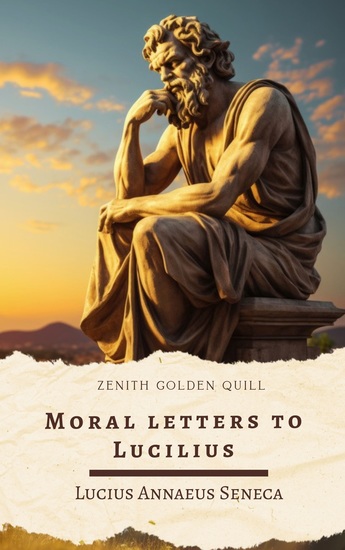
Moral letters to Lucilius - Philosophical Letters from Ancient Rome That Speak to the Soul of Today - cover

Moral letters to Lucilius - Philosophical Letters from Ancient Rome That Speak to the Soul of Today

Lucius Annaeus Seneca, Zenith Golden Quill

Verlag: Zenith Golden Quill

  • 0
  • 0
  • 0

Beschreibung

How should we live? What is virtue? And how do we face death without fear?

In Moral Letters to Lucilius, the Roman philosopher Seneca shares timeless reflections on how to live well, act with courage, and find peace amid chaos. Written in the form of letters to his friend Lucilius, these meditations explore topics like anger, wealth, grief, friendship, and the fleeting nature of life.

As one of the foundational texts of Stoicism, Moral Letters offers practical guidance for navigating the struggles of daily life with reason, resilience, and moral clarity. Each letter is a compact blend of philosophy and personal insight—more relevant now than ever.

This annotated and indexed edition is ideal for modern readers, students of philosophy, and anyone seeking calm, meaning, and inner discipline.

"The original life coach—Seneca speaks to us like a wise friend across centuries." — Ryan Holiday
"A profound source of clarity and courage for anyone pursuing the good life." — The Guardian

Click Buy Now to begin your journey into the Stoic mind and the art of living wisely.
Verfügbar seit: 16.05.2025.
Drucklänge: 780 Seiten.

Weitere Bücher, die Sie mögen werden

  • From Underground Railroad to Rebel Refuge - Canada and the Civil War - cover

    From Underground Railroad to...

    Brian Martin

    • 0
    • 0
    • 0
    Filled with engaging stories and astonishing facts, From Underground Railroad to Rebel Refuge examines the role of Canadians in the American Civil War
    		 
    Despite all we know about the Civil War, its causes, battles, characters, issues, impacts, and legacy, few books have explored Canada’s role in the bloody conflict that claimed more than 600,000 lives.
    		 
    A surprising 20,000 Canadians went south to take up arms on both sides of the conflict, while thousands of enslaved people, draft dodgers, deserters, recruiters, plotters, and spies fled northward to take shelter in the attic that is Canada. Though many escaped slavery and found safety through the Underground Railroad, they were later joined by KKK members wanted for murder. Confederate President Jefferson Davis along with several of his emissaries and generals found refuge on Canadian soil, and many plantation owners moved north of the border.
    		 
    Award-winning journalist Brian Martin will open eyes in both Canada and the United States to how the two countries and their citizens interacted during the Civil War and the troubled times that surrounded it.
    Zum Buch
  • How to Make Money - An Ancient Guide to Wealth Management (series: Ancient Wisdom for Modern Readers) - cover

    How to Make Money - An Ancient...

    PLINY

    • 0
    • 0
    • 0
    Ancient Romans liked money. But how did they make a living and sometimes even become rich? The Roman economy was dominated by agriculture, but it was surprisingly modern in many ways: the Romans had companies with CEOs, shareholders, and detailed contracts regulated by meticulous laws; systems of banking and taxation; and a wide range of occupations, from merchant and doctor to architect and teacher. The Romans also enjoyed a relatively open society, where some could start from the bottom, work, invest, and grow rich. How to Make Money gathers a wide variety of ancient writings that show how Romans thought about, made, invested, spent, lost, and gave away money. 


    The Roman elite idealized farming and service to the state but treated many other occupations with suspicion or contempt, from money lending to wage labor. But whatever their attitudes, pecunia made the Roman world go round. In the Satyricon, Trimalchio brags about his wealth. Seneca accumulated a fortune—but taught that money can't buy happiness. Eumachia inherited a brick factory from her father, married well, and turned to philanthropy after she was widowed. How to Make Money also takes up some of the most troubling aspects of the Roman economy, slavery and prostitution, which the elite deemed unrespectable but often profited from.
    Zum Buch
  • Living in Language - International reflections for the practising poet - cover

    Living in Language -...

    Erica Hesketh

    • 0
    • 0
    • 0
    Living in Language brings together reflections on the craft and purpose of poetry, by 21 leading poets from around the world. The lyric essays, fragments, letters and new poems in this groundbreaking anthology shed light on topics as diverse and vital as writing the body, writing in exile, writing as witness, writing as a shamanic act, grappling with traditional forms, discovering your own voice, and even translation and self-translation. This is an essential resource for anyone looking to broaden their horizons and engage with the cutting edge of poetry as it is practised, around the world, in the 21st century.
    Zum Buch
  • Witch Queens Voodoo Spirits and Hoodoo Saints - A Guide to Magical New Orleans - cover

    Witch Queens Voodoo Spirits and...

    Denise Alvarado

    • 0
    • 0
    • 0
    A magical mystery tour of the extraordinary historical characters that have defined the unique spiritual landscape of New Orleans. New Orleans has long been America’s most magical city, inhabited by a fascinating visible and invisible world, full of mysteries, known for its decadence and haunted by its spirits. If Salem, Massachusetts, is famous for its persecution of witches, New Orleans is celebrated for its embrace of the magical, mystical, and paranormal. New Orleans is acclaimed for its witches, ghosts, and vampires. Because of its unique history, New Orleans is the historical stronghold of traditional African religions and spirituality in the US. No other city worldwide is as associated with Vodou as New Orleans. In her new book, author and scholar Denise Alvarado takes us on a magical tour of New Orleans. There is a mysterious spiritual underbelly hiding in plain sight in New Orleans, and in this book Alvarado shows us where it is and who the characters are. She tells where they come from and how they persist and manifest today. Witch Queens, Voodoo Spirits, and Hoodoo Saints shines a light on notable spirits and folk saints such as Papa Legba, Annie Christmas, Black Hawk, African-American culture hero Jean St. Malo, St. Expedite, plague saint Roch, and, of course, the mother and father of New Orleans Voudou, Marie Laveau and Doctor John Montenée. Witch Queens, Voodoo Spirits, and Hoodoo Saints serves as a secret history of New Orleans, revealing details even locals may not know.
    Zum Buch
  • Black Slaves Indian Masters - Slavery Emancipation and Citizenship in the Native American South - cover

    Black Slaves Indian Masters -...

    Barbara Krauthamer

    • 0
    • 0
    • 0
    From the late eighteenth century through the end of the Civil War, Choctaw and Chickasaw Indians bought, sold, and owned Africans and African Americans as slaves, a fact that persisted after the tribes' removal from the Deep South to Indian Territory. The tribes formulated racial and gender ideologies that justified this practice and marginalized free black people in the Indian nations well after the Civil War and slavery had ended. Through the end of the nineteenth century, ongoing conflicts among Choctaw, Chickasaw, and U.S. lawmakers left untold numbers of former slaves and their descendants in the two Indian nations without citizenship in either the Indian nations or the United States. In this groundbreaking study, Barbara Krauthamer rewrites the history of southern slavery, emancipation, race, and citizenship to reveal the centrality of Native American slaveholders and the black people they enslaved. 


    Krauthamer's examination of slavery and emancipation highlights the ways Indian women's gender roles changed with the arrival of slavery and changed again after emancipation and reveals complex dynamics of race that shaped the lives of black people and Indians both before and after removal.
    Zum Buch
  • History of Ethiopia: A Captivating Guide to Ethiopian History - cover

    History of Ethiopia: A...

    Captivating History

    • 0
    • 0
    • 0
    Ethiopia is an ancient and thought-provoking land. How much do you know about one of the earliest nations to accept Christianity? 
    Ethiopia has a long history. It boasts one of the longest-running continuous civilizations on the planet; even the origins of humanity have been traced back to Ethiopia. Ethiopian kingdoms date back to the days of the Bible, and mentions of Ethiopian monarchs can be found all throughout the historical record. 
    Ethiopians rubbed shoulders with Egyptians, Romans, Ottomans, Portuguese, and a whole host of other nations and empires throughout the centuries. Throughout all of these encounters, Ethiopia has strived to be strong and independent. And on all those occasions, Ethiopian determination and perhaps a little luck have made sure these aspirations were achieved. 
    For example, in the early 1500s, when the flames of Ethiopian civilization were nearly extinguished by the armies of a neighboring sultanate, a joint Ethiopian/Portuguese army (led by none other than Vasco da Gama’s son, Christopher da Gama) came together just in time to heroically fight off the invaders and ensure Ethiopia’s survival. 
    This was just one example of many in which Ethiopians faced a tremendous obstacle yet were able to overcome it right when all hope seemed lost. The story of Ethiopia is an inspiring one. And this book will take you through the astonishing history of this ancient and thought-provoking land in its entirety. 
    Learn more about:Ethiopia’s origin and the legendary Queen of ShebaThe Aksumite Empire and the adoption of ChristianityEthiopia’s Solomonic line—King Solomon to Haile SelassieThe brief intermission of the Zagwe dynastyEthiopian emperors and how they ruledEthiopia’s communist takeover 
    So, what are you waiting for? Scroll up and click the “add to cart” button to begin your journey into Ethiopia’s past!
    Zum Buch
