Rejoignez-nous pour un voyage dans le monde des livres!
Ajouter ce livre à l'électronique
Grey
Ecrivez un nouveau commentaire Default profile 50px
Grey
Abonnez-vous pour lire le livre complet ou lisez les premiĂšres pages gratuitement!
All characters reduced
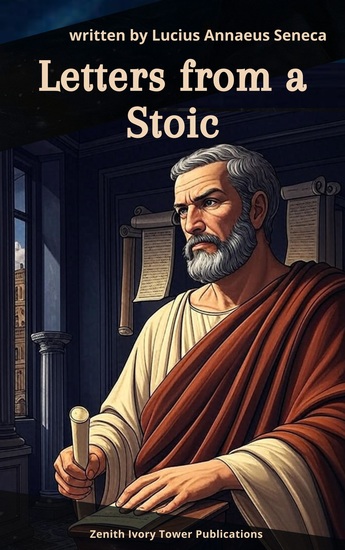
Letters from a Stoic - Seneca's Timeless Wisdom on Resilience Simplicity and the Good Life - cover

Letters from a Stoic - Seneca's Timeless Wisdom on Resilience Simplicity and the Good Life

Lucius Annaeus Seneca, Zenith Ivory Tower Publications

Maison d'édition: Zenith Ivory Tower Publications

  • 0
  • 0
  • 0

Synopsis

🧘 Practical philosophy for a meaningful life—from one of ancient Rome's greatest minds.

Letters from a Stoic by Lucius Annaeus Seneca is a profound and practical guide to living with courage, clarity, and peace. Written nearly 2,000 years ago, these personal letters to his friend Lucilius reveal Seneca's timeless insights on how to master the self, endure adversity, and find freedom through reason.

📜 A spiritual toolkit for modern life, straight from the heart of Stoicism.
In these letters, Seneca tackles topics like fear, anger, grief, wealth, fame, and time—offering clear, direct advice that resonates as strongly today as it did in ancient Rome. With his blend of ethical rigor and calm compassion, he teaches us how to live deliberately, virtuously, and without regret.

🌿 For those seeking tranquility in a chaotic world.
Whether you're new to Stoic philosophy or a longtime student of the Stoics, Letters from a Stoic is a foundational text that can help you navigate life's storms with integrity and strength.

🌟 What Readers and Thinkers Say:
"One of the most profound books ever written." — The Guardian

"Seneca writes with urgency, clarity, and extraordinary compassion." — Ryan Holiday

"Still one of the best self-help books ever written—because it wasn't trying to be one." — Amazon Reviewer

🎯 Why You'll Love This Book:
Offers practical Stoic lessons for everyday challenges

Ideal for readers interested in philosophy, personal growth, and self-mastery

Written in an accessible, deeply personal tone

A must-read for fans of Marcus Aurelius, Epictetus, and modern Stoicism

🛒 Click Buy Now to Begin Your Journey Toward Calm, Purpose, and Wisdom.
Let Seneca guide you toward a richer, more resilient inner life.
👉 Click Buy Now to read Letters from a Stoic—the ancient guide to modern serenity.
Disponible depuis: 21/07/2025.
Longueur d'impression: 762 pages.

D'autres livres qui pourraient vous intéresser

  • Taming Your Amygdala - Brain-Based Strategies to Quiet the Anxious Mind - cover

    Taming Your Amygdala -...

    PhD Catherine M. Pittman

    • 0
    • 0
    • 0
    A chronic sense of unease. Nagging what-ifs. Worry about what other people think. Paralyzing phobias. Full-blown panic attacks. 


    Anxiety shows up in a lot of different ways and can permeate every aspect of your life. The good news is that although it can feel confusing and overwhelming—as if things will never get better—it is possible to retrain your brain and put yourself back in the driver's seat. 


    In Taming Your Amygdala, clinical psychologist Dr. Catherine Pittman offers scientific insight, clear explanations, and simple brain-based strategies to help you overcome excessive worry, anxiety, and fear. Based on the principles of neuroscience and cognitive behavioral therapy, the tools in this workbook will teach you the "language of the amygdala" so you can: 


    ● Understand how and why your brain gets "hijacked" by anxiety and fear 


    ● Identify and cope with anxiety triggers and stuck points 


    ● Develop new, adaptive coping skills to prevent and reduce anxious thoughts and feelings 


    ● Live your life to the fullest, breaking free of the limits of chronic anxiety, paralyzing worry, or debilitating panic
    Voir livre
  • Gavin at War - The World War II Diary of Lieutenant General James M Gavin - cover

    Gavin at War - The World War II...

    Lewis Sorley

    • 0
    • 0
    • 0
    Lieutenant General James Gavin, commander of the 82nd Airborne Division during WWII, is one of the best-known figures of the war. Beginning as the commander of the 505th Parachute Combat Team that spearheaded the American assault on Sicily in July 1943, Gavin advanced to division command and finally command of US forces in Berlin. He kept a wartime diary that starts in April 1943, as the unit was preparing to go to northern Africa and continues through to his final entry on September 1, 1945, during the occupation of Berlin. 


    During the war years, Gavin came into close contact with virtually all the leading airborne commanders and many others who would advance to the top levels of Army leadership. His diary includes observations on fellow military and political leaders, army operations, and the general's personal life. Gavin was an officer who led by example: on four combat jumps, he was the first man out the door. 


    For decades, Gavin kept the existence of the journal a secret; the general's family discovered it among his belongings after his death. Editor Lewis "Bob" Sorley has worked closely with the Gavin family and the Army Heritage Center to prepare the diary for publication. His edited and annotated version includes a prologue and epilogue to frame the entries within the wider scope of the general's life.
    Voir livre
  • Plato's Phaedrus - cover

    Plato's Phaedrus

    Plato

    • 0
    • 0
    • 0
    Plato’s dialogues frequently treat several topics and show their connection to each other. The Phaedrus is a model of that skill because of its seamless progression from examples of speeches about the nature of love to mythical visions of human nature and destiny to the essence of beauty and, finally, to a penetrating discussion of speaking and writing. It ends with an examination of the love of wisdom as a dialectical activity in the human mind.
     
    Phaedrus lures Socrates outside the walls of Athens, where he seldom goes, by promising to share a new work by his friend and mentor Lysias, a famous writer of speeches. This dialogue provides a powerful example of the dialectical writing that Plato uses to manifest ideas that are essential to human existence and to living a good life. The Phaedrus shows how oral and written forms of language relate to each other and to philosophy. It simultaneously embodies the entire process in some of the greatest poetry ever written.
    Voir livre
  • Sacred Foundations - Texts Teachings and Global Influence (4 in 1) - cover

    Sacred Foundations - Texts...

    Joseph Arston

    • 0
    • 0
    • 0
    This comprehensive audiobook explores the enduring impact of Jewish sacred traditions through four essential perspectives: 
    Sacred Texts and Teachings 
     Delve into the foundational texts that have guided Jewish thought and practice for millennia. From the Torah and Talmud to mystical writings and philosophical works, discover how these sacred teachings have been interpreted, debated, and applied across generations. 
    The Jewish Diaspora 
     Follow the remarkable journey of Jewish communities across continents and centuries. Explore how dispersion has shaped unique cultural expressions while maintaining core traditions, creating a rich mosaic of Jewish life from Europe and the Americas to North Africa, the Middle East, and beyond. 
    Historical Influences 
     Examine the profound impact of historical events on Jewish thought, practice, and community. From ancient kingdoms to persecution, enlightenment, and modern statehood, understand how historical forces have challenged and strengthened Jewish resilience and cultural identity. 
    Rich Traditions 
     Experience the vibrant tapestry of customs, rituals, and practices that enrich Jewish life. Discover how traditions surrounding prayer, lifecycle events, ethical teachings, and community have evolved while maintaining their spiritual essence throughout changing times. 
    This audiobook provides both newcomers and those familiar with Judaism a deeper understanding of how sacred foundations have preserved a living tradition that continues to offer wisdom and insight to the contemporary world.
    Voir livre
  • The Common Reader - "Volume 2" - cover

    The Common Reader - "Volume 2"

    Virginia Woolf

    • 0
    • 0
    • 0
    Do not think, because this collection of essays is titled Volume 2, that there is anything lesser or additional to it. Here is Virginia Woolf at her most entertaining and informative, relishing the portraits and insights she presents as she surveys a varied collection of individuals in English society and English literature. 
     
    The subjects range from the Elizabethans to Thomas Hardy, and then concludes, unexpectedly, with ‘How Should One Read A Book?’ Here is one delight after another: twenty-six occasional pieces (journalistic diversions) which demonstrate that her eye for history, for an individual’s place in history and in books, is just as acute and vivid as any character in her better-known novels. 
     
    Many are familiar names. John Donne, Robinson Crusoe, De Quincey, Lord Chesterfield. There is Dr Burney’s Evening Party and George Gissing, names which indicate there is no overall scheme whatsoever! Woolf champions certain figures, such as Mary Wollstonecraft (admiring her personal stance and strength) and yet has time to cast a softer, kindly eye on Dorothy Wordsworth. The detail contained in these portraits will last long in the memory—Beau Brummell descending from being the unimpeachable dandy to a sad decline; the curious eccentric personality of the poet and hymn writer William Cowper and his affection for Lady Austen. 
     
    Time and again, the skill and the wit of the great writer that is Virginia Woolf simply stops one in one’s tracks, as in her opening lines on Laurence Sterne. The essay is on A Sentimental Journey but she starts with tipping the hat to Tristram Shandy, which appeared when the author was 45. Woolf comments on Sterne: ‘No young writer could have dared to take such liberties with grammar and syntax and sense and propriety and the longstanding tradition of how a novel should be written. It needed a strong dose of the assurance of middle age and its indifference to censure to run such risks of shocking the lettered by the unconventionality of one's style, and the respectable by the irregularity of one's morals. But the risk was run and the success was prodigious.’ What a final sentence! Has the 21st century little time for the elegant essay, the joy of focused wit, of kindness, of acute observation, where the very brevity of format provides a space in which to think and reflect? In The Common Reader Volume 2, (published in 1932), the essay lives on and even more so in this sensitive and engaging book by Georgina Sutton.
    Voir livre
  • Making Words Stick: A Four-Step Instructional Routine to Power Up Orthographic Mapping - cover

    Making Words Stick: A Four-Step...

    Molly Ness, Katie Pace Miles

    • 0
    • 0
    • 0
    The average reader instantly recognizes 30,000 to 70,000 words-with no need to sound them out. How does that happen? Through a process called orthographic mapping. This audiobook explains the process by which readers embed words into their long-term memories, and the instruction necessary to help K-5 students do just that. Teachers will learn how to connect decoding, encoding, and meaning through a four-step, research-based, classroom-tested routine that accelerates students' abilities to lift words off the page and capture them in reading and writing.
    Voir livre