Rejoignez-nous pour un voyage dans le monde des livres!
Ajouter ce livre à l'électronique
Grey
Ecrivez un nouveau commentaire Default profile 50px
Grey
Abonnez-vous pour lire le livre complet ou lisez les premières pages gratuitement!
All characters reduced
Moot Court Benefits - cover

Moot Court Benefits

Luca Morgan

Traducteur A AI

Maison d'édition: Publifye

  • 0
  • 0
  • 0

Synopsis

Moot Court Benefits examines how moot court participation cultivates vital legal skills, transforming law students into capable legal professionals. More than just a simulation, moot court hones appellate advocacy, legal reasoning, and presentation skills under professional scrutiny. The book traces the history and evolution of moot court, demonstrating its increasing importance in legal education. The book systematically explores the development of these core competencies, from case preparation to oral argument. It breaks down the process of crafting persuasive legal briefs, mastering oral advocacy techniques, and emphasizing teamwork.

 
Did you know that skills developed through moot court, such as critical thinking and persuasive communication, extend beyond the legal field and are highly valued in business, public policy, and academia? This career guide and academic resource provides a comprehensive understanding of moot court benefits. It offers practical strategies for maximizing the advantages of participation and highlights real-world applications. By focusing on the development of skills relevant to appellate advocacy, the book offers valuable insights for law students, legal educators, and practicing attorneys alike.
Disponible depuis: 07/04/2025.
Longueur d'impression: 89 pages.
D'autres livres qui pourraient vous intéresser

  • Grunwald and Orsha: The History and Legacy of the Polish–Lithuanian Commonwealth’s Most Decisive Battles - cover

    Grunwald and Orsha: The History...

    Editors Charles River

    • 0
    • 0
    • 0
    Like other secretive groups, the mystery surrounding the Teutonic Knights has helped their legacy endure. While some conspiracy theorists attempt to tie the group to other alleged secret societies like the Illuminati, other groups have tried to assert connections with the Teutonic Knights to bolster their own credentials. Who they were and what they had in their possession continue to be a source of great intrigue even among non-historical circles.  
    While the military orders are now often tied to religion or conspiracy theories, they did once wield great power and influence in Europe, and their actions had consequences centuries after they had reached their peak. This was made clear in the wake of a major battle fought between German and Russian forces from August 26-30, 1914 during the First World War. It occurred in Masuria, a region of marshes, woodland, and numerous lakes in northern Poland, almost 400,000 men were involved, and it was a decisive victory for the Germans, who annihilated the Russian army. The Germans named the battle after Tannenberg (Polish Stebark), and the battle, though widely fought over 100 miles, did indeed encompass the village, but there was a historical reason for assigning the name to the battle. On July 15, 1410, Tannenberg was the site of another decisive battle between the army of the Germanic Teutonic Order and that of Poland-Lithuania, a battle now commonly referred to as the Battle of Grunwald (after another nearby village).  
    	In 1514, Orsha was a much smaller town, home to a population of no more than 5,000 as part of the Grand Duchy of Lithuania, but on September 8 of that year, the normally quiet and unpretentious town was thrust into the world’s gaze when over 100,000 troops engaged in one of the 16th century’s biggest battles outside the town walls. The battle pitted the forces of the King of Poland and the Grand Duchy of Lithuania against the Grand Duchy of Moscow.
    Voir livre
  • Poor Richard's Almanack (Deluxe Hardbound Edition) - cover

    Poor Richard's Almanack (Deluxe...

    Benjamin Franklin

    • 0
    • 0
    • 0
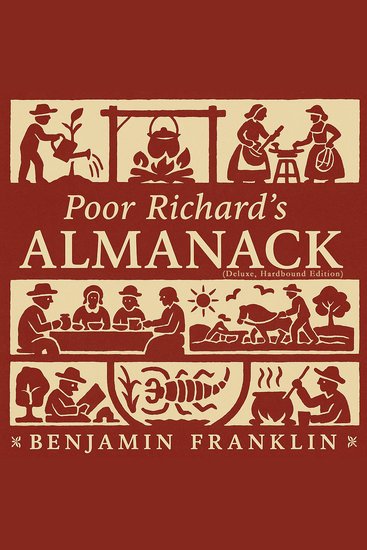
    Benjamin Franklin's Poor Richard's Almanack, first published in 1732 under the pseudonym Richard Saunders, is a seminal work in American literature that blends practical wisdom with sharp wit. Originally serving as an annual publication, the almanac offered readers a mix of weather forecasts, household tips, puzzles, and, most notably, a collection of aphorisms and proverbs that emphasized virtues like thrift, industry, and prudence. Many of these sayings, such as "Early to bed and early to rise, makes a man healthy, wealthy, and wise," have become ingrained in American vernacular. Beyond its practical content, the almanac provided entertainment through its humor and satire, often featuring fictional narratives and characters. Franklin's creation not only reflected the values of colonial America but also played a role in shaping the nation's cultural identity. The enduring popularity of Poor Richard's Almanack underscores its significance as both a historical document and a source of timeless advice.
    Voir livre
  • Transform Your Mind: Four Essential Questions for Lasting Change - "Elevate your mindset! Discover transformative audio lessons for meaningful lasting change in your life" - cover

    Transform Your Mind: Four...

    Tristan Whitlock

    • 0
    • 0
    • 0
    Transform Your Mind: Four Essential Questions for Lasting Change  
    A Simplified Guide for Lasting Impact! 
    Are you ready to enhance your personal and professional growth through transformative mindset shifts? 
    Searching for an all-encompassing guide that provides everything you need to unlock your potential through transformative mindset shifts? 
    Look no further! 
    This guide is your ultimate resource for deepening your understanding, applying your insights, and engaging in actionable exercises that pave the way for lasting change. You’re set up for success! 
    Updated for the latest paradigm shift strategies. 
    Key features of this enhanced guide include: 
    - In-depth insights into transformative mindset shifts 
    - Comprehensive explanation of the foundational concepts behind unlocking your potential 
    - Effective strategies for applying mindset shifts to create lasting change 
    What sets our guide apart is its thorough exploration of vital concepts, ensuring you grasp each idea in depth and clarity. 
    Please note that this guide operates as an independent resource and is not affiliated with any official entities. 
    Crafted with a structured approach and accessible language, our guide ensures clear transitions between topics. Say goodbye to complex terminology and embrace straightforward, precise, and insightful content. 
    Why wait any longer? Click the BUY NOW button to secure your guide and embark on your journey towards transformative mindset shifts! 
    Elevate your journey with “Transform Your Mind: Four Essential Questions for Lasting Change” today!
    Voir livre
  • Beyond Neoliberalism and Neo-illiberalism - Economic Policies and Performance for Sustainable Democracy - cover

    Beyond Neoliberalism and...

    Markus Gabriel, Anna Katsman,...

    • 0
    • 0
    • 0
    In many countries, the political backlash against neoliberalism has mainly been a retreat from democracy, with a decline in independence of the judiciary and the monetary authorities, increased control of the media, and manipulation of elections for purposes of authoritarian control. The economic dynamics and the impact of neoliberalism, i.e. deregulation and liberalized markets, is just one cause of this authoritarian shift. The contributors to this volume examine the impact of neoliberal economic policies in relation to cultural and political factors and how these have promoted the recent authoritarian turn, as well as probing the economic policies and performance of the illiberal regimes.
    Voir livre
  • How to Be Queer - An Ancient Guide to Sexuality (Ancient Wisdom for Modern Readers) - cover

    How to Be Queer - An Ancient...

    Sarah Nooter

    • 0
    • 0
    • 0
    The idea of sexual fluidity may seem new, but it is at least as old as the ancient Greeks, who wrote about queer experiences with remarkable frankness, wit, and insight. How to Be Queer is an infatuating collection of these writings about desire, love, and lust between men, between women, and between humans and gods, in lucid and lively new translations. 


    How to Be Queer starts with Homer's Iliad and moves through lyric poetry, tragedy, comedy, philosophy, and biography, drawing on a wide range of authors, including Sappho, Plato, Anacreon, Pindar, Theognis, Aristophanes, and Xenophon. It features both beautiful poetry and thought-provoking prose, emotional outpourings and humorous anecdotes. From Homer's story of the relationship between Achilles and Patroclus, one of the most intense between men in world literature, to Sappho's lyrics on the pleasures and pains of loving women, these writings show the many meanings of what the Greeks called eros. 


    Complete with brief introductions to the selections, How to Be Queer reveals what the Greeks knew long ago—that the erotic and queer are a source of life and a cause for celebration.
    Voir livre
  • Ancient Greece’s Most Famous Oracles: The History of the Oracles at Delphi and Dodona - cover

    Ancient Greece’s Most Famous...

    Editors Charles River

    • 0
    • 0
    • 0
    In ancient Greece, “no other practice was so universal than the consultation of oracles.” These holy sites were found in 260 locations around the Greek-speaking world, and they were considered the “most satisfactory means of ascertaining the future.” These sanctuaries were “set apart from the profane, ordinary world” and were in the beginning restricted to natural locations where the divine was thought to be “especially present.” They were set aside for special spiritual functions, and a state of purity was generally required of its participants. A historical tendency toward providing haven for criminals was based on the fear of shedding blood in a holy place, and the “fear that the evil magic would emanate from his curse.” 
    The Oracle of Delphi was one of the greatest religious institutions in Greece and one which played a significant role not only in the formation and collective decisions of Hellenic localities and city-states but also in the personal lives of Greeks known and unknown. The site was dedicated to the god Apollo, and the Greeks believed the god spoke his oracles through his prophetess known as the Pythia. The judgments and decisions rendered by the oracle were so important to the Greeks that they often put them above all other interests, even security threats posed by the likes of the Persians, and Delphi was popular even amongst outsiders. Many authors of antiquity mention the oracle for one reason or another, and there even survive epigraphic collections that preserve the god’s words on stone. 
    The Oracle of Dodona was the oldest of all, and it was one of the few dedicated to Zeus and his consort goddess Dione. The oracular utterances heard at the oracles are generally referred to as “smokiness” in Greek, but at Dodona, the answers came in natural sounds and other peripheral phenomena.
    Voir livre