Begleiten Sie uns auf eine literarische Weltreise!
Buch zum Bücherregal hinzufügen
Grey
Einen neuen Kommentar schreiben Default profile 50px
Grey
Jetzt das ganze Buch im Abo oder die ersten Seiten gratis lesen!
All characters reduced
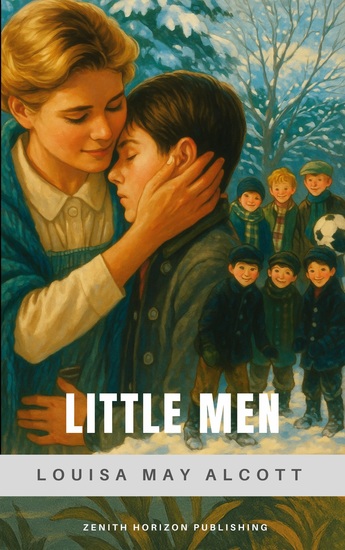
Little Men - Louisa May Alcott's Beloved Sequel to Little Women - cover

Little Men - Louisa May Alcott's Beloved Sequel to Little Women

Louisa May Alcott, Zenith Horizon Publishing

Verlag: Zenith Horizon Publishing

  • 0
  • 0
  • 0

Beschreibung

What happens after Little Women ends? Discover the heartwarming continuation of Jo March's story.

In Little Men, Louisa May Alcott returns to the world of the March family—this time at Plumfield, the school Jo and Professor Bhaer run together. This charming and insightful sequel explores education, friendship, mischief, and moral growth as a lively group of boys learns life's biggest lessons under Jo's care.

Filled with warmth, humor, and timeless values, Little Men is a celebration of character, community, and coming of age.

🎨 This edition features:

The full, unabridged text

Gentle, vintage-style illustrations

Kindle-optimized formatting for easy reading

📚 Perfect for fans of classic children's literature, moral fiction, and the world of Little Women.

Step back into the world of Jo March—and meet the next generation.
Get your illustrated edition today.
Verfügbar seit: 16.06.2025.
Drucklänge: 175 Seiten.

Weitere Bücher, die Sie mögen werden

  • The Iliad - cover

    The Iliad

    Homer

    • 0
    • 0
    • 0
    The Iliad is one of two major ancient Greek epic poems attributed to Homer. It is one of the oldest extant works of literature still widely read by modern audiences. As with the Odyssey, the poem is divided into 24 books and was written in dactylic hexameter. It contains 15,693 lines in its most widely accepted version. Set towards the end of the Trojan War, a ten-year siege of the city of Troy by a coalition of Mycenaean Greek states, the poem depicts significant events in the siege's final weeks. In particular, it depicts a fierce quarrel between King Agamemnon and a celebrated warrior, Achilles. It is a central part of the Epic Cycle. The Iliad is often regarded as the first substantial piece of European literature.The Iliad and the Odyssey were likely written down in Homeric Greek, a literary amalgam of Ionic Greek and other dialects, probably around the late 8th or early 7th century BC. Homer's authorship was infrequently questioned in antiquity, but contemporary scholarship predominantly assumes that the Iliad and the Odyssey were composed independently and that the stories formed as part of a long oral tradition. Given widespread illiteracy,audiences were more likely to have heard the poem than read it; it was performed by professional reciters of Homer known as rhapsodes.America.
    Zum Buch
  • A Society - From their pens to your ears genius in every story - cover

    A Society - From their pens to...

    Virginia Woolf

    • 0
    • 0
    • 0
    Adeline Virginia Woolf was born on the 25th January 1882 in South Kensington in London. 
    Although lauded as a founder of modernist writing with such classics as ‘Orlando’, ‘Mrs Dalloway’ and ‘To the Lighthouse’ and, of course, many classic short stories, her background is filled with elements of tragedy that she somehow overcame to become such a revered writer.   Her mother died when she was 13, her half-sister Stella two years later and with it her first of several nervous breakdowns.  Appallingly it was later found that three of her half-brothers had sexually abused her so darkness must have seemed ever present.   
    She began writing professionally at age 20 but her father’s death two years later brought a complete mental collapse and she was briefly institutionalised.  Somehow she found within herself a literary career and with it great innovations in writing; she was a pioneer of “stream of consciousness”.    
    Her tight circle of friends were the founders of the Bloomsbury Group, a movement whose legacy still influences across the arts and society in many way to this day.   
    Whilst the dark periods continued to interrupt her emotional state her rate of work never ceased.  Until, on 28th March 1941, Woolf put on her overcoat, filled up its pockets with stones, and walked into the River Ouse, in Lewes, East Sussex and drowned herself.  Her body was not recovered until the 18th April.  She was 59. 
    She left behind a note which read in part “Dearest, I feel certain that I am going mad again.  I feel we can't go through another of those terrible times.  And I shan't recover this time.  I begin to hear voices, and I can't concentrate.  So I am doing what seems the best thing to do”.
    Zum Buch
  • Jimmy Goggles the God (Unabridged) - cover

    Jimmy Goggles the God (Unabridged)

    H. G. Wells

    • 0
    • 0
    • 0
    Herbert George Wells (21 September 1866 - 13 August 1946) was an English writer. Prolific in many genres, he wrote dozens of novels, short stories, and works of social commentary, history, satire, biography and autobiography. His work also included two books on recreational war games. Wells is now best remembered for his science fiction novels and is often called the "father of science fiction", along with Jules Verne and the publisher Hugo Gernsback.
    JIMMY GOGGLES THE GOD: "It isn't every one who's been a god," said the sunburnt man. "But it's happened to me. Among other things." I intimated my sense of his condescension.
    Zum Buch
  • Into the Comet - cover

    Into the Comet

    Arthur C. Clarke

    • 0
    • 0
    • 0
    "Into the Comet" is a science fiction short story by British writer Arthur C. Clarke. It was originally published in Fantasy & Science Fiction in October 1960. It is one of several stories by many science fiction authors in which problems are solved by reverting to 'primitive' technology. The story was also published as "Inside the Comet".
    Zum Buch
  • The Princess and Curdie - cover

    The Princess and Curdie

    George MacDonald

    • 0
    • 0
    • 0
    George MacDonald’s The Princess and Curdie is a tale that lingers in the imagination long after its final page, filled with mystery, adventure, and a profound moral vision. First published in 1883 as a sequel to The Princess and the Goblin, this novel continues the journey of the humble miner’s son, Curdie, as he is called upon to aid a kingdom teetering on the brink of ruin. Guided by the enigmatic and benevolent Princess Irene’s great-great-grandmother, Curdie embarks on a quest that is both outwardly heroic and deeply spiritual, confronting corruption, deception, and his own capacity for courage. 
    MacDonald was more than a storyteller; he was a visionary whose works shaped some of the greatest literary minds of the 20th century. C.S. Lewis, author of The Chronicles of Narnia, credited MacDonald as his spiritual mentor, saying, "I have never concealed the fact that I regarded him as my master." J.R.R. Tolkien, creator of The Lord of the Rings, also drew inspiration from MacDonald's mythic sensibility, seeing in his tales the power of Faërie—a realm that reveals deeper truths about our own world. Their admiration speaks to the enduring power of MacDonald’s storytelling, which blends the childlike wonder of fairy tales with the weighty themes of faith, virtue, and redemption. 
    The Princess and Curdie is more than a children’s book; it is a meditation on trust, transformation, and the unseen forces at work in the world. Readers who venture into its pages will find not only a compelling story but also an invitation to consider the nature of goodness, the reality of unseen guidance, and the calling to stand against corruption. As with all great fairy tales, MacDonald's world is both magical and profoundly real, whispering truths that resonate across generations.
    Zum Buch
  • A Witch's Den - A look into the darker rituals of late 19th Century rural India - cover

    A Witch's Den - A look into the...

    Helena Blavatsky

    • 0
    • 0
    • 0
    Helena Petrovna Blavatsky, often known as Madame Blavatsky, was born on 12th August 1831 into an aristocratic family in present day Dnipro in Ukraine, then part of the Russian Empire.  She was the younger sister of the writer Vera Zhelikhovsky. 
     
    Much of Blavatsky’s life story relies on her own memories which changed much during her lifetime and therefore parts of it are unreliable.  What appears to be certain is that much of her life was lived first on family travels and postings and then on her journeys in an effort to further her own self-education and quest for knowledge. 
     
    As a teenager she developed an interest in Western esotericism and from there she claimed many travels including a trip to India where she encountered a group of spiritual adepts, the ‘Masters of the Ancient Wisdom’, who sent her to Shigatse, Tibet, where they trained her to develop a deeper understanding of the synthesis of religion, philosophy, and science.  
     
    By the early 1870s, Blavatsky was involved in the Spiritualist movement, which was then popular both in Britain and abroad, even though she argued against its main tenet that those ‘contacted’ were the spirits of the dead.  
     
    She moved to the United States in 1873 and became close to the journalist Henry Steel Olcott who helped her gain public attention as a spirit medium and then also became an adherent to her principles.   
     
    In 1875 in New York City she co-founded the Theosophical Society and two years later published ‘Isis Unveiled’, a book outlining her Theosophical world-view from its ancient roots to the modern day.  Her work was even more popular in Asia than elsewhere and is said to have influenced both Ghandi and Nehru amongst many others.  
     
    In 1880, she and Olcott moved to India, where the Society was allied to a Hindu reform movement.  That same year she converted to Buddhism.  However, she was often plagued with accusations of fraudulent paranormal phenomena.  
     
    With her health failing she returned to London and published ‘The Secret Doctrine’, her commentary on claimed ancient Tibetan manuscripts, and other books.  
     
    Helena Blavatsky died in London of influenza during the global pandemic on 8th May 1891.  She was 59.
    Zum Buch