Begleiten Sie uns auf eine literarische Weltreise!
Buch zum Bücherregal hinzufügen
Grey
Einen neuen Kommentar schreiben Default profile 50px
Grey
Jetzt das ganze Buch im Abo oder die ersten Seiten gratis lesen!
All characters reduced
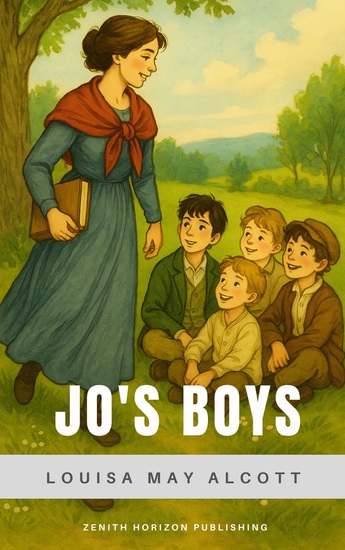
Jo's Boys - The Heartwarming Sequel to Little Men by Louisa May Alcott - cover

Jo's Boys - The Heartwarming Sequel to Little Men by Louisa May Alcott

Louisa May Alcott, Zenith Horizon Publishing

Verlag: Zenith Horizon Publishing

  • 0
  • 0
  • 0

Beschreibung

The boys are grown. The lessons continue. The heart of Plumfield lives on.

In Jo's Boys, Louisa May Alcott brings readers back to the world of Jo Bhaer and the beloved Plumfield school. Now adults, her boys—and girls—face the real world: careers, romances, trials, and triumphs. With warmth, humor, and moral wisdom, Alcott explores the challenges of adulthood and the enduring value of character.

As the final installment in the Little Women saga, this novel offers a rich and satisfying close to the journeys of the March family and their extended circle.

📘 This special edition includes:

The full, unabridged original text

Charming illustrations reflecting 19th-century New England life

Kindle-optimized formatting for an enjoyable reading experience

📚 Perfect for fans of Little Women, classic family sagas, and readers of timeless coming-of-age fiction.

Grow with the boys. Stay with Jo. Complete the journey.
Get your illustrated edition now.
Verfügbar seit: 13.06.2025.
Drucklänge: 201 Seiten.
Weitere Bücher, die Sie mögen werden

  • Mystery and Suspense Short Stories - cover

    Mystery and Suspense Short Stories

    Jack Boyle, Catherine Louisa...

    • 0
    • 0
    • 0
    Are you ready to embark on an enthralling journey filled with intrigue, suspense, and gripping mysteries? Look no further! We proudly present the digital audiobook version of "Mystery and Suspense Short Stories," a collection that will keep you on the edge of your seat and leave you craving for more. 
     
    Unveiling Unparalleled Tales  
     
    Immerse yourself in the enigmatic world of Jack Boyle's "A Problem in Grand Larceny," where cunning thieves engage in an intricate heist that will challenge your detective skills. Join the relentless investigator as he unravels the secrets behind Drawn Daggers in Catherine Louisa Pirkis' captivating narrative. 
     
    Step into the Dark Side  
     
    Feel the spine-chilling atmosphere of Edgar Allan Poe's "The Oblong Box," a haunting tale that will leave you pondering the dark depths of human nature. Be captivated by the genius of Sir Arthur Conan Doyle as he introduces you to "The Redheaded League," a classic Sherlock Holmes mystery filled with mind-boggling twists and turns. 
     
    Unmatched Entertainment for All  
     
    Whether you are an ardent mystery lover, a devoted fan of classic literature, or simply someone seeking a riveting escape, "Mystery and Suspense Short Stories" is the perfect addition to your collection. Ideal for long journeys, commutes, or simply a cozy night at home, the audiobook promises to keep you entertained for hours on end.
    Zum Buch
  • Bernice Bobs Her Hair - cover

    Bernice Bobs Her Hair

    F Scott itzgerald

    • 0
    • 0
    • 0
    "Bernice Bobs Her Hair" is a captivating short story by F. Scott Fitzgerald. It first graced the pages of the Saturday Evening Post in May 1920 and was later included in the September 1920 short story collection titled "Flappers and Philosophers"1. Let's delve into the tale of Bernice and her transformative decision.
    Zum Buch
  • The Ghost in the Cupboard Room - From their pens to your ears genius in every story - cover

    The Ghost in the Cupboard Room -...

    Wilkie Collins

    • 0
    • 0
    • 0
    Wilkie Collins was born on 8th January 1824 in Marylebone, London.  
    The family moved several times in his early years before, at 12, they travelled to France and Italy for 2 years where the sights and atmosphere made a deep and lasting impression on him. 
    He resumed his education at Mr Cole’s private boarding school in Highbury, Islington.  Here, he began his literary career under unusual circumstances: the school bully would give him no peace until he had been told a bedtime story.  This ‘little brute’ helped create one of England’s greatest writers.  
    On leaving school, in 1841, he became a clerk at a tea merchant before, 2 years later, publishing his first short story.  However, his first novel was rejected and remained so during his lifetime.  
    A brief stint at Lincoln’s Inn to please his father and to acquire a steady income was halted by his father’s death.  Collins then wrote and published his fathers’ memoirs.  He then completed his legal education though he would never practice.  
    In March 1851, he was introduced to Charles Dickens and there now started a period of sustained literary output and a remarkable lifelong friendship.  His stories were published in Dicken’s magazines, and he toured with Dicken’s theatrical before the two of them travelled to the Continent. 
    By the early 1860’s worrying signs of ill-health appeared with rheumatic gout.  As it worsened, he sought respite and cures in German spa towns and gave up writing to help his recuperation. 
    His personal life had become very complicated.  He was living with the widowed Caroline Graves and conducting an affair with a much younger Martha Rudd.  With the serialised release of ‘The Moonstone’ and vicious attacks of gout Caroline left him and married another.  Collins was now prescribed opium and was soon its lifelong dependent.  Martha bore him two children and with the return of a now divorced Caroline Graves he now divided his time between the two women. 
    In 1874 he set aside writing to tour North America on a reading tour. 
    Throughout his later years he continued to write and publish.  In all 30 novels, 14 plays, 60 short stories and over a 100 non-fiction essays as well as many more collaborations with Dickens. 
    In 1884 the Society of Authors elected him as it’s Vice-President. 
    Wilkie Collins died from a paralytic stroke on September 23rd, 1889, in London. He was 65.
    Zum Buch
  • The Age of Innocence - cover

    The Age of Innocence

    Edith Wharton

    • 0
    • 0
    • 0
    Winner of the Pulitzer Prize 
    Edith Wharton brings the glamorous Gilded Age to life in this acclaimed 1920 novel. Distinguished heir Newland Archer is happily engaged to proper society darling May Welland–until the day he meets her cousin, the scandalous and bold (and married) Countess Ellen Olenska. Suddenly, his carefully planned future feels restrictive and stale. Ellen represents possibilities Newland has never before imagined, but is he already too entrenched in New York society to take such a leap? Tradition, progress, and obligation vibrate with tension in the book that established Wharton as the first woman to win the Pulitzer Prize.
    Zum Buch
  • Whisperer in Darkness The (Unabridged) - cover

    Whisperer in Darkness The...

    H. P. Lovecraft

    • 0
    • 0
    • 0
    The Whisperer in Darkness is a 26,000-word novella by American writer H. P. Lovecraft. Written February-September 1930, it was first published in Weird Tales, August 1931.[1] Similar to The Colour Out of Space (1927), it is a blend of horror and science fiction. Although it makes numerous references to the Cthulhu Mythos, the story is not a central part of the mythos, but reflects a shift in Lovecraft's writing at this time towards science fiction. The story also introduces the Mi-Go, an extraterrestrial race of fungoid creatures.
    Zum Buch
  • Mysteries Of Atlantis - cover

    Mysteries Of Atlantis

    William Scott-Elliot

    • 0
    • 0
    • 0
    This classic work, written by Theosophist, W. Scott-Elliot, this book goes into detail about the lost city of Atlantis. The information came from C. W. Leadbeater, who said he received his information from astral clairvoyance. Scott-Elliot provides info on the people of Atlantis, such as their religion, races, different periods money, education, and much more. 
     
    Atlantis, is a legendary island in the Atlantic Ocean, lying west of the Strait of Gibraltar. The principal sources for the legend are two of Plato’s dialogues, Timaeus and Critias. In the former, Plato describes how Egyptian priests, in conversation with the Athenian lawgiver Solon, described Atlantis as an island larger than Asia Minor and Libya combined and situated just beyond the Pillars of Hercules (the Strait of Gibraltar). About 9,000 years before the birth of Solon, the priests said, Atlantis was a rich island whose powerful princes conquered many of the lands of the Mediterranean until they were finally defeated by the Athenians and the latter’s allies. The Atlantians eventually became wicked and impious, and their island was swallowed up by the sea as a result of earthquakes. In the Critias, Plato supplied a history of the ideal commonwealth of the Atlantians. 
     
    Medieval European writers who received the tale from Arab geographers believed the stories to be true, and later writers tried to identify it with an actual country. After the Renaissance, for example, attempts were made to identify Atlantis with America, Scandinavia, and the Canary Islands. The story of Atlantis, if Plato did not invent it, may in fact reflect ancient Egyptian records of a volcanic eruption on the island of Thera about 1500 BCE. This eruption, one of the most stupendous of historical times, was accompanied by a series of earthquakes and tsunamis that shattered civilization on Crete, thereby perhaps giving rise to the legend of Atlantis.
    Zum Buch