Rejoignez-nous pour un voyage dans le monde des livres!
Ajouter ce livre à l'électronique
Grey
Ecrivez un nouveau commentaire Default profile 50px
Grey
Abonnez-vous pour lire le livre complet ou lisez les premières pages gratuitement!
All characters reduced
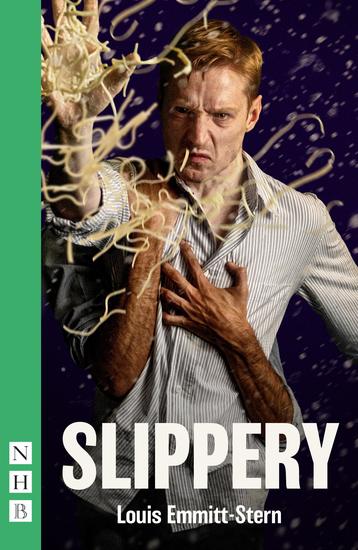
Slippery - Two Plays - cover

Slippery - Two Plays

Louis Emmitt-Stern

Maison d'édition: Nick Hern Books

  • 0
  • 0
  • 0

Synopsis

'Gave it to me when he died. Thought it was a bit odd. Fuck flowers. Have an espresso machine.'
3 a.m. in a London flat. Jude and Kyle return from A&E. Jude has slipped, but they're both falling. A decade after their messy breakup, their surprise reunion threatens to undo them both.
Winner of Soho Theatre's Tony Craze Award, Louis Emmitt-Stern's Slippery is a hilarious and heartfelt play for two actors about ghosts, sex and spaghetti. It was first performed at the Omnibus Theatre, London, in 2026, directed by Matthew Iliffe.
This volume also includes another intimate and insightful two-hander, Is This Us Fading Out, which premiered as part of a digital showcase produced by Swings & Roundabouts in 2020, and was subsequently performed at Watford Palace Theatre. 
'Louis Emmitt-Stern is a rising star playwright'Time Out
Disponible depuis: 26/03/2026.
Longueur d'impression: 128 pages.
D'autres livres qui pourraient vous intéresser

  • Hymn of the Nativity Sung by the Shepherds - cover

    Hymn of the Nativity Sung by the...

    Richard Crashaw

    • 0
    • 0
    • 0
    Librivox volunteers bring you seven readings of A Hymn of the Nativity, Sung by the Shepherds by Richard Crashaw. This was the fortnightly poem for December 7 - December 21, 2014. -  Ann Boulais
    Voir livre
  • Testament to Beauty - A former Poet Laureate demonstrates his poetic talents in this tender and beautiful verse - cover

    Testament to Beauty - A former...

    Robert Seymour Bridges

    • 0
    • 0
    • 0
    Robert Seymour Bridges, OM was born on 23rd October 1844 at Walmer in Kent where he spent his early childhood in a house overlooking the anchoring ground of the British fleet.  
    His father died aged only 47 in 1853. A year later his mother remarried and the family relocated to Rochdale, where his stepfather was the vicar.  
    In 1854 Bridges was sent to Eton College and attended until 1863.  After Eton he went to Corpus Christi College at Oxford. There he became good friends with Gerard Manley Hopkins and would later compile an edition of his poems that is now considered a major contribution to English literature. 
    He graduated from Oxford, in 1867, with a second-class degree in literae humaniores.  Initially he planned to join the Church of England and travelled to the Middle East to broaden his religious horizons.  However, he soon decided that life as a physician would be a better path and, after 8 months studying German (that being the language of many scientific papers at the time) he began his study of medicine at St. Bartholomew's Hospital in 1869.  His long-term ambition was that by the age of forty he could retire from medicine to devote himself to writing. 
    Unfortunately Bridges failed his final medical examinations in 1873 and, as unable to immediately retake the papers, spent six months in Italy learning Italian as well as immersing himself in its art. In July 1874 he went to Dublin to continue his medical studies. Re-examined in December he passed and became a house physician at St Bartholomew's Hospital. It was whilst here that he engaged in a series of highly critical remarks about the Victorian medical establishment. One such was his claim that whilst working as a young doctor he saw a staggering 30,940 patients in one year. 
    A bout of severe pneumonia and lung disease forced his retirement from the medical profession in 1882 and so, slightly ahead of schedule, he began his literary career in earnest.  He already been writing for several years and had published his first poetry collection in 1873.  
    After his illness and a trip to Italy, Bridges moved, with his mother, to Yattendon in Berkshire.  It was during this time, from 1882 to 1904, that Bridges wrote most of his best-known lyrics as well as eight plays and two masques, all in verse.  
    It was also here, in 1884, that he married Monica Waterhouse. They would go on to have three children and spend the rest of their lives in rural seclusion, in an idyllic marriage, first at Yattendon, then at Boars Hill, Oxford. 
    Bridges made an important contribution to hymnody with the publication in 1899 of his Yattendon Hymnal. This collection of hymns became a bridge between the Victorian hymnody of the late 19th century and the modern hymnody of the early 20th century. He was also a chorister at Yattendon church for 18 years. 
    In 1902 Monica and his daughter Margaret became seriously ill with tuberculosis, and a move from Yattendon to a healthier climate was in order. After several temporary homes they moved abroad to spend a year in Switzerland before returning to settle again in England at Chilswell House, which Bridges had designed, and built on Boar's Hill overlooking Oxford University.   
    His greatest achievement though was still some years ahead of him.  The office of Poet Laureate was held by Alfred Austin but with his death it was offered first to Rudyard Kipling, who refused it, and then to Bridges. He was appointed Poet Laureate in 1913 by George V, the only medical graduate to have ever held the office. Bridges, at this time, was neither highly regarded nor well known but a safe pair of hands in a World rapidly being overshadowed by the storms about to erupt over Europe and the First World War. 
    The events of this War, including the wounding of his son, Edward, had a sobering effect on Bridges' poetry. His work became fiercely patriotic. In 1915 edited a volume of prose and poetry, The Spirit of Man, intended to appeal to readers living in war time
    Voir livre
  • Breath for the Bones - Art Imagination and Spirit: A Reflection on Creativity and Faith - cover

    Breath for the Bones - Art...

    Luci Shaw

    • 0
    • 0
    • 0
    “The double question we must always ask is, ‘How does faith inform art?’ and ‘How can art animate faith?’” 
    Imagination, appreciation of beauty, creativity: all of these qualities have been given to us by God. For the Christian artist, the drive to create something wonderful is also a means to glorify and better understand our Lord. Using excerpts from her own works as well as those of writers who have gone before her—Emily Dickinson, Annie Dillard, C.S. Lewis, and others—poet and writer Luci Shaw proves that symbolism and metaphor provide ways for humans to experience God in new and powerful ways. 
    Shaw offers a rich and thought-provoking exploration of art, creativity, and faith. Believing that art emanates from God, she shows how imagination and spirituality “work in tandem, each feeding on and nourishing the other.” Faith informs art and art enhances faith. They both, for each other, are “breath for the bones.” 
    Provocative, enlightening, and above all, inspiring, Breath for the Bones will help readers discover the artist within, and bring them further along the path to God Himself. 
    Discussion questions and exercises are included in the audiobook companion PDF download.
    Voir livre
  • The Matter of Little Losses - Finding Grace to Grieve the Big (and Small) Things - cover

    The Matter of Little Losses -...

    Rachel Marie Kang, K.J. Ramsey

    • 0
    • 0
    • 0
    Life is full of love, but it is also full of loss. Like paper cuts to the heart, every big and seemingly insignificant loss—the loss of friendships, faith, dreams, health, community, and everything in between—grieves us more than we think it will, and often more than we let on. Why? Because they matter. 


    In this compassionate and deeply personal book, Rachel Marie Kang invites you to see and be seen in the midst of your sorrow, your suffering—your story. Through prose and poetry that gives voice to all the things we lose along the way, this gracious book will help you 


    ● ponder your loss without judgment 


    ● remember what was and make meaning of your memories 


    ● reflect on what is yet to be as you heal with hope 


    You don't have to bury your pain, and you don't have to pretend you're over it just because the world thinks you should be. Let Rachel walk hand in hand with you, giving space for sorrow and welcoming you as you find your way along the path to healing.
    Voir livre
  • Stuff and Nonsense - Poems by Lewis Carroll - cover

    Stuff and Nonsense - Poems by...

    Lewis Carroll

    • 0
    • 0
    • 0
    Alexander Woollcott called Lewis Carroll, author of Alice's Adventures in Wonderland, "the man who wrote the most enchanting nonsense in the English language." Besides his many stories, Lewis Carroll wrote nonsensical poems. Eleven of his poems appear here, the most famous of which being Jabberwocky, The Walrus and the Carpenter, and The Hunting of the Snark. Narrator Griffin Rogers recorded Jabberwocky as a Christmas present for his son before spending the next several years recording additional nonsense whenever he was able to find an unlocked window and sneak into a recording studio. (If that sounds like a lot of nonsense to you, you will love this audiobook - and so will your children.)
    Voir livre
  • Dr Esperanto's International Language Introduction and Complete Grammar - cover

    Dr Esperanto's International...

    L. Zamenhof

    • 0
    • 0
    • 0
    In July 1887, Esperanto made its debut as a 40-page pamphlet from Warsaw, published in Russian, Polish, French and German: all written by a Polish eye-doctor under the pen-name of Dr. Esperanto (“one who hopes”). Ludovic Lazarus Zamenhof (1859-1917) had a gift for languages, and a calling to help foster world amity: by a neutral “Internacia Lingvo” that anyone anywhere could readily use as a second language: neither forsaking a mother tongue, nor imposing it. In 1889 Zamenhof published an English translation by Richard H. Geoghegan, a young Irish linguist. All five are respectively considered the “First Book”. This classic sets forth Esperanto pretty much as we know it today (except that we no longer use internal apostrophes for composite words). Its original repertoire of 900 root words has grown tenfold in the past century, but you can still almost make do with the vocabulary herein. -- Summary by Gene Keyes
    Voir livre