Join us on a literary world trip!
Add this book to bookshelf
Grey
Write a new comment Default profile 50px
Grey
Subscribe to read the full book or read the first pages for free!
All characters reduced
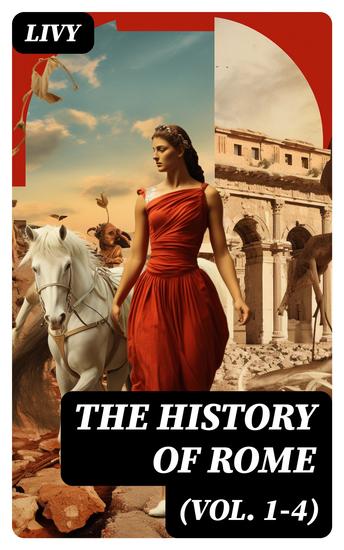
The History of Rome (Vol 1-4) - cover

The History of Rome (Vol 1-4)

Livy

Translator Daniel Spillan

Publisher: DigiCat

  • 0
  • 0
  • 0

Summary

Livy's "The History of Rome" (Volumes 1-4) offers a sweeping narrative that chronicles the rise and fall of Rome from its legendary foundation through the early republic. Written in a rich, eloquent Latin prose, Livy's work is characterized by its moral reflection and engaging storytelling, drawing on both historical and mythological elements. His vivid descriptions and detailed accounts invite readers into the heart of Roman civilization, providing insights into its political, social, and military evolution while situating the narrative within the broader framework of Mediterranean history and Roman values. Titus Livius, known as Livy, was born in 59 BCE in Patavium (modern Padua, Italy). His life coincided with the turbulent transition from the Roman Republic to the Empire, experiences that profoundly influenced his perspective. Writing during the reign of Emperor Augustus, Livy sought to instill a sense of Roman identity and virtue amidst the backdrop of political upheaval, reflecting both nostalgia for the Republic's values and an understanding of contemporary shifts. This monumental work is essential for readers interested in classical history and the foundations of Western civilization. Livy's eloquent prose and keen analytical insights not only entertain but also provoke deep reflections on human nature and governance. "The History of Rome" remains a vital source for scholars and enthusiasts alike, illuminating the struggles and triumphs of one of history's greatest civilizations.
Available since: 12/15/2023.
Print length: 1920 pages.

Other books that might interest you

  • Lead with Faith Play with Purpose - A 100-Day Devotional for Athletes - cover

    Lead with Faith Play with...

    Andy Dooley

    • 0
    • 0
    • 0
    Read by the author. 
    As an athlete, you train your body and mind to be ready for competition. But what about your soul? Lead with Faith, Play with Purpose is your guide to exercising your faith, with Andy Dooley as your trainer. 
    As a professional athlete turned pastor--and a passionate leader, Seattle Seahawks in-game host, social media influencer, and fitness trainer--Andy Dooley knows all about sports and what it takes to be a Christian on and off the field, court, or wherever you may play. A 100-day devotional written to encourage and guide athletes of any age, level, or sport, Lead with Faith, Play with Purpose is just what you need to integrate your faith into what you love to do--play your sport. 
    Let Dooley be your spiritual trainer and coach you to:Become a better teammate in four simple stepsDiscover effective ways to handle stress before a competitionIdentify how God is working through your sport to make you more like himUnderstand and embrace your calling as a Christian who is also an athlete 
      
    Physical training has value for our lives here on earth, yet it holds zero weight for the eternal. If you learn to be tenacious about living a godly life now as you also strive to become a better athlete and teammate, you'll change the trajectory of your life.
    Show book
  • Foundations of Our Democracy: The Documents that Made America - The Declaration of Independence The US Constitution The Federalist Papers and The US Bill of Rights - cover

    Foundations of Our Democracy:...

    Various Authors

    • 0
    • 0
    • 0
    In 1776, the United States of America was born from a document that declared all men created equal and free to choose who they serve in this world. What followed was a difficult fight against a monarchy, a fight that ended with the creation of a powerful country built on the tenets of freedom and equality. These documents are some of the foundational writings from the earliest days of the country that have shaped the United States government for centuries:The Declaration of Independence – This was the formal decree that the 13 colonies wished to separate from the rule of England. This essay declares that the rulership of England had been unjust and did not give the people living in America proper representation in the government, and declared independence from the King of Great Britain.The Constitution – The Constitution of the United States was adopted as the supreme law of the country in 1789. This document, along with its amendments, is the instruction manual for running the United States’ democracy, from outlining the three branches of government to enacting a protocol for succession of power. The Federalist Papers – The Federalist Papers were a series of articles written by Alexander Hamilton, John Jay, and James Madison. The essays present the reasoning and logic behind each article of the Constitution, and were written to garner congressional support for its ratification. Today, they are used to assist in interpreting the intentions of the original supporters of the Constitution.The Bill of Rights – The Bill of Rights is the set of the first 10 amendments added to the Constitution. These amendments outline inalienable and natural rights for individuals, as well as stating that states have the power to create their own laws for matters not addressed in the Constitution.
    Show book
  • What Is It Like to Be a Bat? - cover

    What Is It Like to Be a Bat?

    Thomas Nagel

    • 0
    • 0
    • 0
    "Consciousness is what makes the mind-body problem really intractable." So begins Thomas Nagel's classic 1974 essay "What is it Like to be a Bat?" Nagel's essay initiated the now widespread attention to consciousness as a central problem for philosophy, psychology, and neuroscience; it also influenced the recognition of the consciousness of nonhuman creatures as an important subject of study. Nagel argued that the essential subjectivity of conscious experience—what it is like for the creature undergoing it—means that reductionist theories of mind, which attempt to analyze it in physical terms, can never succeed. It follows that the physical sciences cannot provide a complete description of reality, and that the physical conception of objective reality must be transcended if science is going to comprehend the mind. 


    This edition reissues this classic and widely influential article on its fiftieth anniversary, along with a new preface discussing the origins and influence of the essay, as well as "Further Thoughts: The Psychophysical Nexus," a supplementary essay which describes Nagel's later thoughts about how to respond to the problem posed by "What Is It Like to Be a Bat?"
    Show book
  • European History for Kids Vol 2: A Captivating Guide to the History of Europe from the Age of Enlightenment through the Industrial Revolution to the 21st Century - cover

    European History for Kids Vol 2:...

    Captivating History

    • 0
    • 0
    • 0
    Journey through modern European history in Captivating History’s second volume of European history for kids.  
    Discover the most important historical events in modern European history, such as the Industrial and French Revolutions, the First and Second World Wars, the Holocaust, the Great Depression, the women’s suffrage movement, the Cold War, and so much more. 
    From revolutions to warfare, history comes alive with fun facts, fascinating pictures, and maps. Plus, you’ll put your knowledge to the test with engaging activities. You don’t need to worry about those tricky new words either, as helpful pronunciation guides are provided! 
    Here are just a few of the incredible things you’ll discover in this audiobook:      What inspired the US Declaration of Independence?      Who believed telling the truth was the most important thing, even if it hurts people?      Did you know that children as young as four years old once had full-time jobs?      Where did the famous phrase “let them eat cake” come from?      What was the Reign of Terror?      Who was the most famous short man ever?      How did one man’s death start a world war?      What is the difference between a suffragist and a suffragette?      What happened on Black Tuesday?      Why were British children sent to live with strangers during World War II? 
    So, what are you waiting for? Scroll up and click the “add to cart” button to begin your journey of modern Europe today!
    Show book
  • Proofs of a Conspiracy - Against All Religions and Governments of Europe Carried On In the Secret Meetings of Freemasons Illuminati and Reading Societies - cover

    Proofs of a Conspiracy - Against...

    John Robison

    • 0
    • 0
    • 0
    "In short, I have found that the covert of a Mason Lodge had been employed in every country for venting and propagating sentiments in religion and politics, that could not have circulated in public without exposing the author to great danger. I found, that this impunity had gradually encouraged men of licentious principles to become more bold, and to teach doctrines subversive of all our notions of morality—of all our confidence in the moral government of the universe—of all our hopes of improvement in a future state of existence—and of all satisfaction and contentment with our present life, so long as we live in a state of civil subordination. I have been able to trace these attempts, made, through a course of fifty years, under the specious pretext of enlightening the world by the torch of philosophy, and of dispelling the clouds of civil and religious superstition which keep the nations of Europe in darkness and slavery. I have observed these doctrines gradually diffusing and mixing with all the different systems of Free Masonry; till, at last, an Association has been formed for the express purpose of rooting out all the religious establishments, and overturning all the existing governments of Europe. I have seen this Association exerting itself zealously and systematically, till it has become almost irresistible: And I have seen that the most active leaders in the French Revolution were members of this Association, and conducted their first movements according to its principles, and by means of its instructions and assistance, formally requested and obtained: And, lastly, I have seen that this Association still exists, still works in secret, and that not only several appearances among ourselves show that its emissaries are endeavouring to propagate their detestable doctrines among us, but that the Association has Lodges in Britain corresponding with the mother Lodge at Munich ever since 1784
    Show book
  • Falklands War - History of Its Causes Consequences and Casualties - cover

    Falklands War - History of Its...

    Kelly Mass

    • 0
    • 0
    • 0
    The Falklands War (Guerra de las Malvinas) was a brief but intense conflict in the South Atlantic between Argentina and the United Kingdom. Fought over the sovereignty of the Falkland Islands and their territorial dependencies—South Georgia and the South Sandwich Islands—the war lasted from April to June 1982. The confrontation marked a significant chapter in the longstanding dispute between the two nations over these remote territories. 
    On April 2, 1982, Argentina launched an invasion of the Falkland Islands, quickly seizing control. The following day, Argentine forces invaded South Georgia. These aggressive actions were framed by the Argentine government as a reclamation of their sovereign territory, asserting claims they had maintained since the early 19th century. However, the United Kingdom, viewing the invasion as an attack on a British Crown colony, responded decisively. On April 5, the British government dispatched a naval task force to the South Atlantic. After intense naval and air engagements, the British launched an amphibious assault on the islands. The conflict concluded 74 days later, on June 14, 1982, with Argentina’s surrender and the restoration of British control over the islands.
    Show book