Rejoignez-nous pour un voyage dans le monde des livres!
Ajouter ce livre à l'électronique
Grey
Ecrivez un nouveau commentaire Default profile 50px
Grey
Abonnez-vous pour lire le livre complet ou lisez les premières pages gratuitement!
All characters reduced
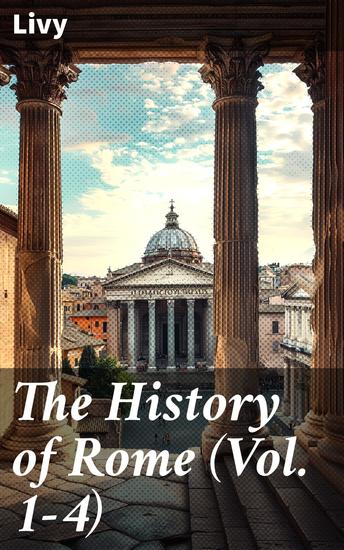
The History of Rome (Vol 1-4) - Epic Chronicle of Rome's Rise and Fall in Ancient Times - cover

The History of Rome (Vol 1-4) - Epic Chronicle of Rome's Rise and Fall in Ancient Times

Livy

Traducteur Daniel Spillan

Maison d'édition: Good Press

  • 0
  • 0
  • 0

Synopsis

In "The History of Rome (Vol. 1-4)", Livy offers a comprehensive and engaging narrative chronicling the foundation and early development of Rome, from its mythical roots to the onset of the Second Punic War. Livy's literary style is characterized by its eloquence and rhetorical flourish, blending historical recounting with moral reflection. As a prominent figure in the Latin prose tradition, Livy presents his work as a source of ethical lessons, intertwining the grandeur of Rome's past with a deep analysis of its virtues and vices, illustrating a nuanced understanding of human nature and governance within the broader context of Roman society. Titus Livius, known simply as Livy, was a Roman historian born in 59 BCE, whose life spanned the tumultuous transition from the Roman Republic to the Empire. His historical vision was shaped by the socio-political upheavals of his time, including civil strife and moral decay, leading him to emphasize the importance of Rome's heroic past as a guide for contemporary challenges. Livy's rich background and education fostered a passion for history, compelling him to document Rome's legacy in a manner that resonates with both the intellect and the spirit. "The History of Rome" is a crucial read for anyone interested in the complexities of ancient civilization and its enduring impact on modern societies. Livy's profound insights and narrative mastery offer readers a vivid portrayal of Rome's ascent, making this work not merely a historical record but a timeless reflection on the human condition. For scholars, students, and lovers of history alike, Livy's masterpiece is an essential addition to the study of Western narrative tradition.
Disponible depuis: 17/11/2023.
Longueur d'impression: 1920 pages.
D'autres livres qui pourraient vous intéresser

  • Ultimate Life Success meditation - Hypnosis for success while sleeping - A guided meditation - DST Hypno with Stu Newman - cover

    Ultimate Life Success meditation...

    Stuart Newman

    • 0
    • 0
    • 0
    If you are looking for a way to achieve permanent success, then the Ultimate Life Success meditation - Hypnosis for success while sleeping - DST Hypno with Stu Newman is the perfect choice.  
    This hypnosis program will help you tap into your subconscious mind and reprogram it to think more positively about yourself and your goals in life.  
    With this powerful tool, you can create new habits that will lead to greater levels of success both professionally and personally.  
    The hypnotic audio track also helps put your body into a deep state of relaxation so that all feelings of stress or anxiety are eliminated during sleep time which leads to improved mental clarity when awake.  
    Plus, it's easy-to-follow instructions make it simple enough for anyone regardless of experience level!  
    So if achieving ultimate life success is something important on your list, give this session a try today!
    Voir livre
  • William Powell and Myrna Loy: The Lives and Careers of One of Classical Hollywood’s Most Iconic Duos - cover

    William Powell and Myrna Loy:...

    Editors Charles River

    • 0
    • 0
    • 0
    It is something of a cliché to say that an actor’s life was like a movie he or she might have starred in, but in the case of Myrna Loy, the cliché is true. It is easy to picture her as a little girl, riding the range with her rancher father, sitting around the table and participating charmingly in family discussions of current events. It is not hard to imagine the camera panning to her first and then second visits to Hollywood, her backlot tour, and starry-eyed decision to become an actress. There would have to be some drama, which the story of her father’s untimely death would provide, along with some sort of deathbed promise made to him to care for the rest of the family. Her mother would be brave but resolute as she moved her young family to California. The lighting on set would brighten and the tempo of the background would pick up as she walked down the Los Angeles streets. Then, her big break would come. The camera would show her first comical meeting with William Powell and then a spinning scene of ticket after ticket being sold to their new picture, The Thin Man.  
    While older silent film stars like Charlie Chaplin and Buster Keaton reached the peak of Hollywood, some actors born near the beginning of the 20th century were ready to capitalize. Though actors like Humphrey Bogart and Cary Grant remain household names, and actresses like Greta Garbo are still widely remembered, few had careers that enjoyed the success of William Powell. In a career spanning several decades, Powell would receive three Oscar nominations for Best Actor for critically acclaimed movies, so it is somewhat ironic that he is mostly remembered today for his association with the more famous Myrna Loy. One thing that helped Powell’s career along in the old days when Hollywood would only cast white actors in major roles, no matter what the nationality of the character was supposed to be, were his dark good looks.
    Voir livre
  • Early History of Montenegro The: The History of the Region from Antiquity to Autonomy - cover

    Early History of Montenegro The:...

    Editors Charles River

    • 0
    • 0
    • 0
    Much has been written about Western intervention during the breakup of Yugoslavia, and whether it made matters worse, prevented worse atrocities, or was simply ineffective. In early 1992, however, what was clear was that Europe was hopelessly divided over the best course of action to take towards Yugoslavia, and after several years of fighting, the Bosnian War was one of the most violent conflagrations in Europe since the end of World War II. 
    That war had been the byproduct of centuries of tensions in the Balkans, and an attempt in the wake of World War I to redraw the political boundaries of Europe and the Middle East. That included forming the Kingdom of Yugoslavia, initially known as the Kingdom of Serbs, Croats and Slovenes, a particularly fragile enterprise, and there was almost constant tension between the majority Serbs and the other Yugoslav nationalities, especially the Croats. As a result, the Kingdom was a land of political assassinations, underground terrorist organizations, and ethnic animosities. In 1929, King Alexander I suspended democracy and ruled as a dictator until he himself was assassinated in 1934. 
    Depending on the source, many authors have focused on different catalysts for Yugoslavia’s demise, but Vesna Drapac may have succinctly summed the situation up when he wrote that by the end, the state “lacked a reason to exist.” There is certainly something in this sentiment, but the disintegration came at an enormous cost. 
    Given what happened in Yugoslavia, it should be little surprise the area that eventually became the modern nation of Montenegro has had a turbulent history for millennia, with shifting borders, different degrees of autonomy, and various conflicts occurring within it.
    Voir livre
  • A Chorus of Ears - On 'the voice of the poem' - cover

    A Chorus of Ears - On 'the voice...

    Denise Riley

    • 0
    • 0
    • 0
    Originally delivered as a series of lectures at Trinity College, Cambridge, in A Chorus of Ears Denise Riley meditates upon the emphasis we place upon the persona of the poet, relegating their actual poetry to a second-order importance. Prize culture and the primacy of the poet – as opposed to the poem – transform criticism into a beauty contest, constraining our ability to meet the lyric on its own terms.What, Riley asks, might be discovered about the purpose of poetry, its originary point within our language and more yet besides, when we liberate it from the persona of the author? In allowing the poem to speak, what might we hear?‘One of the most eloquent thinkers about our life in language’ – The Sunday Times
    Voir livre
  • The Little Book of LGBTQ+ - An A - Z of Gender and Sexual Identities - cover

    The Little Book of LGBTQ+ - An A...

    Harriet Dyer

    • 0
    • 0
    • 0
    Feel confident in the ABCs of LGBTQ+ 


    Language is a key path to awareness, acceptance, and empowerment. It's central to understanding the world and the communities we live in, but it can often be tricky to keep up with correct and ever evolving terminology. 


    This easy-to-use dictionary introduces the most essential vocabulary surrounding LGBTQ+ identities. Whether you're questioning your own identity or simply interested in learning more, this useful guide will help you navigate the world with knowledge, understanding, and kindness.
    Voir livre
  • Crossing Cultures with the Gospel - Anthropological Wisdom for Effective Christian Witness - cover

    Crossing Cultures with the...

    Darrell Whiteman

    • 0
    • 0
    • 0
    Drawing on decades of teaching and mission experience, leading missiologist Darrell Whiteman helps people in cross-cultural ministry learn how to explore and understand their social, cultural, and religious context so they can more effectively witness to people in cultures different from their own.
    Voir livre