Rejoignez-nous pour un voyage dans le monde des livres!
Ajouter ce livre à l'électronique
Grey
Ecrivez un nouveau commentaire Default profile 50px
Grey
Abonnez-vous pour lire le livre complet ou lisez les premières pages gratuitement!
All characters reduced
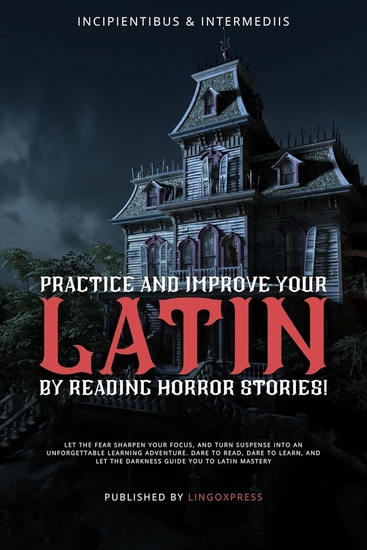
Practice and Improve your Latin by Reading Horror Stories! - cover

Practice and Improve your Latin by Reading Horror Stories!

lingoXpress

Maison d'édition: lingoXpress

  • 0
  • 0
  • 0

Synopsis

Welcome to a world where darkness and learning intertwine, where each spine-chilling tale not only terrifies but teaches.
 
In this gripping collection, you'll encounter haunted houses, sinister dolls, and malevolent spirits, each story crafted to immerse you in fear while expanding your vocabulary and sharpening your grammar skills.
 
As you turn each page, you'll discover:
 
Engaging Vocabulary: Encounter rich, contextualized words that stick with you long after the story ends.
 
Complex Grammar Made Simple: Learn to describe places, things, and situations vividly, using real, thrilling contexts.
 
Emotional Learning: Let the chills and suspense enhance your memory and retention.
 
Adjectives and Adverbs: Horror stories often rely on vivid descriptions to set the scene. Students can learn to use a variety of adjectives and adverbs to create detailed and atmospheric descriptions.
 
Prepositions of Place: Understanding the spatial relationships in a scene is crucial in horror stories.
 
Noun Phrases: Horror stories frequently use complex noun phrases to describe objects and characters in detail. Students can learn to expand their sentences with additional information, making their descriptions more vivid.
 
Relative Clauses: Using relative clauses can help learners add more detail to their sentences, enhancing their descriptive abilities.
 
Conditionals: Horror stories often deal with hypothetical situations, making them a perfect medium to practice conditional sentences (if-clauses).
 
Past Tenses: These stories frequently shift between past simple, past continuous, and past perfect to build suspense and explain backstory. This helps learners understand and use different past tenses appropriately.
 
Passive Voice: The passive voice is often used to create a sense of mystery or focus on the action rather than the subject.
 
Quotations and Reporting Verbs: Horror stories usually include a lot of dialogue, which can help learners practice direct and indirect speech. This is essential for understanding how to report what someone else has said.

 
Perfect for students and lovers of the macabre, this book turns the mundane into the magical and the terrifying into the terrific. The horrors within these pages are not just for fright—they are tools to elevate your Latin to new, thrilling heights.
Disponible depuis: 08/08/2024.
Longueur d'impression: 33 pages.

D'autres livres qui pourraient vous intéresser

  • Native American Mythology - The Role of Nature Animals And Soul Regarding to Human Being - cover

    Native American Mythology - The...

    Wilson Bellacoola

    • 0
    • 0
    • 0
    This audiobook explores Native American mythologies to view the relationships between humans and animals. 
    Traditional Native Americans view animals as elder brothers who embody the knowledge sets necessary for survival on this Earth. This vantage point facilitates openness within humans to learn from animals. Animals play the roles of tutelary spirits, helpers, and guides, and sometimes shapeshift from Holy Person to animal or back. This emphasizes the fluidity between the worlds of spirit and matter and highlights animals as oriented toward being helpful to humanity in various ways. As expressed through language and ritual, respect details preserve the relationship between the community, the animals, and the natural landscape. 
    Animals push human beings into interiority. The spirits choose a person and then utilize animals to communicate and transmit spiritual understandings and abilities. It is then up to the individual to bring this vision to usefulness on Earth.
    Voir livre
  • Speaking Up without Freaking Out 3rd ed - 50 Techniques for Confident and Compelling Presenting - cover

    Speaking Up without Freaking Out...

    Matt Abrahams

    • 0
    • 0
    • 0
    The Speaking Up without Freaking Out audio book by Matt Abrahams (host of the award-winning Think Fast Talk Smart podcast) contains over 50 anxiety management techniques that are based on scientifically supported theory and evidence that will help you become a more confident and compelling communicator regardless of where you present -- on stage, in a meeting, or virtually. 
    Confident and compelling presenting involves a complicated mix of physiological and psychological factors. In the 3rd edition, this audio book provides specific guidance and opportunities to practice developing the skills you will need to feel more comfortable speaking in front of others in an engaging way. 
    This book is divided into seven chapters: 
    Chapter 1 describes speaking anxiety, how it shows itself, its negative effects, and how you can appear less nervous. 
    Chapter 2 describes the main theories about why people feel anxious when speaking and, importantly, offers you several specific techniques to reduce speaking anxiety and bolster your confidence. 
    Chapter 3 details how you can use your nonverbal presence and voice to not only appear more confident, but also feel more confident. 
    Chapter 4 how focusing on your audience’s needs and connecting your content to them can reduce your anxiety and make your presentations more compelling. 
    Chapter 5 provides techniques and guidance on how to structure your presentations to better help you and your audience remember what you present. 
    Chapter 6 teaches how to resist and stop some self-defeating beliefs and behaviors that perpetuate and exacerbate anxiety. 
    Chapter 7 addresses how to put all this information to work for you by creating your own Anxiety-Management Plan.
    Voir livre
  • Italian for holiday - an audiocourse of Italian for beginners to pre-intermediate learners - cover

    Italian for holiday - an...

    Matteo Bianchi, Tomas Dvoracek

    • 0
    • 0
    • 0
    Thank you for your interest in the audiocourse Learn Italian for Holiday by Audioacademyeu. The course is designed for beginners and slightly advanced learners and focuses on words and phrases you can use when travelling and especially on holiday.The course is based on contextual learning, which means that you will not only learn words, but also sentences in which you can use the words you have learned. In this course you will find a total of 600 words and practical sentences. If you are an absolut beginner, you will without a doubt appreciate a minicourse of the Italian pronunciation. The individual lessons are divided into the topics of travelling by car, travelling by plane, travel destinations, in a hotel, in a restaurant,on a trip,   shopping and chatting.  Listening to this course you can combine the pleasant with the useful - you will refresh your holiday vocabulary and revise your Italian in general at the same time.What is the best way to work with the course? Choose the lesson you want to start with. Each lesson contains six tracks. First,  familiarize yourself with the actual vocabulary (tracks 1 and 2). In order to get a better grip over the new expressions  in Italian, in track one you hear the  Italian word twice. Next, you have a  word  followed by a contextual sentence, again in both translation options (tracks 3 and 4).  Then you move on to complete sentences (tracks 5 and 6). ). Again, in track 5, you will hear the sentence in Italian twice. Once you have mastered translating sentences from English into Italian (lesson 6) in the time gap before the English translation, you have won. The words alone will help you in understanding the meaning, but using the mastered complete sentences will help you communicate much better.There is a script to this course available for free download at www.audioacademyeu.eu which will make your activities with the course much more effective. In its  introduction, you will find a learning guide along with helpful tips on how to make the lessons more effective and a lesson plan for you to record your learning progress. The script is divided thematically into three parts.  In the first part you will find a written version of the audio tracks you will listen to.  In the second part you will find the writing tests. For each lesson there is one test of vocabulary and one test of sentences. The key to both tests is available right after the tests too In the third part of the script you will find double-sided flashcards that you can cut out with scissors and practice even when you can't or don't want to listen. The course is narrated by native speakers - Jeff Short in English, Elisa Ciravegna and Matteo Bianchi in Italian.
    Voir livre
  • A Language Learner's Guide to Russian Idioms - A Window into Russian Culture and Language - cover

    A Language Learner's Guide to...

    Dana Levina

    • 0
    • 0
    • 0
    Unlock the hidden rhythms of Russian conversation with A Language Learner’s Guide to Russian Idioms, narrated by Ernest Timkin and crafted by linguist Dana Levina. This audiobook isn’t just about memorizing phrases—it’s a cultural passport, revealing how Russians weave humor, history, and wisdom into everyday speech. Imagine transforming awkward pauses into confident exchanges by knowing when to say someone’s “counting crows” (считать ворон) instead of daydreaming, or calling out empty promises as “noodles hung on ears” (вешать лапшу на уши). Whether you’re a traveler aiming to navigate local markets without getting “led by the nose” (водить за нос), a student tired of “thumbing wooden blocks” (бить баклуши) instead of studying, or a professional striving to “take the bull by the horns” (брать быка за рога) in meetings, these idioms bridge the gap between textbook Russian and authentic dialogue. Each expression unfolds with vivid context: Learn why “walking on heels” (ходить по пятам) means relentless pursuit, how “sitting on needles” (сидеть как на иголках) captures nail-biting anxiety, and when to “keep your ear sharp” (держать ухо востро) in tricky situations. Perfect for learners craving cultural fluency, this guide turns idioms from curiosities into tools, helping you decode films, literature, and casual chats with ease. Dive in—before you know it, you’ll be swapping stale translations for phrases that make Russians lean in and smile. Удачи! (Good luck!)
    Voir livre
  • Mandarin Made Easy - Beginner - Volume 2 of 3 - cover

    Mandarin Made Easy - Beginner -...

    Lingo Wave

    • 0
    • 0
    • 0
    We broke our new series on learning Chinese [Mandarin] down into different learning stages. Start with the "Lower Beginner" books followed by the "Beginner" and "Upper Beginner" books. Next, progress to the "Intermediate" series, then test and reinforce your knowledge with the "Conversations" series. 
    This audiobook is divided into units.While it provides different learning patterns and accommodates various needs, this audiobook focuses on helping you improve your ability to understand, speak, and memorise Chinese [Mandarin]. 
    In Unit 1 you will hear Chinese [Mandarin] decoded with each syllable spoken very slowly and clearly with repetition. Immediately before each sentence is spoken, you will hear the translation, so you will always understand what is being said. 
    Unit 2 focuses solely on increasing your listening ability, which will improve your abilities to engage in dialogue with a native Chinese [Mandarin] speaker. This chapter requires you to listen very carefully to nuances in the language. 
    By Unit 3 you will already notice progress in your abilities to speak and understand Chinese [Mandarin]. The spoken translation is followed by two repetitions in Chinese [Mandarin] at a completely natural speed. While you are learning to process naturally spoken Chinese [Mandarin], Units 3 and 4 will help you memorise new vocabulary and full sentences. 
    In Unit 5 you can test yourself on how much you have learned. If you are having difficulties, we suggest you revisit the listening, speaking, or memorisation section of Units 1, 2 3 or 4, according to what you need more help with. 
    Topics covered in this book: 
    1. Asking about family 
    2. Asking about relationship status 
    3. Expressing frequency 
    4. Talking about spare time activities and hobbies 
    5. Using quantifiers/determiners 
    6. Talking about preference 
    7. Talking about abilities 
    8. Talking about location of places 
    ...
    Voir livre
  • 1000 Common Past Tense Verbs - Learn French Through Simple Sentences - cover

    1000 Common Past Tense Verbs -...

    Science-Based Language Learning Lab

    • 0
    • 0
    • 0
    Unlock French fluency with 1000 Common Past Tense Verbs: Learn French Through Simple Sentences. This guide for intermediate learners introduces 1000 essential French verbs in past tense, using straightforward sentences for easy comprehension. Each sentence is translated into English, making it ideal for self-study or classroom use. Whether you're preparing for travel, boosting career prospects, or exploring a new language, this book lays a strong foundation for building French skills. You'll expand your vocabulary and learn to use these verbs naturally in conversation, enhancing your ability to speak confidently and understand native speakers.  
     
    Features: 
     
    - 1000 common French verbs with practical sentences 
     
    - Clear English translations 
     
    - Suitable for beginners and intermediate learners 
     
    - Improves vocabulary, comprehension, and conversational skills 
     
    - Perfect for self-study, travel, or classroom use 
     
    Start your French learning journey today and see how mastering 1000 common verbs in past tense can transform your communication skills. 1000 Common Past Tense Verbs is your essential guide to becoming proficient in French.
    Voir livre