Join us on a literary world trip!
Add this book to bookshelf
Grey
Write a new comment Default profile 50px
Grey
Subscribe to read the full book or read the first pages for free!
All characters reduced
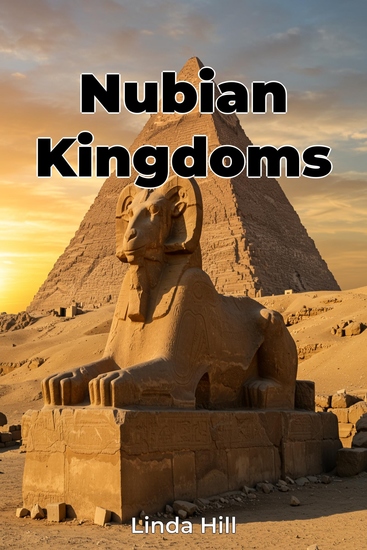
Nubian Kingdoms - cover

Nubian Kingdoms

Linda Hill

Translator A AI

Publisher: Publifye

  • 0
  • 0
  • 0

Summary

Nubian Kingdoms unveils the captivating history of Nubia, a civilization that flourished south of Egypt. This book explores Nubia's unique cultural identity, its complex relationship with Egypt, and the political might wielded by Nubian rulers. For centuries, Nubia and Egypt were deeply intertwined, with Nubian influence at times even surpassing that of its more famous neighbor. The book challenges the conventional view of Nubia as a mere extension of Egypt, revealing it as a dynamic and independent civilization.

 
The book traces Nubia's journey from the early Kerma culture through the powerful Kingdom of Kush and the later Meroitic period. It examines archaeological findings, such as Nubian cities and temples, alongside Egyptian inscriptions and classical accounts. Through a comparative analysis of Nubian and Egyptian cultures, Nubian Kingdoms illuminates Nubia's distinct identity.

 
Beginning with Nubia's geographical setting, the book progresses through periods of Egyptian domination, the Kushite conquest of Egypt, and the cultural developments of Meroe. It offers a comprehensive view of Nubian society by analyzing its art, religion, and social structures. This approach provides a holistic understanding of Nubia's place in world history, moving beyond Egypt-centric narratives.
Available since: 03/19/2025.
Print length: 53 pages.

Other books that might interest you

  • The Watchmakers - A Powerful WW2 Story of Brotherhood Survival and Hope Amid the Holocaust - cover

    The Watchmakers - A Powerful WW2...

    Harry Lenga, Scott Lenga

    • 0
    • 0
    • 0
    Harry Lenga was born to a family of Chassidic Jews in Kozhnitz, Poland. The proud sons of a watchmaker, Harry and his two brothers, Mailekh and Moishe, studied their father's trade at a young age. Upon the German invasion of Poland, when the Lenga family was upended, Harry and his brothers never anticipated that the tools acquired from their father would be the key to their survival. 


    Under the most devastating conditions imaginable—with death always imminent—fixing watches for the Germans in the ghettos and brutal slave labor camps of occupied Poland and Austria bought their lives over and over again. From Wolanow and Starachowice to Auschwitz and Ebensee, Harry, Mailekh, and Moishe endured, bartered, worked, prayed, and lived to see liberation. 


    Derived from more than a decade of interviews with Harry Lenga, conducted by his own son Scott and others, The Watchmakers is Harry's heartening and unflinchingly honest first-person account of his childhood, the lessons learned from his own father, his harrowing tribulations, and his inspiring life before, during, and after the war. It is a singular and vital story, told from one generation to the next—and a profoundly moving tribute to brotherhood, fatherhood, family, and faith.
    Show book
  • A Brilliant Commodity - Diamonds and Jews in a Modern Setting - cover

    A Brilliant Commodity - Diamonds...

    Saskia Coenen Snyder

    • 0
    • 0
    • 0
    During the late nineteenth century, tens of thousands of diggers, prospectors, merchants, and dealers extracted and shipped over 50 million carats of diamonds from South Africa to London. The primary supplier to the world, South Africa's diamond fields became one of the formative sites of modern capitalist production. At each stage of the diamond's route through the British empire and beyond—from Cape Town to London, from Amsterdam to New York City—carbon gems were primarily mined, processed, appraised, and sold by Jews. 


    In A Brilliant Commodity, historian Saskia Coenen Snyder traces how once-peripheral Jewish populations became the central architects of a new, global exchange of diamonds. Centuries of restrictions had limited Jews to trade and finance, businesses that often heavily relied on internal networks. Jews were well-positioned to become key players in the earliest stage of the diamond trade and its growth into a global industry. Relying on mercantile and familial ties across continents, Jews created a highly successful commodity chain that included buyers, brokers, cutters, factory owners, financiers, and retailers. 


    Working within a diasporic ethnic community that bridged city and countryside, metropole and colony, Jews helped build a flourishing diamond industry and a place for themselves in the modern world.
    Show book
  • Why Psychosis Is Not So Crazy - A Road Map to Hope and Recovery for Families and Caregivers - cover

    Why Psychosis Is Not So Crazy -...

    Stijn Vanheule

    • 0
    • 0
    • 0
    An expert's guide to humanizing psychosis through communication offers key insights for family and friends to support loved ones during mental health crises. 


    Are we all a little crazy? Roughly fifteen percent of the population will have a psychotic experience, in which they lose contact with reality. Yet we often struggle to understand and talk about psychosis. Interactions between people build on the stories they tell each other—stories about the past, about who they are or what they want. In psychosis we can no longer rely on these stories, this shared language. So how should we communicate with someone experiencing reality in a radically different way than we are? 


    Drawing on his work in psychoanalysis, Stijn Vanheule seeks to answer this question, which carries significant implications for mental health as a whole. With a combination of theory from Freud to Lacan, present-day research, and compelling examples from his own patients and well-known figures such as director David Lynch and artist Yayoi Kusama, he explores psychosis in an engaging way that can benefit those suffering from it as well as the people who care for and interact with them.
    Show book
  • The Author's Craft - A rumination on the kind of person that becomes an author - cover

    The Author's Craft - A...

    Arnold Bennett

    • 0
    • 0
    • 0
    Why do we write? What does it mean to be a writer?This book contains no useful tips on grammar, style, or plot. Instead, it focuses on the observation and perspective that is needed to be a good writer - on the fact that writing is an expression of the art of living. A lovely journey through a very Edwardian world.Covers Writing novels and plays, dealing with the public, and most importantly, the seeing of life.
    Show book
  • Becoming a Philosopher - Spinoza to Sartre - cover

    Becoming a Philosopher - Spinoza...

    Jonathan Rée

    • 0
    • 0
    • 0
    In 'Becoming a Philosopher' Jonathan Rée describes the extraordinary lives of some of most influential thinkers of the past four hundred years and the radical and sometimes bizarre ideas that emerged from them. In so doing he challenges the notion of philosophy as a set of fixed ideas to be arranged and catalogued like botanical specimens. Rather, the philosophical life is revealed, as Kierkegaard has described, as one of relentless struggle, a never-ending 'dance in the service of thought' which might, with luck, result in a single fresh idea.This collection of ten biographical pieces, originally published as book reviews in the London Review of Books, begins with Spinoza, the excommunicated lens grinder who sought as little attention as possible for his anonymously published work; and ends with Sartre, the most public of public intellectuals whose funeral was marked by thousands on the streets of Paris. In between we find Newton working tirelessly to establish a chronology of the ancient world; Hegel gazing on Napoleon as he marches through Jena in 1806; and Wittgenstein drawing up plans for a new kind of propeller before writing his landmark Tractatus in the trenches of the First World War. Alongside them we also meet Leibniz, Hume, Lessing, Kierkegaard and Collingwood.This audiobook also features an introductory conversation between Jonathan Rée and Thomas Jones, an editor at the LRB and presenter of the LRB Podcast.Subjects covered: Spinoza, Newton, Leibniz, Hume, Lessing, Hegel, Kierkegaard, Wittgenstein, Collingwood, Sartre.These pieces have been amended in places from the original for the purposes of recording.
    Show book
  • My Life in the News - From Village Fete to the Front Line - cover

    My Life in the News - From...

    Michael Clayton

    • 0
    • 0
    • 0
    Journalist and Editor Michael Clayton worked his way up from local newspapers to BBC war correspondent, with radio and magazine experience inbetween.   
    From the sharp end of the action in Vietnam, to the violence of the Troubles in Belfast and the tragedy of the East Pakistan revolt, Clayton    is well placed to compare the varying challenges of journalism on different media platforms.   
    The rivalry between the BBC and ITV, the bravery of war cameramen, dealing on assignment with corrupt officials, the TV preference for close-to-the action film as opposed to insightful reports of the effects of conflict: Clayton has experienced it all over a 70-year career.
    His insights into the ethos of the BBC, the colourful characters he reported and filmed alongside, and his resulting views of humanity, war and crime – Clayton's autobiography in journalism is honest, wry and full of insight.   
    Show book