Begleiten Sie uns auf eine literarische Weltreise!
Buch zum Bücherregal hinzufügen
Grey
Einen neuen Kommentar schreiben Default profile 50px
Grey
Jetzt das ganze Buch im Abo oder die ersten Seiten gratis lesen!
All characters reduced
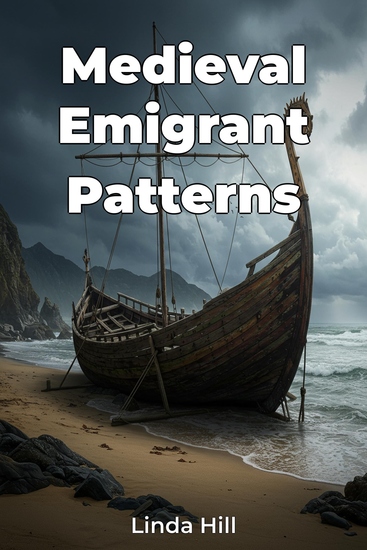
Medieval Emigrant Patterns - cover

Medieval Emigrant Patterns

Linda Hill

Übersetzer A AI

Verlag: Publifye

  • 0
  • 0
  • 0

Beschreibung

Medieval Emigrant Patterns examines the significant population movements that occurred between 500 and 1500 AD, offering a comprehensive look at medieval migration. The book explores why entire communities uprooted themselves, focusing on "push and pull factors" such as climate change, political instability, and religious persecution. For instance, prolonged droughts often forced populations to seek more resource-rich areas. These mass movements significantly influenced cultural exchange and shaped the demographic landscape of Europe, North Africa, and the Near East.

 
The book progresses by first defining medieval migration and then diving into specific case studies driven by environmental pressures, warfare, and religious factors. It analyzes the consequences of these migrations, considering their impact on both the regions people left and the ones they settled in. Drawing from chronicles, legal documents, and archaeological findings, the book emphasizes a multidisciplinary approach, providing a unique synthesis of existing research. It highlights the interconnected nature of these migrations and their lasting legacy on world history.
Verfügbar seit: 21.02.2025.
Drucklänge: 59 Seiten.


Weitere Bücher, die Sie mögen werden

  • The Rise and Fall of the Roman Empire - A Comprehensive History - cover

    The Rise and Fall of the Roman...

    Rogan Fish

    • 0
    • 0
    • 0
    The founding of Rome is one of the most famous legends in history, blending myth and reality to shape the origins of one of the greatest civilizations of the ancient world. According to Roman tradition, the city was established in 753 BCE by Romulus, the first king of Rome, after he and his twin brother, Remus, were rescued and raised by a she-wolf. This tale, passed down through generations, symbolized Rome’s strength, resilience, and divine favor. While the legend is deeply ingrained in Roman identity, historians believe the city’s origins were more complex, involving the gradual unification of Latin and Etruscan tribes. 
    The early formation of Rome was influenced by its strategic location along the Tiber River. The site provided access to trade routes, fresh water, and natural defenses, making it an ideal settlement for early inhabitants. Archaeological evidence suggests that small villages existed in the area long before Rome’s legendary founding, with early settlers engaging in agriculture, trade, and warfare. These early communities gradually coalesced, forming a unified society under a monarchical system. The first rulers of Rome were part of the Roman Kingdom, a period that saw the development of political institutions, religious practices, and military organization that would shape the city’s future. 
    Roman society during its early years was structured around family and clan-based systems, with the patricians, or aristocratic families, holding the majority of political power. The king was the central authority, responsible for religious duties, military leadership, and lawmaking. However, his rule was supported by a council of elders known as the Senate, which played an advisory role. Over time, tensions arose between the patricians and the common people, or plebeians, who sought greater political representation. These early power struggles foreshadowed the later conflicts that would lead to the transition from monarchy to a republic.
    Zum Buch
  • Herod the Great - Jewish King in a Roman World - cover

    Herod the Great - Jewish King in...

    Martin Goodman

    • 0
    • 0
    • 0
    A vivid account of the political triumphs and domestic tragedies of the Jewish king Herod the Great during the turmoil of the Roman revolution 


    Herod the Great (73–4 BCE) was a phenomenally energetic ruler who took advantage of the chaos of the Roman revolution to establish himself as a major figure in a changing Roman world and transform the landscape of Judaea. Both Jews and Christians developed myths about his cruelty and rashness: in Christian tradition he was cast as the tyrant who ordered the Massacre of the Innocents; in the Talmud, despite fond memories of his glorious Temple in Jerusalem, he was recalled as a persecutor of rabbis. 


    The life of Herod is better documented than that of any other Jew from antiquity, and Martin Goodman examines the extensive literary and archaeological evidence to provide a vivid portrait of Herod in his sociopolitical context: his Idumaean origins, his installation by Rome as king of Judaea and cultivation of leading Romans, his massive architectural projects, and his presentation of himself as a Jew, most strikingly through the rebuilding of the Jerusalem Temple. Goodman argues that later stories depicting Herod as a monster derived from public interest in his execution of three of his sons after dramatic public trials foisted on him by a dynastic policy imposed by the Roman emperor.
    Zum Buch
  • Swifterature - A Love Story: English Literature and Taylor Swift - cover

    Swifterature - A Love Story:...

    Elly McCausland

    • 0
    • 0
    • 0
    A daring literary fusion of pop culture and feminism, Swifterature captures the special connection between English literature and the worldwide phenomenon of Taylor Swift. 
    Swifterature captures a unique fusion of different elements: fandom, feminism, and a defense of both literature and popular culture. 
    The narrative is split into thirteen chapters that use Swift's lyrics as departure points. The listener experiences the inspiring influence of English literature as Swift’s lens breathes new vitality and urgency into older texts. McCausland also writes about her own experiences as she copes with intense media scrutiny and is forced to defend her academic integrity. 
    She argues that Swift, through her self-conscious engagement with classic works of literature and her extraordinary popularity, invites us to reflect not only on the culture of our past but also of our present. Swifterature shows how Swift’s place on the world’s stage can teach us about many things, from feminism to politics, nature to childhood. In the process the book makes a compelling case that studying Taylor Swift also turns us into better readers, not only of literature but of ourselves and each other.
    Zum Buch
  • French Made Easy - Beginner - Volume 2 of 3 - cover

    French Made Easy - Beginner -...

    Lingo Wave

    • 0
    • 0
    • 0
    We broke our new series on learning French down into different learning stages. Start with the "Lower Beginner" books followed by the "Beginner" and "Upper Beginner" books. Next, progress to the "Intermediate" series, then test and reinforce your knowledge with the "Conversations" series. 
    This audiobook is divided into units.While it provides different learning patterns and accommodates various needs, this audiobook focuses on helping you improve your ability to understand, speak, and memorise French.  
    In Unit 1 you will hear French decoded with each syllable spoken very slowly and clearly with repetition. Immediately before each sentence is spoken, you will hear the translation, so you will always understand what is being said. 
    Unit 2 focuses solely on increasing your listening ability, which will improve your abilities to engage in dialogue with a native French speaker. This chapter requires you to listen very carefully to nuances in the language. 
    By Unit 3 you will already notice progress in your abilities to speak and understand French. The spoken translation is followed by two repetitions in French at a completely natural speed. While you are learning to process naturally spoken French, Units 3 and 4 will help you memorise new vocabulary and full sentences. 
    In Unit 5 you can test yourself on how much you have learned. If you are having difficulties, we suggest you revisit the listening, speaking, or memorisation section of Units 1, 2 3 or 4, according to what you need more help with. 
    Topics covered in this book: 
    1. Asking about family 
    2. Asking about relationship status 
    3. Expressing frequency 
    4. Talking about spare time activities and hobbies 
    5. Using quantifiers/determiners 
    6. Talking about preference 
    7. Talking about abilities 
    8. Talking about location of places 
    9. Describing appearance 
    10. Talking about personality 
    ...
    Zum Buch
  • The Highly Intelligent Body - How Listening to Your Body Helps You Heal and Connect to Your True Life Path - cover

    The Highly Intelligent Body -...

    Ben Dorfman

    • 0
    • 0
    • 0
    Have you ever felt a strong sense of knowing in your body when you entered an environment or met a new person? A body sense that you knew to be true? 
    How were you able to feel this? And where did this information come from? 
    In The Highly Intelligent Body, Ben Dorfman, acupuncturist and life coach, takes the reader through an in-depth look at the amazing intelligence and energetic sensitivities of the human body. 
     In this book you will learn: 
    ·     How the body uses thoughts, feelings, and body sensations to communicate information to you. 
    ·     How highly attuned your body is to the emotional and energetic information that is all around you. 
    ·     How your body is attuned to your true-life path, helping you become the healthiest version of yourself. 
    ·     How to listen to your body as a guide for physical and emotional healing. 
     Ben Dorfman, E.A.M.P., is the owner of and practitioner at Seattle Acupuncture and Coaching, PLLC, a clinic where he offers physical, emotional, and spiritual healing by combining acupuncture, life coaching, and energetic healing modalities. With his unique approach to body listening, Ben guides his clients through a deep journey of healing and transformation. He also helps people realign with their true-life path, so that they can bring their soul’s gifts to the world and embrace the fullest version of themselves.
    Zum Buch
  • The Religion of Whiteness - How Racism Distorts Christian Faith - cover

    The Religion of Whiteness - How...

    Glenn E. Bracey II, Michael O....

    • 0
    • 0
    • 0
    Recent years have seen a growing recognition of the role that White Christian Nationalism plays in American society. As White Christian Nationalism has become a major force, and as racial and religious attitudes become increasingly aligned among whites—for example, the more likely you are to say that the decline of white people as a share of the population is "bad for society," the more likely you are to believe the government should support religious values—it has become reasonable to wonder which of the adjectives in the phrase "White Christian Nationalism" takes precedence. 


    In this book, Michael O. Emerson and Glenn E. Bracey II respond definitively: the answer is "white." The majority of white Christians in America, they argue, are believers in a "Religion of Whiteness" that shapes their faith, their politics, and more. The Religion of Whiteness, they argue, raises the perpetuation of racial inequality to a level of spiritual commitment that rivals followers' commitment to Christianity itself. 


    Using national survey data, in-depth interviews, and focus group results gathered over several years, Emerson and Bracey show how the Religion of Whiteness shapes the practice of Christianity for millions of Americans—and what can be done to confront it.
    Zum Buch